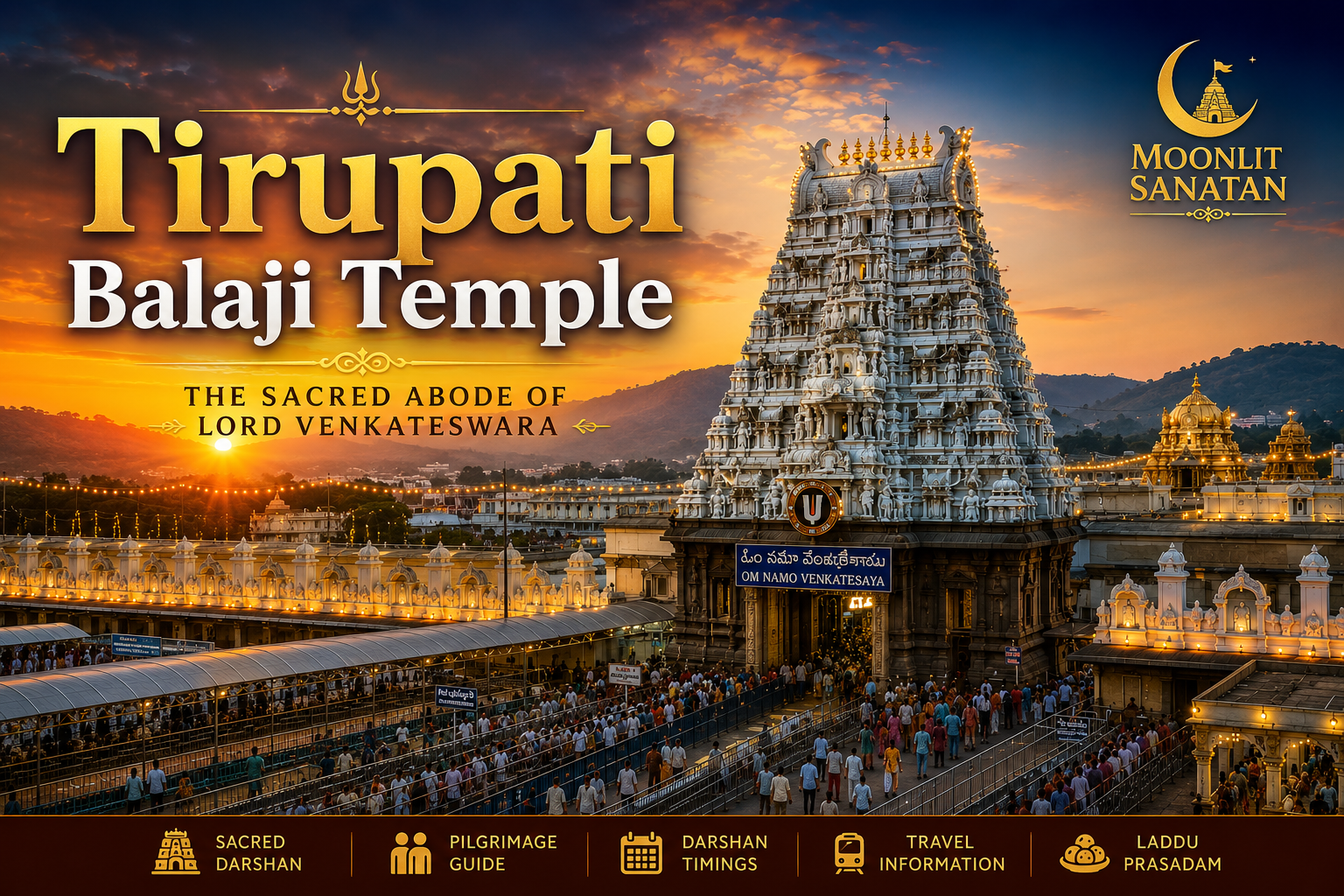
Tirupati Balaji Temple: The Complete Darshan & Travel Guide
Perched on the seventh peak of the Seshachalam hills, the Tirupati Balaji Temple is the richest and most-visited place of worship on Earth — over 60,000 pilgrims a day, all for a few seconds before Lord Venkateswara. Here's the real legend, every darshan option explained, and everything you need to plan the visit.
Why Tirupati Balaji Isn't a Temple You "Just Visit"
Type Tirupati Balaji Temple into any search bar and you'll get a wall of ticket prices and queue hacks. Fair enough — the logistics genuinely matter here more than at almost any other Indian shrine. But reducing Tirumala to a booking tutorial skips the part that actually explains why tens of millions of people make this trip every year: the belief that Lord Venkateswara is still, today, repaying a debt on behalf of every devotee who has ever dropped a coin in the Hundi.
The temple sits atop Tirumala, the seventh of the Seshachalam range's seven peaks (hence "Saptagiri," the Seven Hills), in Chittoor district, Andhra Pradesh — a separate hill town from Tirupati, the city at the base where most travelers actually land, sleep, and start their journey. That distinction trips up a lot of first-time visitors, so it's worth getting straight before anything else.
The shrine is administered by the Tirumala Tirupati Devasthanams (TTD), a trust that also happens to be the wealthiest religious institution in the world by some measures. If you've read our guide to Kamakhya Temple or Vaishno Devi, you'll notice Tirupati Balaji runs on an entirely different rhythm — this is a Vaishnavite shrine built around scale, ritual precision, and an almost corporate level of organization, rather than a single dramatic trek. This guide covers the actual legend behind the deity, every darshan type and how to book it, how to actually get up the hill, and the traditions — laddu prasadam, the tonsure ritual, the Hundi — that make this temple so distinct.
What Makes Tirupati Balaji Different From Other Major Temples
A handful of things set this shrine apart even among India's biggest pilgrimage sites.
- 💰The richest temple trust in the world — Hundi donations alone run into thousands of crores annually, funding everything from free meal programs to hospitals and universities across Andhra Pradesh.
- 🎟️A dozen distinct darshan categories — from the free Sarva Darshan queue to the ₹10,500 SRIVANI Trust VIP break darshan, with several paid and seva-linked tiers in between.
- 💇Mass hair-offering (tonsure) — thousands of devotees shave their heads daily at the Kalyanakatta as an act of surrender, making it one of the largest sources of human hair for the global wig industry.
- 🍬A prasadam so famous it has its own trademark — the Tirupati Laddu received a Geographical Indication (GI) tag in 2009, one of the few food items in India protected that way.
Each of these deserves proper context, so that's what the rest of this guide walks through.
The Story of Venkateswara — A Marriage, a Loan, and a Debt That's Still Being Repaid
According to tradition, Lord Vishnu descended to earth in this Kali Yuga as Venkateswara after being cursed and separated from Goddess Lakshmi. Grieving and wandering, he eventually settled on the Venkata hill (Tirumala) and, in some tellings, was cared for and later married to Vakuladevi in the form of a foster mother figure before events led him toward Padmavati, daughter of King Akasha Raja.
To fund the extravagant wedding to Padmavati, Venkateswara is said to have borrowed a vast sum of gold from Kubera, the celestial treasurer — a loan tradition holds he is still repaying, with interest, until the end of the Kali Yuga. This is the belief most commonly cited for why devotees give so generously at the Hundi: every rupee dropped in is understood, symbolically, as a contribution toward clearing the Lord's own debt on behalf of humanity.
This account is presented here as it's understood within Vaishnavite devotional tradition — a story of divine love, sacrifice, and an eternal debt — rather than as a claim of historical fact.
Balaji, Srinivasa, Venkateswara, Perumal — Are They the Same?
Yes — and the different names reflect India's regional and linguistic diversity more than any real theological distinction. Venkateswara ("Lord of the Venkata hill") is the formal Sanskrit-Telugu name most commonly used in temple literature. Balaji is the popular North and West Indian name, used interchangeably with the temple's own identity in casual speech. Srinivasa ("abode of Sri/Lakshmi") emphasizes the deity's union with the goddess. In Tamil Nadu, devotees more often say Thirupathi Perumal or Venkatachalapathi ("Perumal" being a common Tamil title for Vishnu). All four point to the same black-stone deity standing inside the sanctum at Tirumala.
How to Reach Tirupati Balaji Temple
Tirupati town is the arrival point by air, rail, or road; Tirumala, the actual temple hill, is a further climb from there — either by vehicle on the ghat road or on foot up one of two traditional step paths.
| Route | Distance / Duration | Notes |
|---|---|---|
| Renigunta Airport → Tirupati | ~15 km / ~25 min | Nearest airport, connected to major Indian cities; taxis and buses run to Tirupati town and onward to Tirumala |
| Tirupati Railway Station → Tirumala | ~22 km / ~1 hr | Well connected to Chennai, Bengaluru, Hyderabad, and Delhi; buses and taxis run the ghat road from just outside the station |
| Ghat Road (by vehicle) | ~22 km / ~1 hr | Two separate one-way roads for the up and down journeys; APSRTC buses run frequently, private taxis also permitted |
| Alipiri Mettu (on foot) | ~3,550 steps / ~9–11 km / 3–6 hrs | The longer, more traditional footpath, fully covered with rest points, water stalls, and free luggage drop-off along the way |
| Srivari Mettu (on foot) | ~2,388 steps / ~2.1 km / 1.5–3 hrs | Shorter, steeper alternate footpath starting near Srinivasa Mangapuram, about 15 km from Tirupati railway station |
Pilgrims who climb either footpath are traditionally eligible for free Divya Darshan tokens along the way — walking to the hill is still considered by many devotees to be part of the offering itself, not just a way to save on transport.
Every Type of Tirupati Balaji Darshan, Explained
This is where most first-time visitors get overwhelmed — TTD runs roughly a dozen darshan categories side by side. Here's the practical breakdown.
| Darshan Type | Cost | What to Expect |
|---|---|---|
| Sarva Darshan | Free | No ticket needed; token collected from designated counters in Tirupati. Wait times can run 6–20+ hours depending on the day. |
| SSD (Slotted Sarva Darshan) | Free | Same-day free token with a fixed reporting time slot — a more predictable version of Sarva Darshan. |
| Divya Darshan | Free | Reserved for pilgrims who walk up via Alipiri or Srivari Mettu, collected as a token along the footpath. |
| Special Entry Darshan (SED) | ₹300 | The most popular paid option; online-only booking, typically completes in 3–5 hours versus 8–12+ for Sarva Darshan. |
| Virtual / Arjitha Seva Darshan | ₹500 | Bundled with participation in a specific seva; booked online alongside the seva ticket. |
| NRI Darshan | ₹300 | For NRIs and foreign nationals with a valid passport; similar wait time to Special Entry Darshan. |
| SRIVANI Trust VIP Break Darshan | ₹10,500 | The fastest option — most pilgrims finish in 30–45 minutes; available without a recommendation letter via the SRIVANI Trust donation scheme. |
Prices, quotas, and processes are revised periodically by TTD — always confirm current rates and slot availability on the official website before you travel.
How to Book Tirupati Balaji Online Darshan
Online booking is genuinely the safest and most predictable way to plan a Tirumala visit, and it's the only channel TTD itself endorses for paid darshan tickets.
- 🌐Book only on the official TTD portal at ttdevasthanams.ap.gov.in or the TTD Govinda app — there is no legitimate third-party site for darshan tickets.
- 📅Tickets release roughly three months in advance on a rolling monthly quota; popular dates — weekends, holidays, and Brahmotsavam — sell out within minutes of the release window opening.
- 🪪Have your ID ready before the release time: Indian nationals need an Aadhaar number, NRIs and foreign nationals need a valid passport, each usable once per booking session per date.
- 🔒₹300 Special Entry Darshan tickets are non-transferable and non-cancellable — the date and time slot on your ticket is fixed, so double-check everything before you pay.
- 🏨Accommodation can be booked on the same portal — rooms and guesthouses are also released on a quota system, so it's worth booking darshan and stay together where possible.
Because of fake booking apps and agents claiming "guaranteed" slots, only ever transact through the official TTD website or app — never through resellers, however convincing their listings look.
Tirupati Laddu Prasadam & the Kalyanakatta Tonsure Ritual
The Tirupati Laddu
Every darshan ticket includes one free laddu as prasadam, prepared in the temple's Potu (kitchen) using a recipe followed with near-industrial precision. The laddu received a Geographical Indication tag in 2009, legally protecting the name so that only TTD-made laddus from Tirumala can carry it. Additional laddus can be purchased separately at designated counters — devotees frequently buy extra to take home as prasadam for family.
Kalyanakatta — The Hair-Offering Tradition
Just as central to the Tirupati experience is the tonsure ritual at the Kalyanakatta, where thousands of devotees — men, women, and children alike — shave their heads daily as an act of humility and surrender, fulfilling vows made to the Lord. The donated hair is auctioned by TTD to international buyers, making the temple one of the largest single sources of human hair in the world and a meaningful, if unusual, contributor to its overall revenue.
Dress Code & What to Know Before You Go
Tirumala enforces its dress code more strictly than most Indian temples, so it's worth planning your outfit before you leave home.
- 👘Dress code is mandatory: men need a dhoti or pajama with an upper cloth or kurta; women need a saree or half-saree with a blouse, or a churidar with a dupatta. Shorts, jeans, and Western casual wear are not permitted inside.
- 🪪Carry a valid photo ID at all times — required for booking verification, entry checks, and any accommodation you've reserved.
- 📵Photography and phones are restricted inside the main queue complex and sanctum; lockers are available for storing electronics before entry.
- 🎒Pack light for the queue line — large bags slow down security checks; if you're walking up, TTD's free luggage transport service along the footpath is genuinely useful.
- 🚶Follow queue discipline, especially during Brahmotsavam and Vaikunta Ekadasi, when crowd density is at its annual peak.
Where to Stay for a Tirupati Balaji Visit
Both TTD and private operators run accommodation across Tirumala and Tirupati, catering to every budget.
- 🏛️TTD guesthouses and cottages on Tirumala itself, bookable through the same online portal used for darshan tickets, on a similar release-quota system.
- 🏨Private hotels in Tirupati town span budget lodges to premium chains, all within easy reach of the railway station and ghat road entry point.
- 📆Book well ahead for Brahmotsavam and Vaikunta Ekadasi — rooms across every category fill up fast in the weeks before these dates.
Tirupati Balaji Among India's Great Pilgrimage Shrines
Where Kamakhya Temple and Vaishno Devi represent the Shakta tradition's reverence for the divine feminine, Tirupati Balaji sits firmly within Vaishnavism — devotion centered on Vishnu's earthly forms. The contrast is worth noting: Vaishno Devi's spiritual weight rests heavily on the physical trek itself, while Tirumala's is built around ritual precision, queue discipline, and a temple economy of a scale that has no real parallel elsewhere in India.
📝 Internal link opportunity: if Moonlit Sanatan publishes a dedicated "Vaishnavism vs Shaktism" or "Char Dham & major Vishnu temples" pillar article, link this paragraph to it directly.
Best Time to Visit Tirupati Balaji Temple
| Season | What to Expect |
|---|---|
| Sep–Feb | Cooler, more comfortable weather for the climb and queue lines — generally the most pleasant window outside major festivals. |
| Brahmotsavam (Sep/Oct) | The temple's biggest annual festival — immense spiritual significance, but also the single heaviest crowd surge of the year. |
| Mar–Jun (Summer) | Hot at the base in Tirupati; queue waits can feel considerably longer in the heat, especially in open sections of the line. |
| Jul–Aug (Monsoon) | Cooler and greener, but the Alipiri and Srivari footpaths can get slippery — sturdy, grippy footwear matters more than usual. |
For a calmer visit, aim for a weekday in the Sep–Feb window outside Brahmotsavam. If the festival atmosphere is the draw, Brahmotsavam is unmatched — just book darshan, travel, and stay months in advance.
Continue the Journey With Us
We regularly share temple histories, festival guides, and Sanatan Dharma traditions across our pages — a good way to keep discovering shrines like Tirupati Balaji beyond a single article.
Frequently Asked Questions About Tirupati Balaji Temple
Where exactly is Tirupati Balaji Temple located?
The temple stands on Tirumala, the seventh peak of the Seshachalam hills in Chittoor district, Andhra Pradesh — roughly 22 km by road from Tirupati town, where most pilgrims arrive by air, rail, or bus.
What is the difference between Tirupati and Tirumala?
Tirupati is the town at the base of the hills where the railway station, airport road, and most hotels are located. Tirumala is the separate hill town on top, where the temple itself stands — the two are often used interchangeably but are distinct places about an hour's drive apart.
How do I book Tirupati Balaji darshan online?
Book only through the official TTD website (ttdevasthanams.ap.gov.in) or the TTD Govinda app. Tickets release roughly three months in advance; Indian nationals need an Aadhaar number, NRIs and foreigners need a valid passport, ready before the booking window opens.
What are the Tirupati Balaji darshan timings?
The temple is open most of the day, generally 18–20+ hours depending on rituals and the season, though exact reporting and queue-entry times shift with the darshan type and time of year — always check the official TTD site closer to your visit.
How much does Special Entry Darshan cost?
Special Entry Darshan (SED) costs ₹300 per person and is booked online only, typically completing in 3–5 hours compared to 8–12+ hours for the free Sarva Darshan queue.
What is VIP or break darshan and how do I get it?
VIP break darshan through the SRIVANI Trust costs ₹10,500 per person and is the fastest option, usually completing in 30–45 minutes. It's available without a recommendation letter, unlike some older VIP schemes, and should only be booked through official TTD channels.
How do I reach Tirupati Balaji Temple from the airport or railway station?
Renigunta Airport is about 15 km from Tirupati town, and the railway station is well connected to Chennai, Bengaluru, Hyderabad, and Delhi. From either point, it's roughly a 22 km, one-hour drive up the ghat road to Tirumala, or a multi-hour walk via the Alipiri or Srivari Mettu footpaths.
What is the dress code for Tirupati Balaji Temple?
Men are expected to wear a dhoti or pajama with an upper cloth or kurta; women wear a saree or half-saree with a blouse, or a churidar with a dupatta. Shorts, jeans, and Western casual clothing aren't permitted inside the temple.
Why do so many devotees shave their heads at Tirupati?
The tonsure, performed at the Kalyanakatta, is a traditional act of humility and surrender to fulfill vows made to Lord Venkateswara. The donated hair is later auctioned internationally, making it a notable, if unusual, part of the temple's revenue.
What is the best time to visit Tirupati Balaji Temple?
September through February offers the most comfortable weather for the queue and any walking involved. Brahmotsavam in September/October carries the greatest festival significance but also draws the year's heaviest crowds, so plan bookings well in advance if visiting then.
A Respectful Note
This article draws on the official TTD website, widely cited travel guides, and traditional devotional accounts of the Venkateswara–Padmavati legend. Beliefs and practices described here are presented as they are understood within Hindu devotional tradition. Darshan prices, booking windows, and travel details change often — please verify current information through TTD's official channels before planning your visit.
Travel & Reference Sources
- 📖 Tirumala Tirupati Devasthanams (TTD) — Official Website
- 📖 Tirumala.org — TTD Information Hub
- 📖 Traditional devotional accounts of the Venkateswara–Padmavati–Kubera legend, as commonly recorded in pilgrimage guides
- 📖 Widely published Tirumala darshan-type, booking, and route guides (ticket categories, distances, timings)
Made the Trip to Tirumala? 🛕
Whether you walked all 3,550 steps at Alipiri, booked Special Entry, or you're still planning your first visit — we'd love to hear about it. Drop a comment below and share what stood out most about your Tirupati Balaji darshan. 💬
Want More Temple Histories and Sanatan Dharma Guides Like This?
Moonlit Sanatan explores the real stories, scholarship, and living traditions behind India's most significant sacred sites — no sensationalism, just genuine reverence.
📸 Follow on Instagram 📌 Follow on Pinterest