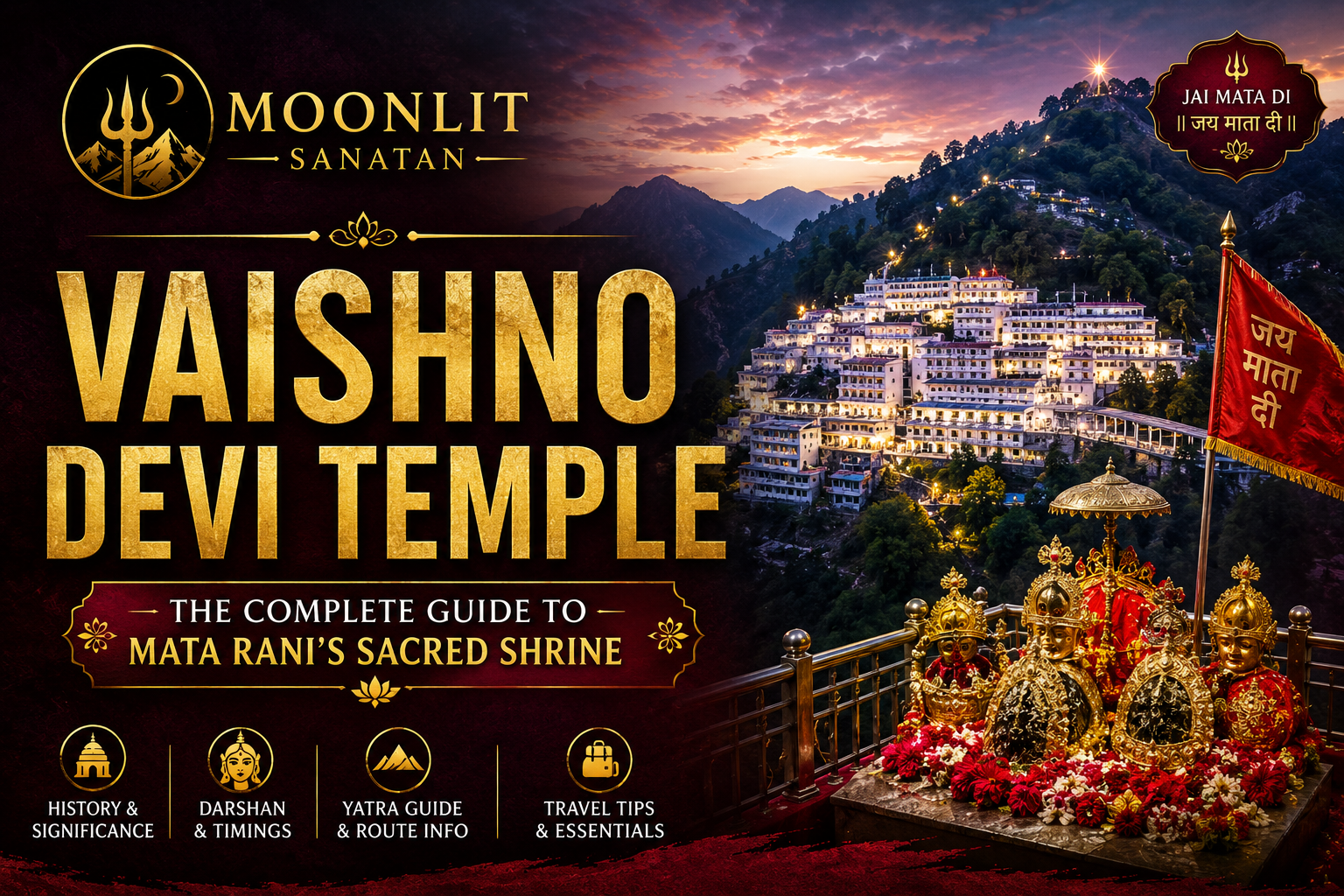
Vaishno Devi Temple: The Complete Yatra Guide
Perched in the Trikuta Hills above Katra, Vaishno Devi draws over a crore devotees a year — most walking 13km on faith alone. Here's the real legend, the route, and everything you need to plan the journey.
Why Vaishno Devi Is More Than Just a Trek
Most guides to Vaishno Devi reduce the whole experience to a checklist — book the helicopter, do the trek, get the darshan, done. That misses the point entirely. This is one of India's most visited Shakti Peethas, and devotees have a saying about it that tells you everything: you don't choose to visit Mata Vaishno Devi — you go only when she calls you.
The shrine sits inside the Trikuta Hills near Katra, in the Reasi district of Jammu & Kashmir, roughly 13 km uphill from the base camp. Inside the sanctum, there's no idol — devotees worship three naturally formed rock pindis, believed to embody Maha Kali, Maha Lakshmi, and Maha Saraswati together in one place, which is part of what makes this shrine theologically unusual.
If you've read our guide to Kamakhya Temple, you already know that Shakti Peethas tend to have layered histories and legends that get flattened into a single sentence online. Vaishno Devi is no different — so this guide covers the actual legend, the full route from Katra to Bhawan, registration and helicopter booking, and honest, practical trip-planning details.
What Makes Vaishno Devi Different From Other Shakti Shrines
Vaishno Devi isn't just one of the most popular pilgrimage sites in North India — its scale, its route, and its central legend all set it apart from most other temples in the Shakti tradition.
- 🪨Three natural pindis, not one idol — the sanctum houses three rock formations representing Maha Kali, Maha Lakshmi, and Maha Saraswati together, rather than a single carved or cast image.
- 🥾The pilgrimage itself is the point — most devotees still choose the 13 km trek from Katra over the helicopter, treating the walk as part of the spiritual experience rather than an obstacle.
- 🏢One of India's most professionally managed shrines — the Shri Mata Vaishno Devi Shrine Board (SMVDSB) runs registration, accommodation, medical aid, and crowd control at a scale few pilgrimage sites match.
- 👹A two-part darshan tradition — the yatra is considered incomplete without visiting Bhairon Nath's temple after Bhawan, a custom tied directly to the shrine's founding legend.
Each of these threads is worth unpacking properly, so that's exactly what the rest of this guide does.
The Story of Vaishno Devi — Vaishnavi, Lord Ram, and Bhairon Nath
According to popular tradition, Mata Vaishno Devi was born as Vaishnavi, an incarnation of Lord Vishnu's divine energy, into a devout family. From a young age she renounced worldly life and undertook deep penance in pursuit of spiritual union with the divine.
During her wanderings, she is said to have encountered Lord Ram, who told her that the time for her union with her creator had not yet arrived — that moment, tradition holds, would come only in the Kali Yuga, when Ram himself would return as Kalki. Until then, she was to continue her penance at the Trikuta Hills, where devotees would one day seek her blessings.
It was during this period of meditation that a tantric named Bhairon Nath repeatedly tried to disrupt her penance, pursuing her relentlessly and attempting to force her into marriage. After being pursued into the very cave where she now resides, the goddess was ultimately compelled to slay him. His head is said to have landed at what is now known as Bhairon Ghati. Before his death, she granted him forgiveness and a boon: that no pilgrim's yatra would be considered complete without also visiting his shrine after her own darshan — a tradition still followed by nearly every devotee today.
This legend is presented here as it's understood within Hindu devotional tradition — a story of faith, penance, and forgiveness — rather than as a claim of historical fact.
What Are the Three Pindis, and Why Do They Matter?
Unlike most temples, the sanctum at Bhawan contains no statue at all. Devotees walk through a narrow passage into a cave-like chamber where three naturally formed rock pindis stand side by side, believed to be the manifest forms of Maha Kali, Maha Lakshmi, and Maha Saraswati — the three primary forms of divine feminine energy in Shakta tradition.
The idea of worshipping all three energies — power, wealth, and wisdom — in a single, unbroken darshan is part of what makes Vaishno Devi theologically distinct from temples dedicated to just one form of the goddess. For many devotees, that combined darshan is considered the central spiritual purpose of the entire yatra.
Katra to Bhawan: The Complete Route Breakdown
The yatra begins at Katra, the base camp town at around 2,500 ft altitude, and climbs roughly 13 km to Bhawan. The well-paved, well-lit path runs 24/7 with food stalls, rest points, medical aid, and clean toilets along the way, managed by the Shrine Board.
| Stop | Distance from Katra | Significance |
|---|---|---|
| Banganga | ~1 km | Sacred stream; devotees traditionally bathe here before starting the climb |
| Charan Paduka | ~3.5 km | Believed to bear the footprints of Mata Vaishno Devi |
| Ardhkuwari Cave | ~6 km | Where the goddess meditated for nine months during her penance |
| Sanjichhat | ~10.5 km | Helicopter landing point; ~2.5 km trek remains to Bhawan |
| Bhawan (Main Shrine) | ~13 km | The holy cave — darshan of the three pindis |
| Bhairon Temple | ~2.5 km beyond Bhawan | Traditional final stop that completes the yatra |
On foot, most devotees take 5–8 hours to climb and 3–6 hours to descend, depending on fitness, crowd, and weather. For those who prefer not to walk the full distance, pony, palki (palanquin), porter, and battery car services are available — always hire through authorized counters and check the official rate card rather than negotiating informally on the path.
Vaishno Devi Yatra Registration — What You Need to Know
Registration is mandatory before you begin the trek, and it exists for a genuinely practical reason: pilgrim safety, tracking, and crowd management across a route that sees enormous daily footfall.
- 💻Online registration is available through the official Shrine Board (SMVDSB) website, where you can book your Yatra Parchi (RFID slip) in advance.
- 🏢Offline registration counters in Katra also issue the slip on the spot with a valid photo ID — useful if you haven't pre-booked.
- 📋Keep your slip on you at all times. It's checked at multiple points along the route, so losing it can genuinely disrupt your yatra.
Due to fraudulent agents and lookalike websites, only register and book through the official SMVDSB portal or verified counters in Katra — never through third-party sites promising guaranteed slots.
Vaishno Devi Helicopter Booking: Prices, Process, and Tips
For elderly pilgrims, families with young children, or anyone short on time, the helicopter service between Katra and Sanjichhat is a genuinely useful alternative to the full trek.
- 🕐Flight time: around 5–8 minutes from Katra helipad to Sanjichhat, covering roughly 7 km by air.
- 🥾You'll still walk a bit: Sanjichhat sits about 2.5 km from Bhawan, so a short trek, pony, or palki ride remains even after the flight.
- 📅Booking window: opens 60 days in advance at 10:00 AM on the official website — book early, especially around Navratri and long weekends.
- 👥Capacity: each flight carries around 5–6 passengers, and each traveler is weighed before boarding for balance purposes.
- 🎟️Same-day counter tickets are available in limited numbers at Katra, but queues often start well before dawn during peak season.
Book only through the official Shrine Board website or clearly authorized operators. As with most major pilgrimage sites, unofficial agents near Katra sometimes promise guaranteed helicopter slots for a premium — verify everything through official channels first.
Vaishno Devi Temple Timings and Darshan Hours
Unlike many temples, Vaishno Devi's darshan is open 24 hours a day, all year round — there's no fixed closing time.
- 🌅Continuous darshan: the shrine never fully closes, though certain rituals happen at set times each day.
- 🌇Aarti timing: the special Aarti ceremony is held morning and evening and typically runs for a few hours.
- ⚠️Peak periods: Navratri, summer holidays, and long weekends bring significantly longer queues, even though the shrine stays open around the clock.
Because queue times shift so much with the season, it's worth checking the Shrine Board's official notices closer to your travel date rather than relying on any single blog's estimate — including this one.
What to Know Before You Go
A few practical and customary points make the yatra smoother, especially if it's your first time.
- 🎒Pack light — comfortable walking shoes, a light jacket, water, and ID proof are essentials; heavy bags can be deposited or sent via porter services.
- 🪪Carry valid ID at all times — it's required for registration, helicopter boarding, and checkpoints along the route.
- 📵Photography is restricted inside the sanctum — follow posted signage and staff instructions near Bhawan.
- 🚶Follow queue discipline, especially during Navratri and long weekends when crowd density is at its highest.
- 🌧️Be extra cautious during monsoon — the trek path can get slippery in July–August, so sturdy footwear matters more than usual.
Where to Stay for the Vaishno Devi Yatra
The Shrine Board maintains clean, affordable accommodation at multiple points along the route, alongside private options in Katra town.
- 🏛️Shrine Board guesthouses and dormitories are available at Katra, Ardhkuwari, Sanjichhat, and Bhawan itself — ideal if you want to break the trek into stages.
- 🏨Private hotels and guesthouses in Katra range from budget to premium, all within easy reach of the yatra registration counters.
- 📆Book well ahead during Navratri — rooms across every price range fill up fast in the weeks before the festival.
Vaishno Devi Among India's Shakti Shrines
Vaishno Devi is often grouped with the 51 Shakti Peethas in popular devotion, alongside sites like Kamakhya Temple in Assam — each tied to its own distinct legend, ritual tradition, and regional history, yet united by the same underlying reverence for the divine feminine. Reading the two guides together is a good way to see how differently that reverence is expressed from one shrine to the next.
📝 Internal link opportunity: if Moonlit Sanatan publishes a dedicated "51 Shakti Peeth" pillar article, link this paragraph to it directly for readers wanting the full list and context.
Best Time to Visit Vaishno Devi
| Season | What to Expect |
|---|---|
| Mar–Jun / Sep–Nov | Pleasant, stable weather — the most comfortable window for the trek, with moderate crowds outside holidays. |
| Navratri (Chaitra & Sharadiya) | Peak spiritual significance and festival energy, but also the heaviest crowds of the year — book everything early. |
| Jul–Aug (Monsoon) | Lush scenery, but slippery paths and occasional route disruptions — extra caution needed. |
| Dec–Feb (Winter) | Cold, especially near the upper stretches — pack warm layers if you're visiting during this period. |
If you want a calmer, more contemplative yatra, aim for a weekday outside Navratri and summer holidays. If the festival atmosphere is what you're after, Navratri is unmatched — just plan registration and stay well in advance.
Continue the Journey With Us
We regularly share temple histories, festival guides, and Sanatan Dharma traditions across our pages — a good way to keep discovering shrines like Vaishno Devi beyond a single article.
Frequently Asked Questions About Vaishno Devi
Which state is Vaishno Devi Temple in?
Vaishno Devi Temple is located in the Reasi district of Jammu & Kashmir, inside the Trikuta Hills near the town of Katra.
Where exactly is Vaishno Devi Temple located?
The shrine sits inside a cave in the Trikuta Hills, roughly 13 km uphill from Katra, the base camp town at around 2,500 ft altitude where the yatra begins.
What is the story (legend) of Vaishno Devi?
Mata Vaishno Devi is believed to be an incarnation of Vaishnavi who undertook penance at Trikuta Hills after being told by Lord Ram that her divine union would come in the Kali Yuga. The tantric Bhairon Nath repeatedly disrupted her penance and was ultimately slain by her — before dying, he was forgiven and granted the boon that every yatra must include his darshan too.
How far is it from Katra to Vaishno Devi Bhawan?
The trek from Katra to Bhawan covers about 13 km one-way, typically taking 5–8 hours to climb on foot. Pony, palki, battery car, and helicopter options are available for those who prefer not to walk the entire distance.
How do I complete Vaishno Devi yatra registration?
Registration is mandatory and can be done online via the official SMVDSB website or in person at registration counters in Katra with valid photo ID. You'll receive a Yatra Parchi (RFID slip) that's checked at multiple points along the route.
How do I book Vaishno Devi helicopter tickets?
Helicopter tickets can be booked through the official SMVDSB website, with the booking window opening 60 days in advance. The flight runs from Katra to Sanjichhat in about 5–8 minutes, after which a 2.5 km trek or pony/palki ride remains to reach Bhawan.
What are the temple's darshan timings?
Vaishno Devi is open 24 hours a day, year-round, with no fixed closing time — though queues are considerably longer during Navratri, summer holidays, and long weekends.
What do the three pindis at Vaishno Devi represent?
The sanctum at Bhawan contains three naturally formed rock pindis representing Maha Kali, Maha Lakshmi, and Maha Saraswati — worshipped together in a single darshan rather than as separate deities.
Why is visiting Bhairon Nath's temple considered necessary?
According to the legend, Mata Vaishno Devi granted Bhairon Nath a boon before his death that no pilgrim's yatra would be complete without visiting his shrine after Bhawan — a tradition most devotees still follow today, either on foot or via the ropeway.
What is the best time to visit Vaishno Devi?
March–June and September–November offer the most comfortable trekking weather. Navratri carries the greatest spiritual significance but also draws the heaviest crowds of the year, so plan registration and stay well ahead if visiting then.
Is the Vaishno Devi yatra open all year?
Yes, the yatra remains open year-round, 24 hours a day. Temporary suspensions can occur during severe weather, so it's worth checking the official SMVDSB website for any current advisories before you travel.
A Respectful Note
This article draws on widely cited travel guides, the official Shrine Board's published information, and traditional accounts of the Vaishno Devi legend. Beliefs and practices described here are presented as they are understood within Hindu devotional tradition. Registration rules, helicopter prices, and travel details change often — please verify current information through the SMVDSB's official channels before planning your visit.
Travel & Reference Sources
- 📖 Shri Mata Vaishno Devi Shrine Board — Official Website
- 📖 Traditional devotional accounts of the Vaishnavi–Bhairon Nath legend, as commonly recorded in pilgrimage guides
- 📖 Widely published Vaishno Devi yatra and helicopter-booking travel guides (route distances, timings, and registration process)
Have You Made the Yatra? 🏔️
Whether you walked all 13 km, took the helicopter, or you're still planning your first trip — we'd love to hear about your experience. Drop a comment below and share what stood out most about your Vaishno Devi darshan. 💬
Want More Temple Histories and Sanatan Dharma Guides Like This?
Moonlit Sanatan explores the real stories, scholarship, and living traditions behind India's most significant sacred sites — no sensationalism, just genuine reverence.
📸 Follow on Instagram 📌 Follow on Pinterest