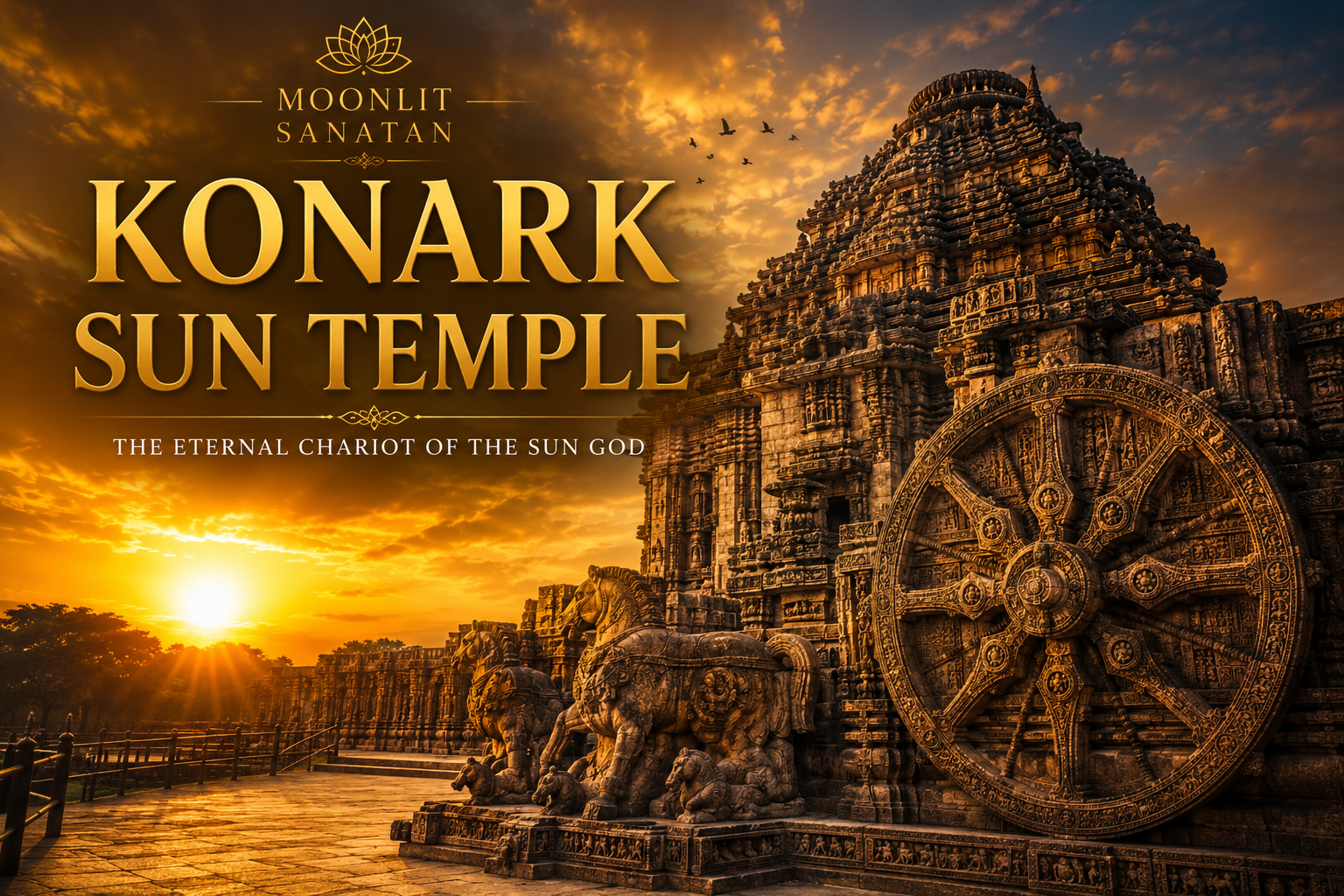
On a quiet stretch of Odisha's coastline, where the Bay of Bengal once lapped much closer to shore than it does today, stands one of the most extraordinary things anyone has ever carved out of stone: an entire chariot, built to the scale of a temple, complete with twenty-four wheels and seven straining horses, all frozen mid-gallop as if the Sun God himself had simply stepped down for a moment. This is the Konark Sun Temple — and unlike almost every other major shrine in India, no priest has performed a daily puja here in centuries. It is not, technically, an active temple at all. It is something rarer: a 750-year-old monument so audacious in its ambition that Rabindranath Tagore once said its stone spoke a language beyond words.
This guide covers everything worth knowing about Konark — its founding legend tied to Krishna's son Samba, the astonishing history of King Narasimhadeva I and the Eastern Ganga dynasty, the temple's ingenious astronomical architecture, its long decline into ruin, its UNESCO recognition, and every practical detail you'll need to plan a visit from Puri or Bhubaneswar. Whether you're a student piecing together a history project, a devotee curious about Surya worship, or a traveler mapping out Odisha's Golden Triangle, you'll find the complete picture below.
Konark Sun Temple — Quick Facts
| Deity | Surya, the Hindu Sun God |
| Location | Konark, Puri district, Odisha, on the Bay of Bengal coastline |
| Built by | King Narasimhadeva I of the Eastern Ganga dynasty |
| Year built | Circa 1250 CE (13th century) |
| Architectural style | Kalinga (Odisha) style, shaped as a colossal chariot |
| Design | 24 carved stone wheels and 7 horses representing the Sun's chariot |
| Original height | Estimated at over 200 feet (main shikhara now collapsed) |
| UNESCO status | World Heritage Site since 1984 |
| Distance from Puri | Approx. 35 km |
| Distance from Bhubaneswar | Approx. 65 km |
| Visiting hours | 6:00 AM – 8:00 PM daily |
| Entry fee | ₹40 for Indian nationals; ₹600 for foreign nationals |
About Konark Sun Temple
In its simplest description, Konark Sun Temple is a 13th-century shrine in Odisha built entirely in the shape of Surya's mythical chariot — twenty-four enormous stone wheels, each one functioning as a working sundial, arranged along a raised platform and drawn by seven rearing horses, all carved from Khondalite rock quarried and transported at a scale that still puzzles engineers today. It was constructed to be the grandest expression of sun worship India has ever produced, and even in its partially ruined state — the great tower above the sanctum collapsed long ago — what remains is considered one of the finest surviving examples of Kalinga architecture anywhere in the world. Declared a UNESCO World Heritage Site in 1984, it draws well over a million visitors annually, ranking among the most recognizable monuments in India alongside the Taj Mahal.
The Legend Behind the Temple: Samba and the Sun God
Long before King Narasimhadeva I laid the temple's foundation, Konark already carried deep mythological weight as a sacred site for sun worship. The Samba Purana, an ancient text devoted to Surya, tells the story of Samba, a son of Lord Krishna, who was cursed with leprosy after offending his father by trespassing where he shouldn't have. Devastated, Samba retreated to the coast northeast of Puri and undertook twelve years of unbroken penance to Surya, praying at a site called Maitreyavana. Moved by his devotion, the Sun God cured him completely. In gratitude, Samba is said to have built the very first sun temple at this location — centuries before Narasimhadeva's version — and even brought Magi, Persian sun-priests, to conduct worship here, since local Brahmin priests of the time reportedly refused to worship Surya's image directly.
This legend matters for understanding why Narasimhadeva chose this exact spot centuries later. Konark, sometimes referred to in old texts as Konaditya, was already regarded as the most sacred site for Surya worship in the entire Odisha region — meaning the 13th-century king wasn't picking an arbitrary location for his grand architectural statement. He was building on ground that Hindu tradition already considered uniquely blessed by the Sun God himself.
History & Origins: Who Built Konark Sun Temple
The Konark Sun Temple was commissioned around 1250 CE by King Narasimhadeva I, who ruled the Eastern Ganga dynasty from 1238 to 1264 CE. He was, by every historical account, a formidable warrior-king — he successfully repelled repeated Turko-Afghan invasions launched from Bengal, and his decisive 1244 CE victory over the forces of Tughan Khan in the Varendra and Rarh regions (parts of present-day Bangladesh and West Bengal) firmly established Odisha as the dominant regional power of its era. Several traditions suggest the temple was commissioned specifically to commemorate these military triumphs, functioning as much as a statement of imperial power as an act of religious devotion — an assertion of Eastern Ganga supremacy over rival dynasties like the Chalukyas, Cholas, and Pallavas, whose own temple-building achievements set a high bar across the subcontinent.
Construction was overseen by an official named Samantaraya Mahapatra, and historical accounts suggest the project mobilized an extraordinary labor force over more than a decade, quarrying and transporting massive blocks of Khondalite stone from sites many kilometres away — an engineering feat that remains genuinely difficult to explain given the tools available at the time. Even the precision of the stonework drew astonishment from later observers: joints between blocks were fitted so seamlessly that, in places, the seams are almost invisible to the naked eye.
Architecture: The Chariot of the Sun God
Nothing quite prepares a first-time visitor for the scale of Konark's central conceit: the entire temple is designed as Surya's chariot, caught mid-motion across the sky. The platform is ringed by twenty-four intricately carved stone wheels, each roughly 12 feet in diameter, generally interpreted as representing either the 24 hours of the day or the 24 fortnights of the Hindu lunar calendar. Every wheel functions as an accurate sundial — its spokes cast shadows that, with careful study, can be read to tell time down to the minute, a detail that continues to draw architectural historians and horologists alike.
Pulling this stone chariot are seven magnificently carved horses, positioned at the temple's entrance, symbolizing the seven days of the week — or, in another common interpretation, the seven colors of sunlight. The temple was deliberately oriented to face east, so that the first rays of the rising sun would strike the entrance directly and illuminate the inner sanctum, a level of astronomical precision that reflects extraordinarily advanced observational knowledge for its time.
Structurally, the complex originally consisted of three main components: the deul (main sanctuary tower), the jagamohana (audience hall), and the nata mandira (dance hall). The great sanctuary tower, once estimated to have risen well over 200 feet, collapsed centuries ago and no longer stands; what visitors see today is primarily the surviving jagamohana, still an imposing structure in its own right, along with the temple's dance hall and its famous wheels. Every surviving surface is covered in extraordinarily detailed carvings — deities, royal processions, musicians, animals, mythical creatures, and scenes of daily life, alongside the temple's famous and, at the time, controversial erotic sculptures, which drew both fascination and shock from early European travelers who encountered them.
A Legend Within the Architecture
One enduring, unverified legend claims the temple's inner sanctum once held a massive image of Surya suspended in mid-air, held aloft purely through a precisely calibrated arrangement of magnets embedded in the structure — with some accounts claiming Portuguese sailors later removed the magnets, fearing they were disrupting their ships' compasses along the coast. Historians generally treat this as folklore rather than documented fact, but it's repeated often enough in local tradition that it's worth knowing before you visit.
The Sculptural Program
Beyond the wheels and horses, Konark's surviving walls are essentially a stone encyclopedia of 13th-century Odishan life and cosmology. Rows of miniature figures depict royal processions, hunting scenes, musicians and dancers frozen mid-performance, elephants and mythical beasts called yalis, and an enormous range of deities beyond Surya himself, reflecting the layered, inclusive nature of temple iconography in this period. Art historians consider the smaller, more intimate carvings — some barely a few inches tall — to be every bit as accomplished as the temple's monumental centerpieces, demonstrating a level of craftsmanship that operated confidently at every possible scale.
The temple's erotic sculptures, concentrated mainly on the upper tiers of the surviving structure, remain among its most discussed features. Scholars have offered various explanations over the years — from tantric symbolism and fertility rites to interpretations tied to temple initiation rituals — but no single explanation has achieved full consensus. What's clear is that these carvings were startling enough to Victorian-era European visitors that they were sometimes deliberately omitted from official photographs and guidebooks well into the 20th century, a reminder of how differently colonial-era observers approached Indian religious art compared to the communities that created it.
Why the Temple Fell Silent: Decline & Restoration
Unlike Meenakshi or Kashi Vishwanath, Konark's decline wasn't the result of a single, well-documented act of destruction — and that ambiguity is itself part of what makes the site so fascinating to historians. The exact cause of the temple's ruin remains genuinely debated. Some accounts point to structural failure, possibly triggered by the sheer weight and ambition of the original tower combined with the loose, sandy coastal soil beneath it. Others point to gradual abandonment following shifts in patronage after the fall of the Eastern Ganga dynasty, compounded by the slow retreat of the Chandrabhaga River, at whose mouth the temple was originally built — the coastline has since receded significantly, leaving the temple further from the water than it once stood.
Whatever combination of causes was responsible, the temple had largely fallen out of active worship and into disrepair by the time European travelers began documenting it in the following centuries, giving rise to its evocative nickname, the "Black Pagoda," so called by sailors for its dark, weathered façade — a deliberate counterpart to Puri's Jagannath Temple, which sailors correspondingly nicknamed the "White Pagoda," both serving as navigational landmarks along the Bay of Bengal coastline.
The temple was effectively rediscovered by British colonial-era archaeologists in the 19th century, buried in places under drifted sand, and has since undergone continuous, careful conservation by the Archaeological Survey of India (ASI). Restoration work has focused on structurally stabilizing the surviving jagamohana, halting further erosion of the delicate stone carvings, and, more recently, employing 3D scanning and digital modeling to document the site's condition with a precision earlier generations of conservators could only have dreamed of. Sand infill inside the jagamohana, added by British engineers in the early 20th century specifically to prevent structural collapse, remains in place today — a pragmatic, if visually unglamorous, intervention that has kept the surviving hall standing for over a century since.
UNESCO World Heritage Status & Significance
In 1984, UNESCO formally inscribed Konark Sun Temple as a World Heritage Site, recognizing it as an outstanding example of 13th-century Kalinga temple architecture and one of the most extraordinary religious monuments in the world. It has also repeatedly appeared on various lists of the "Seven Wonders of India," reflecting both its architectural audacity and its enduring cultural significance.
Beyond the honor itself, the UNESCO listing has meaningfully shaped how the site is managed today — funding and international attention that support the ASI's ongoing conservation efforts, and a framework that balances genuine preservation against the demands of hosting well over a million visitors each year. For India more broadly, Konark stands alongside sites like the Taj Mahal and the Ajanta and Ellora Caves as one of the definitive architectural statements of the country's civilizational history — proof, as Tagore put it, that stone itself can carry meaning beyond what language is able to express. The temple's image also appears on India's ten-rupee note, a small but telling sign of how central Konark has become to the country's sense of its own architectural heritage, recognized well beyond Odisha or specialist academic circles.
Konark has also been recognized on various published lists of the "Seven Wonders of India," a distinction that, while less formal than UNESCO status, reflects the same underlying consensus: that few structures anywhere in the country combine mythological ambition, engineering precision, and sheer sculptural density quite the way Konark does.
Surya Worship in Hindu Tradition
To fully appreciate why a 13th-century king would pour such extraordinary resources into a single temple, it helps to understand just how central Surya has been to Hindu worship since the earliest Vedic period. Surya appears prominently in the Rig Veda, one of Hinduism's oldest sacred texts, praised as the source of all light, life, and time itself — the deity whose daily journey across the sky quite literally structures how humans measure their existence. The Gayatri Mantra, among the most widely recited verses in Hindu practice even today, is itself a hymn addressed to the solar deity, underscoring how deeply solar worship is woven into daily ritual life across India, independent of any single temple or region.
By the time of the Eastern Ganga dynasty, Odisha in particular had developed into a significant center of Surya devotion, with several smaller sun temples predating Konark scattered across the region. What made Narasimhadeva's project unprecedented wasn't the act of building a sun temple — it was the sheer scale and architectural imagination he brought to it, transforming a well-established devotional tradition into arguably the single most ambitious expression of solar worship ever attempted in stone. Even today, the Chhath Puja festival, observed largely across North India and Nepal, continues this ancient tradition of direct sun worship, offering a living link between Konark's 13th-century ambitions and the way millions of Hindus still honor Surya each year.
Location and How to Reach Konark Sun Temple
Konark sits on the Bay of Bengal coastline in Puri district, Odisha, roughly 35 km northeast of Puri city and about 65 km from the state capital, Bhubaneswar — making it an easy day trip from either city, and frequently visited as part of Odisha's popular "Golden Triangle" circuit alongside Puri and Bhubaneswar.
By Air
Biju Patnaik International Airport in Bhubaneswar is the nearest airport, roughly 65 km from Konark and about an hour's drive, with regular domestic connections to Delhi, Mumbai, Bengaluru, Kolkata, and other major Indian cities.
By Rail
Puri Railway Station is the closest major station, around 30–35 km from Konark, well connected to Bhubaneswar and other cities across India. Many travelers fly into Bhubaneswar, take a short train to Puri, and then continue to Konark by road.
By Road
Regular buses and shared taxis connect Konark to both Puri and Bhubaneswar, and the drive along the coastal Marine Drive route from Puri is considered one of the most scenic short road trips in eastern India. Private taxis are readily available from either city's airport or railway station, typically priced between ₹1,500 and ₹2,000 for the full trip from Bhubaneswar.
Visiting Hours, Entry Fee & Photography Rules
Since Konark functions as a protected monument rather than an active temple, its visitor logistics look quite different from a typical darshan guide:
- Visiting hours: 6:00 AM to 8:00 PM daily, with no weekly closing day
- Entry fee (Indian nationals): ₹40
- Entry fee (SAARC/BIMSTEC nationals): ₹40
- Entry fee (foreign nationals): ₹600
- Children under 5: Free entry
- Light and Sound Show: An additional ₹30–70 ticket, held after sunset (two nightly showings, typically 6:30 PM and 7:30 PM in winter months, later in summer), narrated in English, Hindi, or Odia via wireless headphones
Tickets can be booked in advance through the ASI's official e-ticketing portal, which is strongly recommended during peak season to avoid long queues. A complete visit — including the main temple complex, the surrounding grounds, and the on-site archaeological museum — typically takes 2 to 3 hours. Because the temple is a protected ASI monument, touching the carved surfaces, applying any oils or offerings to the stone, and bringing food inside are all prohibited, in contrast to the more devotional visiting norms at active temples.
Best Time to Visit Konark Sun Temple
The most comfortable months to visit are between October and March, when Odisha's coastal climate is at its mildest, with daytime temperatures generally between 20°C and 30°C. Summers (April–June) bring intense heat and humidity that can make walking the open stone platform genuinely uncomfortable by midday, so early morning between 6:00 AM and 8:00 AM is consistently recommended as the best window — both for comfortable temperatures and for the best natural light for photography, since the temple's east-facing design means the morning sun illuminates the carvings beautifully.
If your schedule allows it, the annual Konark Dance Festival, typically held in early December against the backdrop of the temple itself, is an exceptional time to visit — classical Indian dance forms including Odissi, Bharatanatyam, and Kathak are performed by leading artists on an open-air stage set against the illuminated monument, drawing visitors from across the country specifically for the event.
Nearby Attractions
Jagannath Temple, Puri
Roughly 35 km away, this is one of the four Char Dham pilgrimage sites and the spiritual anchor of the entire region — most visitors combine a Konark trip with darshan at Puri, historically nicknamed the "White Pagoda" in the same sailor tradition that gave Konark its "Black Pagoda" nickname.
Chandrabhaga Beach
Located right beside the temple complex, this coastal stretch is where pilgrims traditionally take a ritual bath during the Magha Saptami festival, and it remains a popular spot for a quiet sunrise walk after visiting the temple.
Chilika Lake
Asia's largest brackish water lagoon, roughly an hour's drive from Konark, is a major stop for migratory birds in winter and a worthwhile addition to a longer Odisha itinerary.
Suggested One-Day Itinerary
- 6:00 AM – 8:00 AM: Arrive at opening time for the best light and smallest crowds; explore the main platform, wheels, and horses
- 8:00 AM – 9:00 AM: Visit the on-site Archaeological Museum to see recovered sculptures and artifacts up close
- 9:00 AM – 9:30 AM: Walk to nearby Chandrabhaga Beach for a quieter, reflective close to the visit
- 10:00 AM onward: Continue on to Puri (approx. 1 hour) for Jagannath Temple darshan and lunch
- Evening (optional, if staying overnight): Return for the Light and Sound Show after sunset
Shop Your Odisha Heritage Trip Essentials
As an Amazon Associate, Moonlit Sanatan earns from qualifying purchases. This helps support the free guides we publish here.
Compact Travel Camera
A lightweight camera to properly capture Konark's intricate stone carvings, ideal for the golden morning light.
Check PriceUV-Protection Sunglasses
Coastal Odisha sun is intense on the open temple platform — proper UV protection makes the visit far more comfortable.
Check PriceCompact Travel Backpack
A lightweight anti-theft daypack for carrying water, sunscreen, and essentials while exploring the temple grounds hands-free.
Check PriceTravel-Size Sunscreen
High-SPF sunscreen for extended time on Konark's open stone platform under the coastal Odisha sun.
Check PriceBook: Temples of Odisha
An illustrated guide to Odisha's Kalinga-style temple architecture, perfect for deepening your appreciation of Konark's design.
Check PriceWide-Brim Sun Hat
Breathable sun protection for walking the fully exposed temple complex, especially outside the winter months.
Check PriceInsulated Water Bottle
Keeps water cool through a multi-hour visit — there's little natural shade across the open temple grounds.
Check PriceFrequently Asked Questions About Konark Sun Temple
Who built Konark Sun Temple?
Konark Sun Temple was built around 1250 CE by King Narasimhadeva I of the Eastern Ganga dynasty, reportedly to commemorate his military victories against invading forces from Bengal. Construction was overseen by an official named Samantaraya Mahapatra.
In which state is Konark Sun Temple located?
Konark Sun Temple is located in Odisha, in Puri district, on the Bay of Bengal coastline, roughly 35 km from Puri city and 65 km from Bhubaneswar.
Why is Konark Sun Temple famous?
It's famous for its extraordinary architecture — the entire temple is designed as Surya's chariot, with 24 carved stone wheels functioning as sundials and 7 horses at its entrance. It's a UNESCO World Heritage Site and considered the finest surviving example of Kalinga temple architecture.
Is Konark Sun Temple still an active place of worship?
No, regular worship hasn't taken place at Konark for centuries, following the collapse of its main tower and a long period of decline. It functions today as a protected monument and UNESCO World Heritage Site managed by the Archaeological Survey of India, rather than an active temple.
When was Konark Sun Temple declared a UNESCO World Heritage Site?
UNESCO declared Konark Sun Temple a World Heritage Site in 1984, recognizing it as an outstanding example of 13th-century Kalinga architecture.
What are the visiting hours and entry fee?
The temple is open daily from 6:00 AM to 8:00 PM. Entry costs ₹40 for Indian, SAARC, and BIMSTEC nationals, and ₹600 for foreign nationals, with an additional ticket required for the evening Light and Sound Show.
Continue Exploring Sacred India
Final Thoughts
Konark occupies a strange and singular place among India's great religious monuments — a temple that no longer functions as one, and yet remains one of the most spiritually and artistically resonant structures the country has ever produced. There's something genuinely humbling about standing beside a stone wheel taller than a person, carved with such geometric precision that it still tells accurate time eight centuries later, built by a civilization that had no machinery beyond human will and simple tools. Whatever brought the temple's great tower down, whatever slow combination of soil, sea, and shifting power caused it to fall silent, the wheels, the horses, and the carvings that remain still manage to communicate exactly what Narasimhadeva intended eight hundred years ago: that this was a monument built for a god who moves the sun itself across the sky. Few ruins anywhere manage to feel this alive.
Whether you visit as part of a longer Odisha pilgrimage circuit through Puri, as a history or architecture enthusiast, or simply as someone chasing one of India's most photographed sunrises, Konark rewards visitors who take the time to actually look closely — because so much of what makes this temple extraordinary is in the details carved into the stone, not just the silhouette from a distance. Bring a full morning, not just an hour, and let the wheels tell you their time.