Ramanathaswamy Temple: The Complete Guide to the Sacred Jyotirlinga of Rameswaram
Jyotirlinga Series · Char Dham Series · Rameswaram, Tamil Nadu
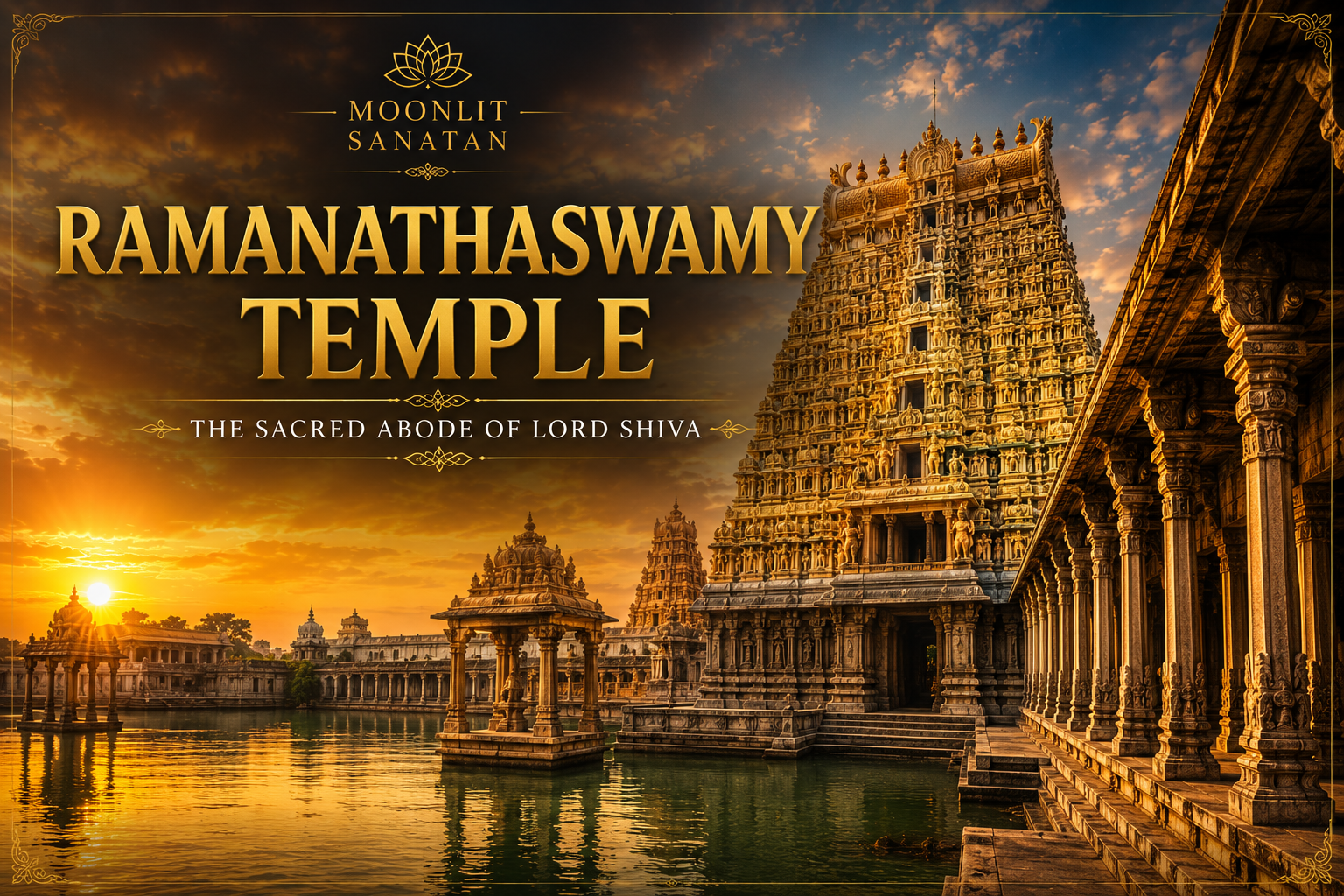
There is a particular hush that falls over you the moment you cross the Pamban Bridge and see the sea open up on both sides. Somewhere ahead, on a small island shaped like a conch shell, stands a temple that Lord Rama himself is said to have consecrated after his war with Ravana. This is Ramanathaswamy Temple — known also as the Rameshwaram Temple — one of the twelve Jyotirlingas of Lord Shiva, one of the four sacred Char Dhams, and home to the longest temple corridor on earth. It is a place where mythology, architecture, and the ritual of water come together in a way found almost nowhere else in India.
In this guide, we walk through everything the Arulmigu Ramanathaswamy Temple has to offer — its Ramayana-era origins, the centuries of Pandya, Chola, Nayak, and Setupati craftsmanship that shaped its corridors, the ritual of the 22 sacred wells, darshan timings, and practical travel information for anyone planning this pilgrimage in 2026.
Quick Facts: Ramanathaswamy Temple
| Deity | Lord Shiva, worshipped here as Ramanathaswamy ("Lord of Rama") |
| Significance | One of the 12 Jyotirlingas · One of the 4 Char Dhams · Paadal Petra Sthalam |
| Location | Rameswaram Island (Pamban Island), Ramanathapuram District, Tamil Nadu – 623526 |
| Architecture | Dravidian style · longest temple corridor in the world (~197 m) |
| Sacred wells | 22 Theerthams inside the temple, out of 64 in and around Rameswaram |
| Darshan timings | 5:00 AM – 1:00 PM and 3:00 PM – 9:00 PM (subject to change on festival days) |
| Entry fee | Free general darshan; paid special/VIP darshan options available |
| Nearest airport | Madurai Airport (~170 km) |
| Nearest railway station | Rameswaram Railway Station (on the island itself) |
Table of Contents
- History & Mythology of Ramanathaswamy Temple
- Ramanathaswamy Temple & the Char Dham Yatra
- Why It Is One of the 12 Jyotirlingas
- What Does "Arulmigu Ramanathaswamy" Mean?
- Architecture & The World's Longest Corridor
- The 22 Sacred Theerthams (Holy Wells)
- Temple Timings, Darshan Types & Fees
- Best Time to Visit & Major Festivals
- Dress Code & Temple Etiquette
- How to Reach Rameswaram
- Places to Visit Near Ramanathaswamy Temple
- What to Pack for the Rameswaram Yatra
- Frequently Asked Questions
History & Mythology of Ramanathaswamy Temple
The story of Ramanathaswamy Temple begins not with a king or a dynasty, but with a war and a moment of penance. According to the Ramayana, after Lord Rama defeated Ravana in Lanka and rescued Sita, he realised that Ravana — for all his tyranny — was still a Brahmin and a great devotee of Shiva. To atone for this act (Brahmahatya dosha), Rama wished to worship Lord Shiva and seek forgiveness before returning home.
Rama sent Hanuman to the Himalayas to fetch a Shivalinga. But Hanuman took longer than expected, and the auspicious hour for the worship was approaching. Rather than wait, Sita herself is said to have shaped a linga from the sands of the seashore, and Rama consecrated it. This sand linga became the presiding deity of the temple, known today as the Ramalingam. When Hanuman finally returned with the linga from Kailash, Rama, not wanting to disappoint him, installed that second linga as well, right beside the first, and directed that it be worshipped first in ritual out of respect for Hanuman's effort. This is why, even today, the temple honours two lingams — the Ramalingam and the Vishwalingam — in its sanctum.
The structure that pilgrims walk through today is the result of nearly a thousand years of continuous devotion and construction. The earliest stone structure is generally attributed to the Pandya dynasty around the 12th century, though the site itself is referenced far earlier in Tamil devotional literature — it is one of the 274 Paadal Petra Sthalams, the Shiva temples glorified in verse by the Nayanmars (Saivite saints) Appar, Sundarar, and Tirugnana Sambandar.
Over the following centuries, successive rulers added to the temple in layers: the Cholas, the Pandyas, the Vijayanagara Empire, and later the Nayak kings of Madurai all contributed shrines, gopurams, and mandapams. It was under the Setupati kings of Ramanathapuram, however, that the temple took the monumental form it has today. Raghunatha Kilavan Setupati is credited with sanctioning much of the temple's expansion, and it was his successor, Muthuramalinga Setupati, whose reign gave the temple its most celebrated feature — the third corridor, the longest in any Hindu temple in the world.
This pairing is why many pilgrims plan to visit our detailed guide to the Kashi Vishwanath Temple in Varanasi alongside Rameswaram — together, the two form a symbolic journey across the length of India, from the Himalayas to the Indian Ocean.
Inscriptions found within the temple, written in both Tamil and Sanskrit, add further texture to this history — recording donations, land grants, and repairs made by successive rulers. One notable episode: the Vijayanagara emperor Krishna Deva Raya is said to have visited the temple in 1513, after a military campaign, and made magnificent gifts to the shrine, a gesture that reflects how even emperors from far outside Tamil Nadu regarded Rameswaram as a site worth honouring. Later, in the 14th and 15th centuries, kings of the Jaffna kingdom in present-day Sri Lanka — Jeyaveera Cinkaiariyan and his successor Gunaveera Cinkaiariyan — are recorded as having shipped stone blocks across the sea from the Koneswaram temple in Trincomalee specifically to renovate Rameswaram's sanctum, a detail that speaks to how this temple's influence and devotional network extended well beyond mainland India.
Ramanathaswamy Temple & the Char Dham Yatra
Beyond its status as a Jyotirlinga, Ramanathaswamy Temple also holds the distinction of being one of the four Char Dhams established in the Hindu pilgrimage tradition — alongside Badrinath in the north, Dwarka in the west, and Puri in the east. Together, these four sites are traditionally understood to mark the four cardinal directions of sacred India, and completing a pilgrimage to all four is considered one of the most significant spiritual undertakings a devout Hindu can attempt in their lifetime.
What sets Rameswaram apart within this circuit is that it is the only Char Dham that is also a Jyotirlinga, giving it a rare dual sanctity. Pilgrims following the traditional route often combine a visit here with the Himalayan legs of the yatra, making a conscious pilgrimage arc from the mountains to the sea. If you are mapping out this larger journey, our guides to Badrinath Temple and Jagannath Temple, Puri cover the other legs of this circuit in similar depth.
Why It Is One of the 12 Jyotirlingas
Of the twelve Jyotirlingas scattered across India, Ramanathaswamy holds a special place as the southernmost Jyotirlinga. A Jyotirlinga, literally a "pillar of light," represents Shiva in his most formless and infinite aspect, and each of the twelve sites is believed to mark a place where that infinite light manifested itself.
What makes Rameswaram's jyotirlinga status especially poignant is its human origin story — unlike some Jyotirlingas tied purely to divine appearances, this one is inseparable from Rama's very personal act of devotion and repentance. It links the Shaiva tradition (worship of Shiva) directly with the Vaishnava tradition (worship of Vishnu, of whom Rama is an avatar), which is one reason the temple is revered equally by Shaivites, Vaishnavites, and Smarthas alike.
If you are exploring the Jyotirlinga pilgrimage circuit, you may also want to read our guides to Mahakaleshwar Temple in Ujjain and Kedarnath Temple in the Himalayas — each Jyotirlinga carries its own distinct legend, yet together they map a spiritual geography that spans the entire subcontinent. You can browse our full Jyotirlingas collection for the complete series.
What Does "Arulmigu Ramanathaswamy" Mean?
Visitors often come across the temple's full formal name: Arulmigu Ramanathaswamy Temple. "Arulmigu" is a Tamil honorific, roughly translating to "the one overflowing with grace" or "the gracious one." It is a title used across Tamil Nadu for temples administered as significant, grace-bestowing shrines, and it is prefixed almost ceremonially before the deity's name on signage, government notices, and temple trust documents.
So while "Ramanathaswamy Temple" and "Arulmigu Ramanathaswamy Temple" refer to the exact same shrine, the latter is the more formal, official form — the one you'll see on the Tamil Nadu HR&CE (Hindu Religious and Charitable Endowments) Department's records and on the temple's own signboards.
Architecture & the World's Longest Corridor
Ramanathaswamy Temple is, above all, an architectural marvel of Dravidian temple-building at its most ambitious scale. The entire complex is enclosed by a massive compound wall running roughly 865 feet from east to west and 657 feet from north to south, guarded by towering gopurams (gateway towers) on each side. The eastern Rajagopuram alone rises to nearly 126 feet across nine tiers, visible long before you reach the temple itself.
But it is the interior corridors that leave visitors speechless. The temple has three concentric corridors, and the third — known as the Chokkattan Mandapam — is the longest temple corridor in the world, stretching roughly 197 metres from east to west and 133 metres from north to south, lined with an estimated 1,212 intricately carved granite and sandstone pillars. Every pillar is individually sculpted, and when you stand at one end and look down the passage, the repeating rows of pillars create a striking optical illusion, appearing to converge into a single point in the distance.
What makes this even more remarkable is the engineering behind it. Much of the stone used in the temple's construction had to be transported by sea to this island, at a time when moving such heavy granite blocks across water was an extraordinary feat — one that still impresses architects and historians today. The corridors themselves are raised on platforms over five feet high, and the second corridor's beams, sandstone columns, and detailed roof work reflect a slightly earlier phase of construction than the grand third passage completed under the Setupati kings.
Did You Know?
Photography and videography are strictly prohibited inside the temple premises, including within the famous pillared corridors. This rule is enforced to preserve the sanctity of the space — so the experience of walking those 1,212 pillars is one you'll have to witness with your own eyes, not through a camera lens.
The sanctum sanctorum, home to the Ramalingam and the Vishwalingam, sits at the heart of this vast complex, a quiet centre around which centuries of stonework radiate outward. Architecturally, it stands in an interesting contrast to more compact northern shrines like the Kedarnath Temple or the intricately layered Meenakshi Temple in Madurai, showing just how varied Dravidian and Himalayan temple traditions can be even within the same broader Hindu architectural heritage.
The 22 Sacred Theerthams (Holy Wells)
If the corridors are the architectural soul of Ramanathaswamy Temple, the 22 Theerthams are its ritual heart. These are sacred wells located within the temple's inner courtyards, and bathing at each of them, in a fixed sequence, is considered as spiritually significant as the darshan of the Jyotirlinga itself — for many pilgrims, arguably more so.
According to temple tradition, the 22 wells correspond to the 22 arrows in Lord Rama's quiver during the war against Ravana. What fascinates pilgrims and researchers alike is that despite being located on a narrow strip of land surrounded by sea, the water in each well is distinct — some noticeably sweet, some faintly saline, some cool, some curiously warm — a phenomenon that has never fully lost its sense of mystery even after centuries of study.
The full ritual, often called Teertha Snanam, typically begins outside the temple altogether, at Agni Theertham — the open sea-bathing point on Rameswaram's eastern coast, just a short walk from the temple's eastern entrance. Pilgrims take a purifying dip in the Bay of Bengal here before entering the temple to begin the well-by-well bathing sequence inside.
22 Theerthams: What to Expect
| Total wells inside temple | 22 (out of 64 Theerthams across Rameswaram) |
| Bathing fee | Approx. ₹25 per person at the HR&CE counter (subject to change) |
| Timings | Typically 5:00 AM – 1:00 PM and 3:00 PM – 7:00 PM |
| Duration | 45 minutes to 2 hours depending on crowd levels |
| Starting point | Agni Theertham (sea bath) on the eastern coast, before entering the temple |
Attendants usually pour water from each well over pilgrims in turn, guiding them along the traditional order. It is worth budgeting extra time for this — on a quiet weekday it might take under an hour, but during festival season or weekends, the queue for all 22 wells can easily stretch beyond two hours. Carrying a change of dry clothes is highly recommended, since you will be thoroughly drenched by the time the ritual concludes.
Temple Timings, Darshan Types & Fees
Ramanathaswamy Temple follows a two-block daily schedule, with a mid-day break for rituals and temple maintenance:
- Morning darshan: 5:00 AM – 1:00 PM
- Evening darshan: 3:00 PM – 9:00 PM
General darshan at Ramanathaswamy Temple is completely free, though on a busy day the queue can take anywhere from one to three hours. For pilgrims short on time, the temple also offers a few paid options, generally along these lines (fees and structures are revised periodically by the HR&CE department, so it's wise to confirm current rates on arrival):
- Special Darshan: A quicker, separate queue for a modest fee.
- Spatika Lingam Darshan: A close viewing of the crystal (Spatika) lingam kept in the temple, usually offered at a fixed early-morning slot.
- Quick/VIP Darshan: The fastest route to the sanctum, with a wait time typically under 30 minutes.
For the most reliable, up-to-date timings and darshan fee structure, always check with the temple's Public Relations Office at the eastern entrance, or the Tamil Nadu HR&CE Department's official channels before you travel, since temple schedules can shift around major festivals.
Best Time to Visit & Major Festivals
Rameswaram's climate is coastal and warm through most of the year, which means the temple experience changes considerably depending on when you go.
Ideal Months to Visit
The period from October to April is generally considered the most comfortable window, with milder temperatures and lower humidity than the peak summer months. Early mornings, regardless of season, offer the calmest and coolest darshan experience — arriving by 4:30–5:00 AM on weekdays is one of the most effective ways to beat both the heat and the crowds.
Mahashivratri
As a Jyotirlinga temple, Ramanathaswamy sees some of its largest crowds during Mahashivratri, when special abhishekams and night-long vigils draw pilgrims from across South India. If a grand, festival-charged atmosphere is what you're after, this is the time to plan for — but expect significantly longer queues for both darshan and the 22 Theerthams.
Panguni Uthiram & Vaikasi Visakam
These Tamil calendar festivals, tied to important temple legends and processions, also bring heightened devotional activity, with the temple's deities taken out in elaborately decorated processions through the town.
Planning Tip
If your goal is a quieter, more contemplative pilgrimage rather than a festival crowd, avoid weekends and major Tamil festival dates. Weekday early mornings outside festival season offer the closest thing to solitude you'll find at one of India's busiest pilgrimage sites.
Dress Code & Temple Etiquette
Like most major South Indian temples, Ramanathaswamy maintains a traditional dress code, and it's worth planning your outfit before you arrive rather than discovering the rules at the entrance.
- Men are generally expected to wear a dhoti/veshti or formal attire; shorts and casual western wear are typically not permitted inside the sanctum areas.
- Women are expected to wear a saree, salwar kameez, or other modest, traditional clothing.
- Photography and videography are strictly prohibited throughout the temple premises, including the famous corridors.
- Since the 22 Theerthams ritual leaves you drenched, carrying a spare set of dry clothing is essential — many pilgrims change immediately after the well-bathing sequence and before proceeding for the main sanctum darshan.
How to Reach Rameswaram
Rameswaram sits on Pamban Island, connected to mainland Tamil Nadu by the historic Pamban Bridge, and is well linked by rail, road, and (indirectly) air.
By Air
The nearest airport is Madurai Airport, roughly 170 km away, with regular domestic flights connecting to major Indian cities. From Madurai, taxis and buses cover the remaining distance to Rameswaram in about 3–4 hours.
By Rail
Rameswaram has its own railway station right on the island, connected directly to major cities including Chennai, Madurai, and Trichy, making the train one of the most popular and scenic ways to arrive — the approach across the Pamban Bridge, with the sea on either side, is a memorable start to the pilgrimage in itself.
By Road
Rameswaram enjoys good highway connectivity, with Chennai around 560 km away, Madurai about 174 km, and Tiruchirappalli roughly 220 km. Both government and private buses run regularly to the island, and self-drive or taxi options are increasingly popular for pilgrims wanting flexibility to also see Dhanushkodi along the way.
Places to Visit Near Ramanathaswamy Temple
Most pilgrims extend their trip by a day or two to take in the extraordinary landscape surrounding the temple — and it is well worth doing so.
Dhanushkodi
A ghost town at the very tip of the island, Dhanushkodi is where the Indian Ocean and the Bay of Bengal are said to meet, and where the legendary Ram Setu (Adam's Bridge) begins its underwater stretch toward Sri Lanka. The stark, sand-swept ruins here, remnants of a town destroyed by a cyclone decades ago, create one of the most surreal landscapes in India.
Pamban Bridge
The engineering marvel connecting Rameswaram to the mainland, Pamban Bridge offers sweeping sea views and is worth stopping at, whether you're crossing by train or road.
Kothandaramaswamy Temple
Located near Dhanushkodi, this temple marks the spot where, according to legend, Vibhishana (Ravana's brother) surrendered to Rama — a quieter, smaller shrine but rich in Ramayana significance.
Gandamadhana Parvatham
A small hillock temple said to house Rama's footprints, offering one of the best panoramic views of Rameswaram town and the surrounding coastline.
If your pilgrimage plans extend beyond Rameswaram, you might also enjoy our guides to other major shrines along the Char Dham circuit, including Badrinath Temple and Jagannath Temple, Puri — together with Rameswaram and Dwarka, these four form the sacred Char Dham that many devout Hindus aim to complete in a lifetime. Explore our complete Char Dham collection for detailed guides to each.
Where to Stay
Rameswaram town offers accommodation ranging from simple pilgrim lodges and dharamshalas close to the temple's eastern entrance, to mid-range hotels and a handful of resort-style properties near the coast. Most pilgrims prefer staying within walking distance of the temple, since the early-morning darshan and the Agni Theertham sea bath both begin before sunrise, and a short walk makes those pre-dawn routines far easier to manage. Booking ahead is strongly advised during Mahashivratri and other major festival periods, when the town's limited rooms fill up quickly.
Local Food to Try
Being a coastal Tamil town, Rameswaram's food culture leans toward simple, satvik vegetarian fare near the temple, alongside fresh seafood options elsewhere in town for those who eat non-vegetarian food. Filter coffee, curd rice, and traditional Tamil thalis served on banana leaves are easy to find close to the temple streets, making it simple to eat well between darshan sessions without straying far from the pilgrimage route.
What to Pack for the Rameswaram Yatra
Given the combination of sea bathing, temple wells, long walking distances, and traditional dress requirements, a little preparation goes a long way. Here are a few travel essentials that past pilgrims have found genuinely useful for the Rameswaram trip:
Traditional Cotton Dhoti / Veshti Set
A breathable, pure cotton dhoti is essential for men entering the sanctum, and having a spare set ready after the 22 Theerthams ritual saves a lot of discomfort.
View on AmazonQuick-Dry Waterproof Dry Bag
Ideal for keeping your phone, wallet, and dry change of clothes safe while you go through the sea bath at Agni Theertham and the 22 wells inside the temple.
View on AmazonRudraksha Mala (Shiva Japa Mala)
Many pilgrims like to carry or wear a rudraksha mala for japa and meditation while at a Jyotirlinga shrine like Ramanathaswamy.
View on AmazonPortable Brass Puja Thali Set
A compact brass thali with diya, kumkum box, and bell is handy for personal prayers at your hotel or before setting out for darshan each morning.
View on AmazonLightweight Travel Backpack
With long corridors to walk and multiple nearby sites like Dhanushkodi to cover, a comfortable, lightweight daypack makes the whole yatra far easier on your back.
View on AmazonSun & Sand Protection Kit (Cap, Sunglasses, Sunscreen)
Rameswaram's coastal sun is strong, especially around Dhanushkodi's open sands — a simple protection kit makes daytime sightseeing far more comfortable.
View on AmazonCompact Travel Idol – Rama Darbar / Shiva Linga
A small, travel-friendly idol of Rama Darbar or a miniature Shiva Linga makes a meaningful keepsake to carry home from this Jyotirlinga pilgrimage.
View on AmazonDisclosure: Some links on this page are Amazon affiliate links. As an Amazon Associate, Moonlit Sanatan may earn from qualifying purchases, at no extra cost to you. (Replace the placeholder Amazon search links above with your own tagged affiliate links before publishing.)
Frequently Asked Questions
What is Ramanathaswamy Temple famous for?
Ramanathaswamy Temple is famous as one of the twelve Jyotirlingas of Lord Shiva, one of the four Char Dhams, the home of the longest temple corridor in the world, and its deep connection to the Ramayana, where Lord Rama is believed to have worshipped Shiva after the war with Ravana.
Who built the Ramanathaswamy Temple?
The temple's origins trace back to a shrine associated with Rama and Sita, with the stone structure seen today built up over centuries by the Pandya dynasty, the Cholas, the Vijayanagara Empire, the Nayak rulers of Madurai, and finally completed in its present grand form by the Setupati kings of Ramanathapuram, particularly Raghunatha Kilavan Setupati and Muthuramalinga Setupati.
What are the 22 wells (Theerthams) inside the temple?
The 22 Theerthams are sacred wells within the temple courtyards, believed to correspond to the 22 arrows in Rama's quiver. Pilgrims bathe in each well in sequence as part of a purification ritual, usually after first taking a dip in the sea at Agni Theertham.
What are the Ramanathaswamy Temple darshan timings?
The temple is generally open from 5:00 AM to 1:00 PM and again from 3:00 PM to 9:00 PM daily, though timings can shift around major festivals, so it's best to confirm before you travel.
Is Ramanathaswamy Temple darshan free?
Yes, general darshan is free. The temple also offers optional paid darshan categories for those who wish to avoid longer queues, with fees revised periodically by the Tamil Nadu HR&CE Department.
What is the dress code at Ramanathaswamy Temple?
Men are generally expected to wear a dhoti/veshti or formal attire, and women a saree or salwar kameez, or other modest traditional clothing. Photography is not permitted inside the temple premises.
How do I reach Rameswaram?
Rameswaram has its own railway station connected to major cities like Chennai, Madurai, and Trichy. The nearest airport is Madurai Airport, about 170 km away, and the island is also well connected by road via the Pamban Bridge.
What else should I see near Ramanathaswamy Temple?
Nearby highlights include Dhanushkodi (the ghost town at the tip of the island where two seas meet), the Pamban Bridge, Kothandaramaswamy Temple, and Gandamadhana Parvatham for panoramic views of the coastline.
What is the meaning of "Arulmigu" in Arulmigu Ramanathaswamy Temple?
"Arulmigu" is a Tamil honorific meaning "the one overflowing with grace." It is used as a formal prefix for significant Tamil Nadu temples in official records and signage, so "Arulmigu Ramanathaswamy Temple" and "Ramanathaswamy Temple" refer to the same shrine.
Can I check the official Ramanathaswamy Temple website or contact number before I travel?
Yes, the temple is administered by the Tamil Nadu HR&CE (Hindu Religious and Charitable Endowments) Department. For the most current darshan timings, fees, and contact details, it's best to check the official HR&CE channels or contact the temple's Public Relations Office at the eastern entrance directly, since schedules and fee structures are periodically revised.
Final Thoughts
Few pilgrimages in India compress so much history, engineering, and devotion into one place. At Ramanathaswamy Temple, you are walking the same ground where Rama is believed to have sought forgiveness after war, passing beneath pillars carved centuries ago by Pandya and Setupati craftsmen, and standing in water drawn from 22 wells that continue to puzzle scientists to this day. Whether you come for the darshan, the ritual bath, or simply to witness one of the finest examples of Dravidian architecture in the world, Rameswaram tends to leave pilgrims quieter than when they arrived — which, in the end, might be the truest sign of a place genuinely sacred.
Continue Exploring on Moonlit Sanatan
Follow Moonlit Sanatan
For more temple guides, Ramayana stories, and daily Sanatan wisdom, follow along on our social channels: