Epic Tales
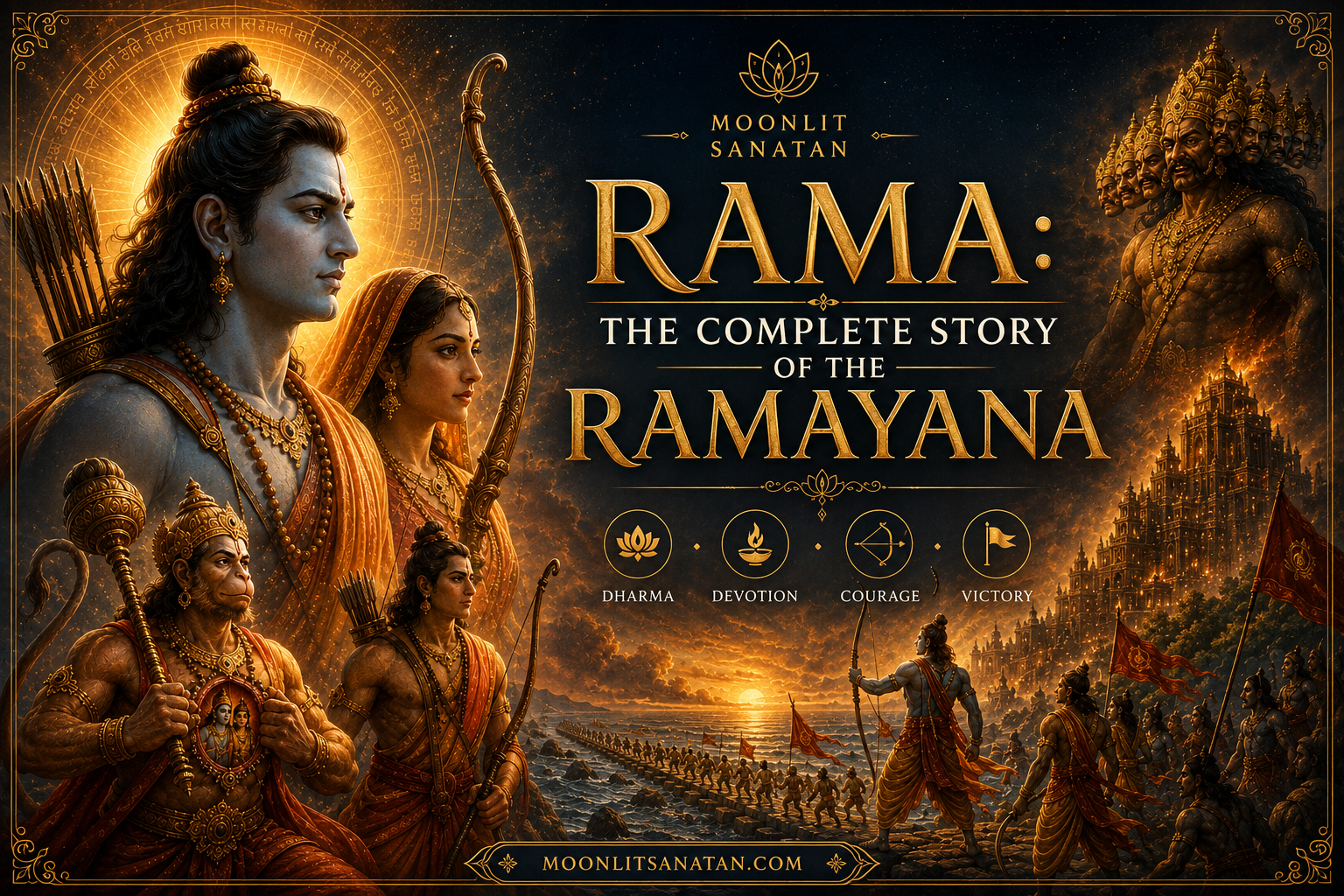
Rama: The Complete Story of the Ramayana
Fourteen years of exile, one kidnapped queen, and a war that gave India its most enduring definition of duty
Some stories get retold so often, in so many languages, that people forget they're actually one continuous narrative rather than a loose collection of famous scenes. Everyone recognizes the golden deer, the burning of Lanka, the ten-headed demon king — but strung together in order, in one sitting, the Ramayana is something else entirely: a genuinely gripping story about a prince who loses everything through no fault of his own, and spends fourteen years proving that losing everything doesn't have to mean losing yourself.
Rama is worshipped across Hinduism as the seventh avatar of Vishnu, but the Ramayana itself works on a second, more human level too — it's a story about promises kept at enormous personal cost, about a brother's loyalty, a wife's courage, and a devotee's total surrender, all set against a war between a rightful king and a tyrant who believed his own power made him untouchable. Nearly every major relationship in Hindu culture — between siblings, spouses, ruler and subject, devotee and god — has some reference point somewhere in this one epic.
This is the full story, told in order, in clear English — Rama's birth, the exile that defines the epic's first half, Sita's abduction, Hanuman's leap across the ocean, the war with Ravana, and the return to Ayodhya that Hindus still celebrate every year as Diwali.
Rama at a Glance
| Detail | Answer |
|---|---|
| Who he is | Seventh avatar of Vishnu, Prince of Ayodhya |
| Wife | Sita (an avatar of Goddess Lakshmi) |
| Closest allies | Lakshmana (brother), Hanuman (devotee), Sugriva (Vanara king) |
| Antagonist | Ravana, the ten-headed demon king of Lanka |
| Core text | Valmiki's Ramayana (Sanskrit), c. 5th century BCE or earlier |
| Most famous title | Maryada Purushottam — "the ideal man of principled conduct" |
| Connected festival | Diwali marks his return to Ayodhya after 14 years of exile |
Birth in Ayodhya: Four Brothers, One Destiny
The story begins with King Dashratha of Ayodhya, a righteous ruler with three wives — Kaushalya, Kaikeyi, and Sumitra — but no heir. Through a special yagna (fire ritual) performed to secure sons, all three queens conceived: Kaushalya gave birth to Rama, Kaikeyi to Bharata, and Sumitra to twins, Lakshmana and Shatrughna. Rama, as Kaushalya's son and the eldest, was recognized from birth as an avatar of Vishnu, sent to Earth specifically to defeat Ravana, a demon king whose boons had made him virtually unkillable by gods or demons — but not, crucially, by a mortal man, a loophole Ravana himself had overlooked.
The four brothers were raised together in close bond, but Rama and Lakshmana in particular became inseparable — a closeness that would matter enormously once exile began. As young princes, both were sent to train under the sage Vishwamitra, where Rama proved his growing strength by defeating several demons sent to disrupt sacred rituals.
Winning Sita: the breaking of Shiva's bow
It was during this period that Rama travelled to the kingdom of Mithila, ruled by King Janaka, whose daughter Sita had been discovered as an infant in a furrow of earth during a ploughing ritual — considered, like Rama, a direct avatar, of Goddess Lakshmi. Janaka had set an extraordinary challenge for any suitor seeking her hand: lift and string an immensely heavy bow that had once belonged to Shiva himself. Where every other prince who attempted it failed, Rama not only lifted the bow but drew it with such force that it broke in two. Sita and Rama were married shortly after, in a union still referenced today as the ideal of a devoted, equal partnership.
Fourteen Years in the Forest: Why Rama Was Exiled
As Dashratha grew old, he announced his intention to crown Rama as heir — a decision met with celebration across Ayodhya. But Kaikeyi, Rama's stepmother, had once saved Dashratha's life in battle, and he had granted her two boons in gratitude, to be claimed whenever she wished. Manipulated by her maidservant Manthara, who convinced her that Rama's coronation threatened her own son Bharata's future, Kaikeyi finally called in both boons on the eve of the coronation: that Bharata be crowned king instead, and that Rama be exiled to the forest for fourteen years.
Rama accepted the exile without a single word of protest or bitterness — a response so central to his character that it's cited even today as the definitive example of Maryada Purushottam, dharma placed above personal desire. Sita insisted on accompanying him rather than remaining in comfort at the palace, and Lakshmana refused to be separated from his brother, choosing exile alongside them both. Devastated by what he had been forced to do, King Dashratha died of grief not long after the three departed for the forest — never living to see his son's return.
Back in Ayodhya, Bharata refused to accept the throne he felt had been stolen through his mother's manipulation. He travelled to the forest to beg Rama to return, and when Rama declined — determined to honour his father's word in full — Bharata carried Rama's sandals back to Ayodhya instead, placing them on the throne and ruling only as a regent in his brother's name for the remainder of the fourteen years, refusing even to wear a crown himself.
The Golden Deer and Sita's Abduction
Years into the exile, the three were living peacefully in a forest hermitage near Panchavati when a demoness named Surpanakha, Ravana's sister, attempted to seduce first Rama and then Lakshmana, and was disfigured by Lakshmana when she attacked Sita out of jealousy and rage. Humiliated, Surpanakha fled to Lanka and appealed to her brother Ravana for revenge — describing Sita's beauty in the process, which planted the idea that would drive the rest of the epic.
Ravana devised a plan: he sent the demon Maricha, disguised as a stunning golden deer, to lure Rama away from the hermitage. Sita, enchanted by the deer, begged Rama to capture it for her. Rama pursued it deep into the forest, and as Maricha died from Rama's arrow, he cried out in Rama's voice, calling for help — a cry designed specifically to draw Lakshmana away from Sita as well. Sita insisted Lakshmana go to his brother's aid; before leaving, Lakshmana drew a protective boundary around the hermitage — the Lakshmana Rekha — instructing Sita not to cross it under any circumstance.
Ravana, disguised as a wandering ascetic, approached the hermitage and begged for alms. Bound by the sacred duty of hospitality to a holy man, Sita stepped across the line to offer him food — the moment Ravana had been waiting for. He seized her and fled to Lanka in his flying chariot, with only the vulture king Jatayu attempting to stop him, fatally wounded in the effort to protect her.
Hanuman, Sugriva, and the Alliance That Found Sita
Grief-stricken and desperate, Rama and Lakshmana searched the forest and eventually encountered Sugriva, exiled king of the Vanaras (a forest-dwelling monkey people), who had lost his kingdom to his brother Vali. Rama helped Sugriva reclaim his throne by defeating Vali in single combat, and in return, Sugriva pledged his entire army to help find Sita.
Among Sugriva's forces was Hanuman — son of the wind god Vayu, and a figure whose devotion to Rama would become one of the most celebrated relationships in the entire epic. Hanuman was tasked with the seemingly impossible mission of locating Sita, eventually leaping across the ocean to reach the island kingdom of Lanka itself.
Inside Lanka, Hanuman found Sita held captive in the Ashoka Vatika, a grove where Ravana kept her, still refusing his repeated demands that she marry him. Hanuman revealed himself, gave her Rama's ring as proof of his mission, and offered to carry her back immediately — an offer Sita declined, insisting Rama himself must be the one to defeat Ravana and reclaim her honour properly. Before leaving, Hanuman allowed himself to be captured and had his tail set on fire by Ravana's soldiers as punishment — only to use the burning tail to set much of Lanka ablaze before escaping and returning to report Sita's location to Rama.
If Hanuman's devotion here is the part of the epic that resonates with you most, our Hindu Gods and Goddesses guide covers his role across the wider pantheon in more depth.
The Bridge to Lanka and the War With Ravana
With Sita's location confirmed, Rama assembled the Vanara army and marched to the shore facing Lanka. To cross the ocean, the army — led by the architect Nala — built Rama Setu, a bridge of floating stones across the strait separating India from the island, an engineering feat still referenced today in discussions of the Adam's Bridge shoal formation between India and Sri Lanka.
The ensuing war was long and brutal, involving Ravana's brothers — Kumbhakarna, a giant who slept for months at a time and fought Rama's army when finally woken, and Vibhishana, who broke from his own family to join Rama's side, believing Ravana's actions were indefensible even by a brother's loyalty. Lakshmana was gravely wounded during the fighting by Ravana's son Indrajit, and was saved only when Hanuman flew to the Himalayas and, unable to identify the single healing herb needed, carried back the entire Sanjeevani mountain rather than risk choosing incorrectly.
The war's climax came in a direct duel between Rama and Ravana. Despite Ravana's ten heads and immense boon-granted power, Rama ultimately struck him down using a celestial weapon aimed at his navel, the one vulnerable point where Ravana's boon of invincibility did not apply — ending the tyranny that had terrorized both gods and mortals for years.
A Difficult ChapterSita's Agni Pariksha and the Return to Ayodhya
Upon Sita's rescue, Rama — bound by concerns over public perception after her long captivity in another man's kingdom — asked her to undergo Agni Pariksha, a trial by fire, to prove her purity. Sita walked into the flames, and the fire god Agni himself emerged to return her unharmed, testifying to her complete chastity throughout the ordeal. This episode remains one of the most debated moments in the entire epic, with many retellings and commentators over the centuries questioning why such a proof was demanded of Sita at all — a discomfort modern readers and scholars still openly discuss rather than gloss over.
With Sita vindicated and the fourteen years of exile finally complete, Rama, Sita, and Lakshmana returned to Ayodhya, where Bharata immediately stepped down as regent and reinstated Rama as king. According to tradition, the people of Ayodhya lit rows of oil lamps to welcome their king home through the darkness — the origin most commonly cited for Diwali, the festival of lights celebrated across Hinduism every year to this day.
Rama Rajya and the Uttara Kanda
Rama's reign that followed is remembered in Hindu tradition as Rama Rajya — an era held up as the gold standard of just, prosperous governance, still invoked today as shorthand for ideal leadership. Under Rama, the kingdom is described as free of want, injustice, and premature death, with a ruler so devoted to his subjects' wellbeing that the phrase itself has outlived the epic as a standalone political ideal.
The Uttara Kanda, the final and most disputed book of the Ramayana — considered by many scholars a later addition to Valmiki's original text — describes a second painful chapter: hearing a citizen question Sita's purity despite the Agni Pariksha, Rama, prioritizing his subjects' trust in the crown over his own personal certainty, exiled a pregnant Sita to the forest, where she was sheltered by the sage Valmiki himself and raised their twin sons, Lava and Kusha, alone. Rama and Sita were only reunited years later, when the twins — trained by Valmiki — recited the Ramayana itself in Rama's own court, revealing their identity. Asked once more to publicly prove her purity, Sita instead called upon the Earth, her mother, to receive her if her devotion had been true — and the ground opened to take her back, ending the epic on a note many readers still find quietly devastating rather than triumphant.
This final chapter is genuinely difficult, and different traditions and commentators handle it differently — some treating it as a later addition inconsistent with Rama's established character, others reading it as a sober meditation on the cost a just ruler sometimes pays for the sake of his people's trust. Either way, it's rarely skipped in serious retellings, precisely because it complicates the "ideal king" narrative rather than simply reinforcing it.
Who's Who in the Ramayana
Sita
Rama's WifeAn avatar of Goddess Lakshmi, found as an infant by King Janaka. Revered as the embodiment of purity, courage, and unwavering devotion throughout every trial the epic puts her through.
Lakshmana
Rama's BrotherChose exile alongside Rama without hesitation and stood guard through all fourteen years, considered the archetype of selfless brotherly devotion in Hindu tradition.
Hanuman
DevoteeVanara warrior and son of Vayu, whose leap to Lanka and total devotion to Rama made him one of the most widely worshipped figures in all of Hinduism.
Ravana
AntagonistThe ten-headed demon king of Lanka — a brilliant scholar and devoted Shiva worshipper whose unchecked pride and desire ultimately caused his downfall.
Bharata
Rama's BrotherRefused the throne gained through his mother's manipulation and ruled only as regent for fourteen years, placing Rama's sandals on the throne in his place.
Vibhishana
Ravana's BrotherBroke from his own family to join Rama's side, believing Ravana's actions indefensible — later installed as king of Lanka after Ravana's defeat.
One Story, Many Retellings
Valmiki's Sanskrit Ramayana is considered the original text, but the story has been retold so extensively across South and Southeast Asia that "the Ramayana" is really more of a shared narrative tradition than a single fixed book.
- Ramcharitmanas (Awadhi, 16th century): Goswami Tulsidas's devotional retelling is the version most North Indian households actually grew up hearing, emphasizing bhakti (devotion) even more strongly than Valmiki's original.
- Kamba Ramayanam (Tamil, 12th century): Kambar's Tamil retelling remains a literary landmark in its own right, with distinct regional emphases and character interpretations.
- Ramakien (Thailand): Thailand's national epic, directly adapted from the Ramayana, forms the basis of classical Thai dance-drama and remains deeply embedded in Thai royal and cultural identity.
- Kakawin Ramayana (Indonesia): An Old Javanese retelling that shaped centuries of Balinese and Javanese performance art, including the Ramayana ballet still staged near Prambanan today.
- Regional Indian versions: Bengali, Kannada, Malayalam, Odia, and numerous other language traditions each carry their own respected retelling, often with local details and emphases not found in Valmiki's original.
This breadth is part of why the Ramayana is often described less as a single work of literature and more as a living tradition — one that has been reinterpreted, translated, and re-emphasized differently by nearly every culture it has reached.
Devotional PracticeBringing the Ramayana Into Daily Devotion
For many Hindu households, the Ramayana isn't just a story read once — it's a text returned to regularly, particularly during Ram Navami and the nine nights of Navratri, when portions are read aloud as a form of devotional practice in themselves.
Ramcharitmanas / Valmiki Ramayana
A clear English or Hindi-English edition of Tulsidas's or Valmiki's text is the natural starting point for reading the full epic at home, chapter by chapter.
View a Ramayana edition →Ram Darbar Brass Idol Set
A grouped idol set of Rama, Sita, Lakshmana, and Hanuman together — known as Ram Darbar — is one of the most traditional configurations for a home shrine.
View a Ram Darbar set →Panchmukhi Hanuman Idol
The five-faced form of Hanuman is specifically associated with protection and courage, a popular choice for households seeking his blessing beyond the standard single-face depiction.
View a Panchmukhi Hanuman idol →Hanuman Chalisa Pendant
A locket-style pendant with the full Chalisa engraved inside is a common way devotees carry the prayer with them beyond the puja room.
View a Hanuman Chalisa pendant →A decorative Kodanda (bow) wall replica — referencing Rama's own weapon and famous title Kodanda-Rama — makes a striking piece for a puja room or study, and a Ram Naam likhit japa notebook, where devotees write "Ram" repeatedly as a meditative practice, remains one of the simplest and most widely practiced forms of daily devotion tied directly to his name. For those planning or dreaming of a visit to Ayodhya, a framed Ram Mandir photo print is also a meaningful addition to a home altar.
ConnectionsRama, Diwali, and the Wider Pantheon
Rama's return to Ayodhya after fourteen years is the mythological anchor for Diwali, one of the largest festivals in the entire Hindu calendar — a connection worth knowing even before that guide is published on this site. In the meantime, our Hindu Gods and Goddesses guide places Rama within Vishnu's full Dashavatara alongside Krishna, and our Krishna Janmashtami 2026 guide covers the other major Vishnu avatar in similar depth, if you'd like to see how the two compare.
ClosingWhy This Story Still Gets Told
Three thousand years and dozens of languages later, the Ramayana hasn't survived because it's a simple story about good defeating evil — the Uttara Kanda alone makes sure of that. It's survived because nearly every relationship it depicts still asks something recognisable of the people living it: a brother choosing loyalty over comfort, a wife choosing partnership over safety, a devotee choosing total surrender over self-interest, a king choosing his word over his own happiness. Rama's story keeps getting retold in a new language every generation because the questions underneath it were never really about Ayodhya, Lanka, or a fourteen-year exile at all.
Follow Moonlit Sanatan
Daily puja reminders, temple stories, and festival dates all through the year.
Frequently Asked Questions About Rama and the Ramayana
Who is Rama in Hinduism?
Rama is worshipped as the seventh avatar of Vishnu, born as a prince of Ayodhya specifically to defeat the demon king Ravana. He's also widely revered as Maryada Purushottam, the ideal man who upheld duty and righteousness even at enormous personal cost.
Why was Rama exiled for 14 years?
Rama's stepmother Kaikeyi called in two boons King Dashratha had promised her years earlier — that her own son Bharata be crowned instead of Rama, and that Rama be exiled to the forest for fourteen years. Bound by his word, Dashratha had no way to refuse.
Who kidnapped Sita and why?
Ravana, the demon king of Lanka, abducted Sita after his sister Surpanakha was humiliated by Lakshmana and urged him toward revenge, describing Sita's beauty in the process. Ravana lured Rama and Lakshmana away using a golden deer before seizing Sita.
How did Hanuman help Rama?
Hanuman located Sita in Lanka by leaping across the ocean, delivered Rama's ring as proof of his mission, set part of Lanka ablaze before escaping, and later carried an entire mountain of healing herbs to save Lakshmana's life during the war.
How did Rama defeat Ravana?
Despite boons that made Ravana nearly invincible against gods and demons, he remained vulnerable to a mortal man. Rama struck him down in single combat using a celestial weapon aimed at his navel, the one point where his invincibility did not apply.
Why does Diwali celebrate Rama's return?
According to tradition, the people of Ayodhya lit rows of oil lamps to welcome Rama home after his fourteen-year exile and victory over Ravana — the origin most commonly cited for Diwali, the festival of lights celebrated across Hinduism today.
What is the Uttara Kanda, and why is it controversial?
The Uttara Kanda is the Ramayana's final book, describing Rama's exile of a pregnant Sita after a citizen questioned her purity. Many scholars consider it a later addition to Valmiki's original text, and it remains one of the most debated and difficult chapters in the entire epic.
What does "Maryada Purushottam" mean?
The title translates roughly to "the ideal man of principled conduct," referring to Rama's consistent choice to uphold dharma and duty even when doing so came at severe personal cost, most notably his unquestioning acceptance of exile.