Epic Tales
The Bhagavad Gita: Complete Summary & Meaning
700 verses spoken on a battlefield, in the minutes before a war nobody in Arjuna's chariot actually wanted to fight
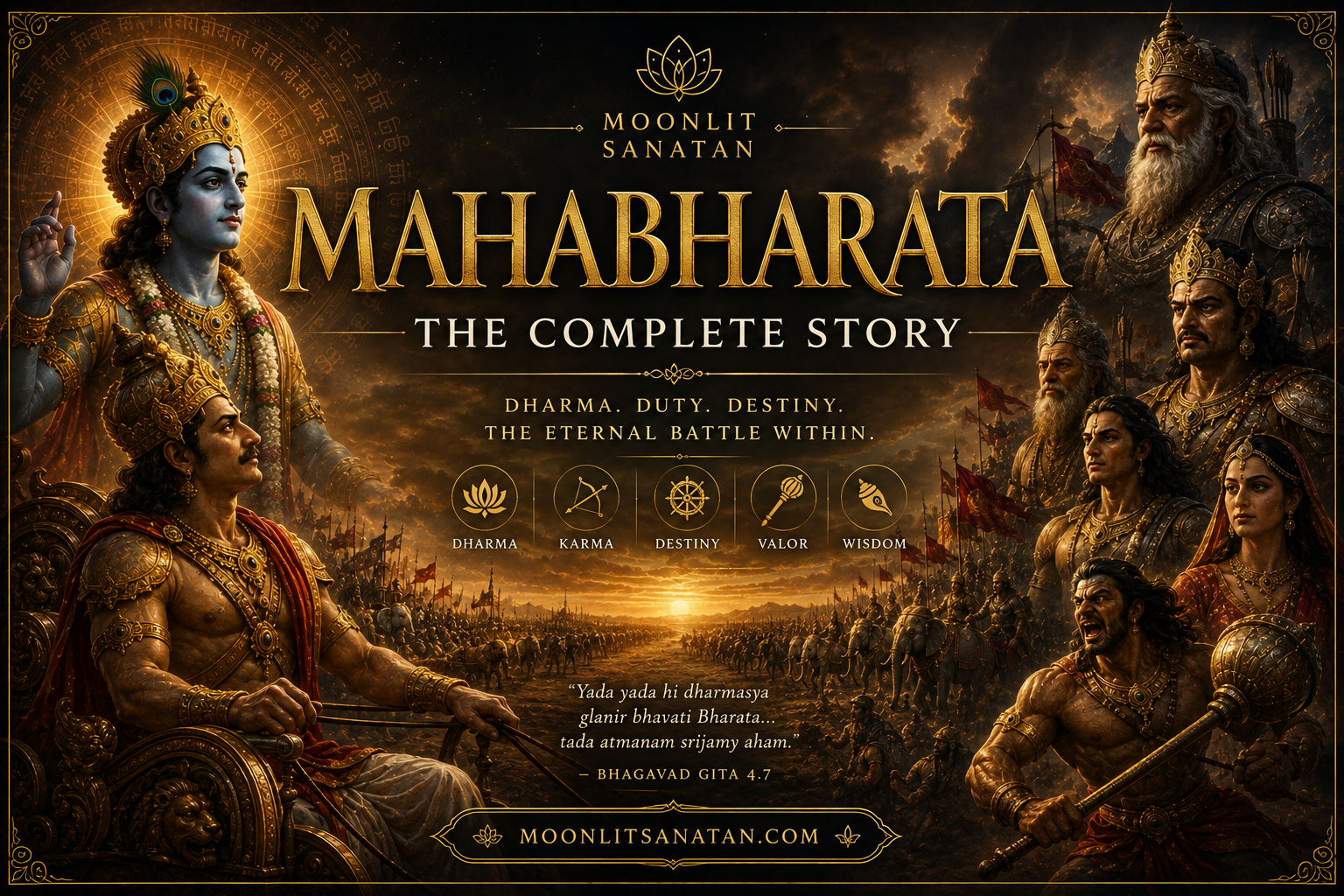
Two armies stand facing each other across the plain of Kurukshetra, ready for a war that has been building for years — betrayals, broken promises, and a rigged game of dice all leading to this single unavoidable morning. And then, at the exact moment it should begin, one of the greatest warriors on either side simply stops. Arjuna lowers his bow, sits down in his chariot, and says he cannot go through with it — not out of fear, but because the people he's about to kill are his own teachers, his cousins, his grandfather.
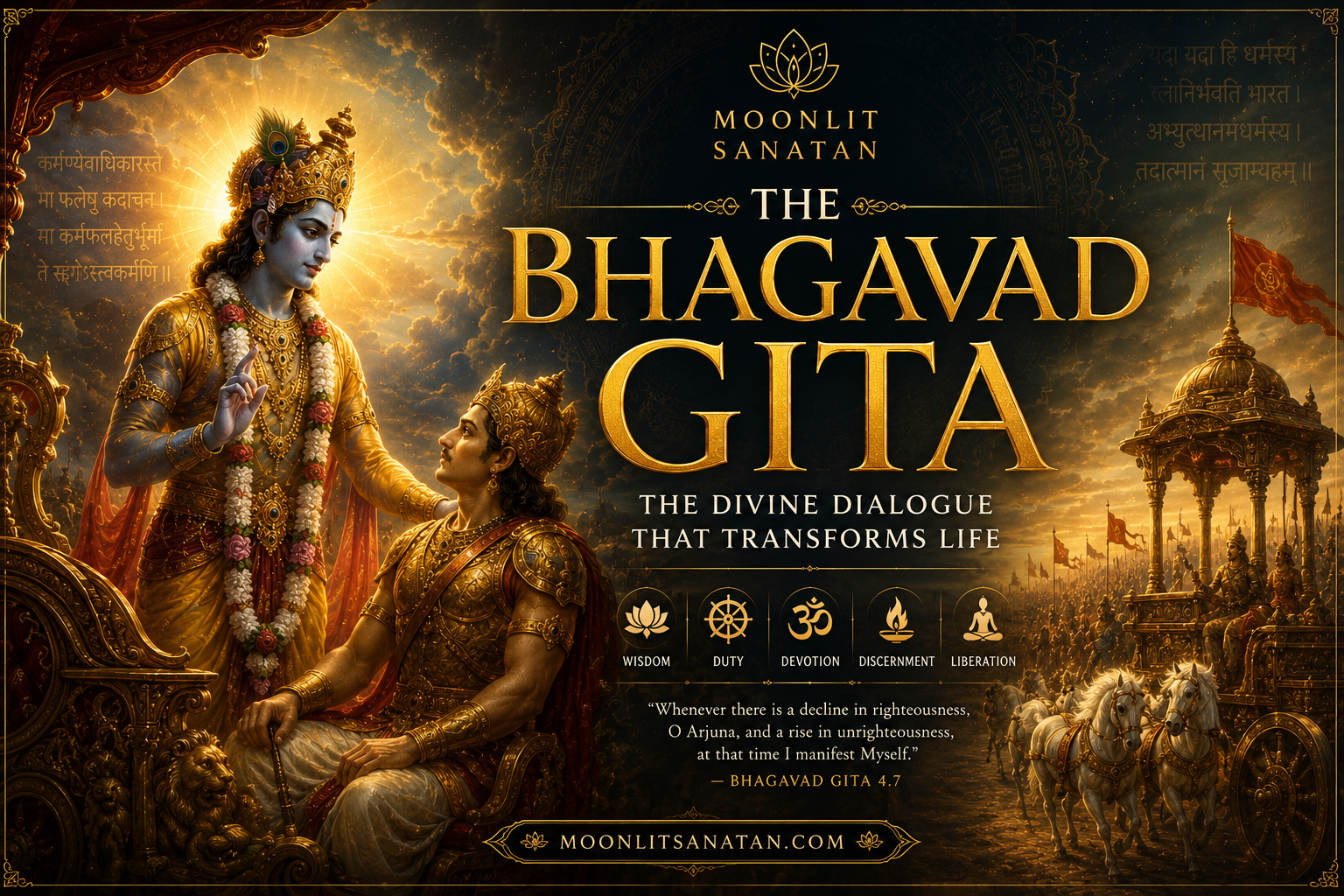
What follows is the Bhagavad Gita — Krishna's response to that exact moment of collapse, delivered not as a battle speech but as a complete philosophical dialogue on duty, the nature of the self, and how to act in a world where every option seems to cause harm. It's one chapter embedded inside a much longer epic, the Mahabharata, and yet it's read today as a complete, self-contained work in its own right — 700 verses across 18 chapters that have shaped Hindu philosophy for over two thousand years and are still studied today by readers with no religious background at all, from philosophy seminars to leadership workshops far removed from any temple.
This guide walks through the full context, a chapter-by-chapter overview, the core teachings in plain language, and where to start if you're reading it for the first time.
The Gita at a Glance
| Detail | Answer |
|---|---|
| What it is | A 700-verse philosophical dialogue between Krishna and the warrior Arjuna |
| Where it sits | Part of the Bhishma Parva, book six of the Mahabharata |
| Setting | The battlefield of Kurukshetra, moments before war begins |
| Structure | 18 chapters, traditionally grouped into three sets of six |
| Core question | How should one act, when every available action seems to cause harm? |
| Central teaching | Act according to duty (dharma), without attachment to the results |
Where the Gita Fits Inside the Mahabharata
The Mahabharata is, at its core, the story of a succession war between two branches of one royal family — the Pandavas and the Kauravas — over the throne of Hastinapura. Years of broken promises, a rigged game of dice that stripped the Pandavas of their kingdom, and a thirteen-year exile have all led to this single, unavoidable war. Arjuna, the greatest archer among the five Pandava brothers, has Krishna himself serving as his charioteer — not fighting directly, but guiding him through the battle as both driver and advisor.
As the two armies assemble, Arjuna asks Krishna to drive his chariot into the middle of the battlefield so he can see who he's about to fight. What he sees stops him cold: grandfather Bhishma, who raised him; his teacher Dronacharya, who trained him in archery; cousins, uncles, and friends, all arrayed on the opposing side. Arjuna's bow slips from his hands. This moment of complete collapse — grief, moral confusion, and paralysis all at once — is where the Gita actually begins.
If you'd like the fuller context of the war this dialogue precedes, our guides to Rama and the Ramayana and Sita's story cover Hinduism's other great epic in similarly full detail, and our Krishna Janmashtami guide covers Krishna's own life and significance beyond this single battlefield dialogue.
Chapter OneArjuna's Crisis: Why He Refuses to Fight
Chapter one, Arjuna Vishada Yoga ("the Yoga of Arjuna's Despair"), lays out his objection in full: what victory could possibly be worth killing the people who raised and taught him? He argues that the destruction of the family and the social order that would follow such a war isn't worth any kingdom, and that he would rather be killed unarmed than fight. It's worth noting how the Gita frames this opening — not as weakness to be dismissed, but as a genuinely serious moral position that deserves a genuinely serious response, which is exactly what the following seventeen chapters provide.
The Three Six-Chapter Sections
Traditional commentary divides the Gita's 18 chapters into three sets of six, each building on a different path (yoga) toward the same underlying goal — freedom from suffering through right understanding and right action.
Chapters 1–6: Karma Yoga
The path of selfless action. Krishna's opening argument to Arjuna: the soul is eternal and cannot truly be killed, so grief over death misunderstands what death actually is. Right action means doing one's duty without attachment to results.
Chapters 7–12: Bhakti Yoga
The path of devotion. Krishna reveals more of his own divine nature, culminating in the Vishwarupa — his overwhelming cosmic form shown to Arjuna in chapter 11 — and explains loving devotion as a direct path to liberation.
Chapters 13–18: Jnana Yoga
The path of knowledge. A deeper philosophical treatment of matter versus spirit, the three gunas (qualities of nature), and a final synthesis of everything discussed, closing with Krishna's request that Arjuna act from conviction rather than blind obedience.
Why Three Paths, Not One
The Gita doesn't insist everyone reach the same understanding through the same method — action, devotion, and knowledge are presented as three valid doors into the same room, suited to different temperaments.
All 18 Chapters, Briefly
| Ch. | Name | Summary |
|---|---|---|
| 1 | Arjuna Vishada Yoga | Arjuna's despair; he refuses to fight |
| 2 | Sankhya Yoga | The immortality of the soul; the core argument begins |
| 3 | Karma Yoga | Why action, performed selflessly, is superior to inaction |
| 4 | Jnana Karma Sanyasa Yoga | Knowledge and the renunciation of attachment to action |
| 5 | Karma Sanyasa Yoga | Reconciling renunciation with active duty |
| 6 | Dhyana Yoga | The practice and discipline of meditation |
| 7 | Jnana Vijnana Yoga | Knowledge and realization of the divine nature |
| 8 | Akshara Brahma Yoga | The imperishable Brahman and what happens at death |
| 9 | Raja Vidya Raja Guhya Yoga | The "royal knowledge" — Krishna's most confidential teaching |
| 10 | Vibhuti Yoga | Krishna's divine glories manifest throughout creation |
| 11 | Vishwarupa Darshana Yoga | Arjuna is shown Krishna's overwhelming universal form |
| 12 | Bhakti Yoga | The path of loving devotion explained directly |
| 13 | Kshetra Kshetrajna Vibhaga Yoga | Distinguishing the body (field) from the soul (knower) |
| 14 | Gunatraya Vibhaga Yoga | The three gunas — sattva, rajas, and tamas — explained |
| 15 | Purushottama Yoga | The Supreme Person, beyond the perishable and imperishable |
| 16 | Daivasura Sampad Vibhaga Yoga | Divine versus demonic tendencies in human nature |
| 17 | Shraddhatraya Vibhaga Yoga | Three types of faith, aligned with the three gunas |
| 18 | Moksha Sanyasa Yoga | Final synthesis; Arjuna resolves to fight, fully convinced |
The Idea the Gita Is Best Known For
If the entire text had to be reduced to a single instruction, most readers and commentators point to the same one: you have a right to your actions, but never to the fruits those actions produce. Act fully, with complete effort and sincerity, but release your attachment to whether the outcome turns out the way you hoped.
This idea — commonly referred to as Nishkama Karma, action without selfish desire for reward — is the philosophical backbone the rest of the text builds on, whether it's discussing devotion, meditation, or the nature of the soul.
Core TeachingThe Soul, the Body, and Why Arjuna's Grief Is "Misplaced"
Krishna's opening philosophical move, in chapter two, is to challenge the very premise of Arjuna's grief: that death is a real loss at all. The Gita describes the soul (atman) as eternal, never born and never truly dying, simply passing from one body to another the way a person changes worn-out clothes for new ones. What Arjuna fears killing — his relatives' physical bodies — was never, in this framework, the actual person to begin with.
This teaching underlies much of the rest of the text's approach to fear, grief, and attachment: if the self that truly matters cannot be destroyed by any weapon, burned by fire, or dried by wind, then most of what causes human suffering is rooted in mistaking the temporary container for the permanent occupant.
Core TeachingThe Vishwarupa: Krishna's Cosmic Form
Chapter 11 contains one of the most striking passages in all of Hindu literature. Arjuna, still not fully convinced by philosophical argument alone, asks Krishna to show him his true divine form. What follows is overwhelming: Krishna reveals himself as the entire universe contained within a single body — countless mouths, eyes, and arms, all of creation and destruction happening simultaneously within him, entire armies being devoured into his blazing form. Arjuna, terrified, begs him to return to his familiar, gentle human appearance.
This vision serves a specific philosophical purpose beyond spectacle: it establishes, experientially rather than just argumentatively, that Krishna isn't merely a wise charioteer offering good advice — he is, within the text's own framework, the totality of existence itself, and everything happening on the battlefield is already unfolding within that totality regardless of what Arjuna personally decides to do.
Core TeachingThree Paths, One Destination
Rather than insisting on a single correct method of practice, the Gita lays out several paths and largely treats them as complementary rather than competing, giving different temperaments a legitimate way in rather than demanding one uniform approach from every reader:
- Karma Yoga — the path of selfless action, performing one's duties without attachment to outcome.
- Bhakti Yoga — the path of loving devotion to the divine, considered by many later commentators the most accessible path for ordinary devotees.
- Jnana Yoga — the path of knowledge and philosophical discernment between the eternal self and the temporary material world.
- Dhyana Yoga — the path of meditation and inner discipline, covered specifically in chapter six.
Different schools of Vedanta have historically emphasized different paths as primary — a point worth knowing if you notice two respected commentaries disagreeing on which path the Gita considers ultimate. The text itself is generally read as making room for all four as legitimate approaches suited to different temperaments, rather than ranking them in strict order.
Who Wrote the Bhagavad Gita, and When?
Traditional attribution credits the sage Vyasa as the author of the entire Mahabharata, the Gita included, with the text itself framed as a conversation Sanjaya — Vyasa's disciple, granted divine sight — relays in real time to the blind king Dhritarashtra from the battlefield, describing the scene as it unfolds verse by verse. This narrative device is why the Gita opens with Dhritarashtra's question and Sanjaya's reply, a framing device easy to miss if you jump straight to Krishna and Arjuna's dialogue.
Modern scholarship generally treats the Gita's composition as a more layered process than a single moment of authorship, with most historians dating its core text to somewhere between the 5th and 2nd centuries BCE, though estimates vary. What's rarely disputed is the text's remarkable internal consistency and structure, which is part of why it functions so well as a standalone philosophical work even when read entirely apart from the rest of the Mahabharata's sprawling narrative.
Clearing ConfusionCommon Misconceptions About the Gita
- "The Gita justifies violence and war." The text is set on a battlefield, but its actual argument centres on the nature of duty and detachment from outcome, not on glorifying combat. Arjuna's war was already unavoidable by the time the dialogue begins — a last, failed peace negotiation is described earlier in the Mahabharata itself — and Krishna's counsel addresses how to act rightly within a situation already in motion, not whether war in general is desirable.
- "It's only relevant to Hindus." While rooted in Hindu philosophy, its treatment of duty, action, and decision-making under moral pressure has made it a text studied in secular philosophy, psychology, and leadership contexts worldwide, independent of religious framing.
- "It teaches blind obedience to duty regardless of consequence." Krishna explicitly asks Arjuna, in the final chapter, to reflect fully on everything discussed and then act according to his own considered judgment — not simply to obey without understanding.
- "There's one single correct interpretation." Major schools of Vedanta — Advaita (non-dualist), Vishishtadvaita (qualified non-dualist), and Dvaita (dualist) — have each produced substantial, respected commentaries on the Gita that reach different philosophical conclusions on the exact nature of the relationship between the soul and the divine, and none is treated as definitively settling the question for all traditions.
Why the Gita Is Read Outside Religious Contexts Too
The Gita's central dilemma — how to act decisively and well when every available choice carries real cost — is general enough that it's studied today in contexts having nothing to do with Hindu religious practice: leadership and management courses, philosophy departments, and psychological literature on decision-making under moral conflict all reference it. Mahatma Gandhi described it as a spiritual dictionary he turned to throughout his life for guidance on how to act during difficult decisions. Its themes of duty, detachment from outcome, and clarity under pressure translate cleanly into secular language, which is a significant part of why it remains one of the most widely translated texts from any tradition, religious or otherwise.
EditionsPopular English Translations and Where to Start
Because the Gita is written in classical Sanskrit verse, virtually every reader outside specialist circles encounters it through translation and commentary rather than the original text directly — and the choice of edition genuinely shapes the reading experience.
- Bhagavad Gita As It Is — A.C. Bhaktivedanta Swami Prabhupada's translation and commentary, published by ISKCON, is one of the most widely circulated English editions worldwide, presented from a devotional Gaudiya Vaishnava perspective with extensive purport (commentary) after each verse.
- Eknath Easwaran's translation — a widely praised, more literary rendering aimed at general readers, with accessible introductory essays for each chapter.
- Swami Sivananda's commentary — a traditional Advaita-leaning interpretation, popular among readers drawn to the non-dualist philosophical reading of the text.
- Bilingual Sanskrit-English editions — for readers who want the original verse alongside a translation, useful for study rather than a single linear read-through.
None of these is the single "correct" version — each reflects a particular tradition's emphasis, and comparing two editions on the same chapter is often more illuminating than reading only one.
Getting StartedHow to Actually Start Reading the Gita
- Read chapter one and two first, slowly, to properly absorb Arjuna's crisis before Krishna's response — skipping ahead to "the good parts" tends to make the philosophy feel disconnected from the problem it's actually solving.
- Choose one translation and stick with it for a full first read-through rather than comparing multiple editions verse-by-verse on your first pass.
- Read a chapter a day rather than the whole text in one sitting — the material rewards slow, repeated reading far more than speed.
- Keep a simple journal of which verses actually land for you on a given day; the Gita is often read multiple times across a lifetime, and different chapters resonate at different life stages.
- Don't skip chapter 11 even if the philosophical chapters feel slower going — the Vishwarupa vision is genuinely one of the most remarkable passages in all of Hindu literature.
Setting Up a Space for Gita Study
Bhagavad Gita As It Is
The widely circulated ISKCON hardbound edition, with full Sanskrit verses, transliteration, and Prabhupada's commentary after each one.
View this edition →Krishna-Arjuna Chariot Idol
A statue depicting Krishna as charioteer beside Arjuna captures the exact battlefield moment the entire Gita springs from.
View a chariot idol →Sanskrit Shloka Framed Print
A framed print of a well-known Gita verse in Sanskrit script makes a striking, contemplative addition to a study or puja room.
View a shloka wall art →Gita Study Journal
A guided daily journal structured around chapter-by-chapter reflection helps turn a single read-through into a sustained practice.
View a study journal →A framed Vishwarupa (cosmic form) art print is a fitting visual companion to chapter 11 specifically, and a proper sandalwood scripture bookstand (rehal) keeps your reading copy off the floor and properly elevated during daily study, in line with traditional practice for handling sacred texts. A dedicated meditation cushion or asana mat also makes a real difference for anyone pairing Gita reading with the meditation practice chapter six specifically describes.
ConnectionsContinue Exploring Krishna and the Epics
The Gita is Krishna's philosophical voice, but his fuller story — birth, childhood in Vrindavan, and the significance of his avatar — is covered in our Krishna Janmashtami 2026 guide. For the Mahabharata's sister epic, our guides to Rama and the Ramayana and Sita's story cover the Ramayana in full, and our Hindu Gods and Goddesses guide places Krishna within Vishnu's wider avatar tradition.
ClosingA Battlefield That Was Never Really the Point
It's worth remembering, after eighteen chapters of philosophy, that the Gita never actually leaves the battlefield. Arjuna doesn't get to retreat to a monastery to work through his crisis in peace — he has to resolve it standing in his chariot, weapons in hand, with an army waiting on his decision. That constraint is arguably the entire point: the Gita isn't a philosophy for quiet contemplation away from consequence, but one built specifically for the moment right before an irreversible decision, when clarity matters more than it ever has.
Most readers who return to it across a lifetime aren't looking for a battlefield of their own. They're looking for that same clarity, applied to whatever chariot they happen to be standing in.
Follow Moonlit Sanatan
Daily puja reminders, temple stories, and festival dates all through the year.
Frequently Asked Questions About the Bhagavad Gita
What is the Bhagavad Gita, in simple terms?
The Bhagavad Gita is a 700-verse philosophical dialogue between Krishna and the warrior Arjuna, set on the battlefield of Kurukshetra just before a war begins. It's part of the larger Mahabharata epic and addresses how to act rightly when duty and personal grief pull in opposite directions.
Why does Arjuna refuse to fight?
Arjuna sees his own relatives, teachers, and grandfather arrayed on the opposing army and is overcome with grief and moral doubt, questioning whether any victory could be worth killing the people who raised and taught him.
What is the main teaching of the Bhagavad Gita?
The most commonly cited core teaching is that one has a right to perform actions, but never a right to the fruits those actions produce — act with full sincerity and effort, without attachment to a specific outcome.
How many chapters and verses does the Gita have?
The Bhagavad Gita has 18 chapters and approximately 700 verses in total, traditionally grouped into three sets of six chapters covering the paths of action, devotion, and knowledge respectively.
What is the Vishwarupa in chapter 11?
The Vishwarupa is Krishna's revelation of his universal cosmic form to Arjuna — a vision containing the entirety of creation and destruction within a single overwhelming body — shown to demonstrate his true divine nature beyond his familiar human appearance.
Is the Bhagavad Gita a separate book from the Mahabharata?
No — the Gita is a section within the Bhishma Parva, the sixth book of the Mahabharata. It's frequently published and read as a standalone text because of its self-contained philosophical structure, but it was originally composed as part of the larger epic.
What is "Bhagavad Gita As It Is"?
Bhagavad Gita As It Is is a widely circulated English translation and commentary by A.C. Bhaktivedanta Swami Prabhupada, founder of ISKCON, presented from a Gaudiya Vaishnava devotional perspective with detailed purport after each verse.
Do I need to be Hindu to read or benefit from the Gita?
No. While it's a foundational Hindu scripture, the Gita is widely read by people of all backgrounds for its philosophical treatment of duty, action, and decision-making under moral conflict, and is studied in secular academic and leadership contexts around the world.
Who is traditionally credited with writing the Bhagavad Gita?
The sage Vyasa is traditionally credited as the author of the entire Mahabharata, including the Gita, with the dialogue itself narrated within the story by Sanjaya, who relays it in real time to the blind king Dhritarashtra using a divinely granted sight.