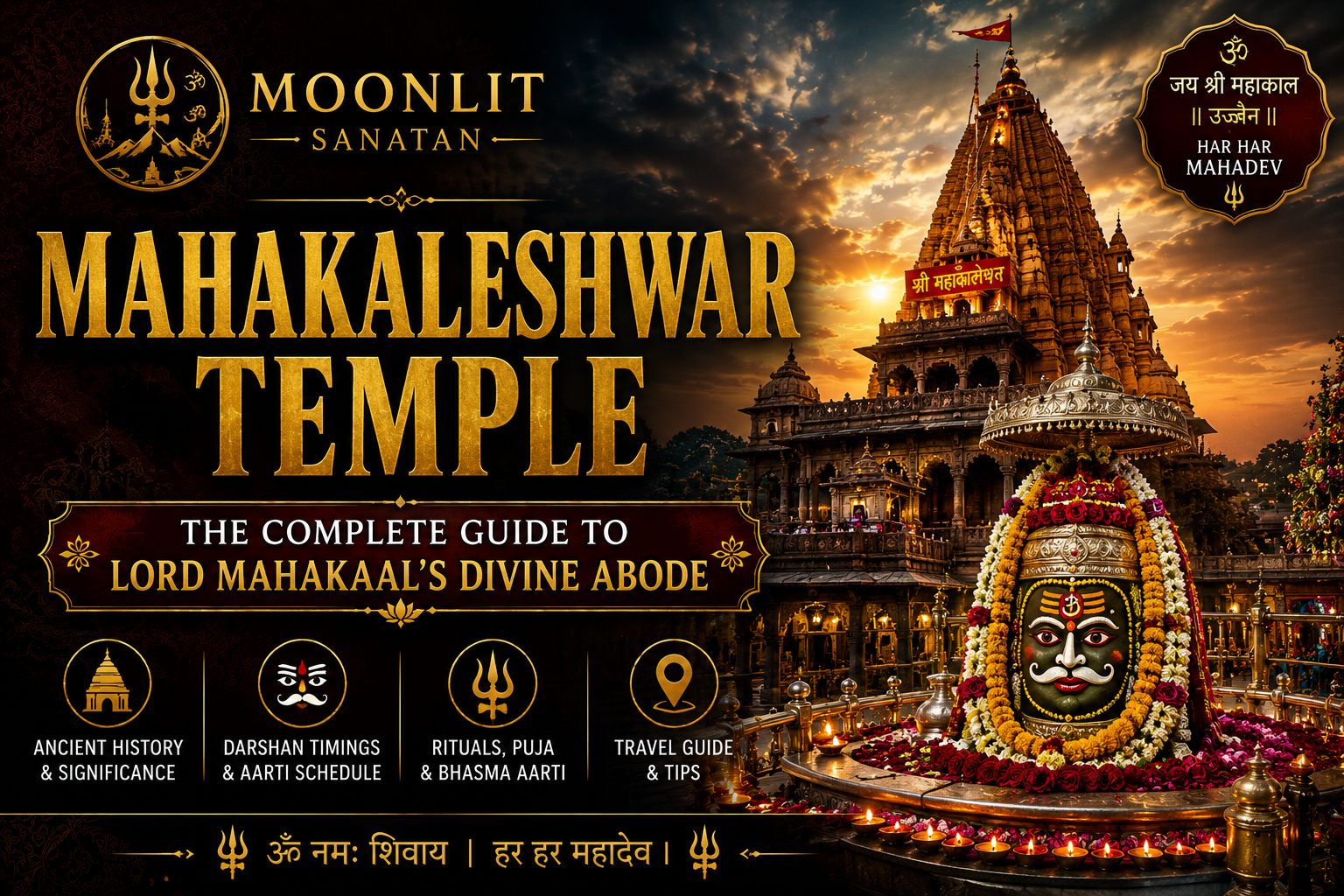
Mahakaleshwar Temple: The Complete Guide to Ujjain's Living Jyotirlinga
History, the Bhasma Aarti, darshan timings, and everything you need to plan a visit to the only south-facing Jyotirlinga of Lord Shiva.
On the western bank of the Shipra River, in the ancient city of Ujjain, stands a temple where Shiva is worshipped not as a distant deity but as Mahakal — the Lord of Time itself. Mahakaleshwar Temple is one of the twelve Jyotirlingas of India, and the only one among them that faces south, a direction associated in Hindu tradition with Yama, the god of death — which is precisely why devotees consider Mahakal the deity who conquers death rather than fears it.
This guide walks you through the temple's origin story, its rituals, the famous pre-dawn Bhasma Aarti, and the practical details — timings, routes, and nearby shrines — you'll need to plan a visit of your own.
Quick Facts
History & Mythology of Mahakaleshwar Jyotirlinga
Ujjain appears in Hindu texts under its older name, Avanti, and the story of Mahakaleshwar is bound up with the city's own legend. According to the Puranas, King Chandrasena, a devout ruler and ardent worshipper of Shiva, once ruled Avanti. A rival army, aided by a demon named Dushan who had been granted the power of invisibility, marched on the city intending to destroy it. Chandrasena's prayers to Shiva were answered directly: the god manifested from the earth in his fierce form as Mahakal, destroyed the invading forces, and — at the pleading of his devotees — chose to remain in Ujjain permanently as a self-manifested (Swayambhu) lingam, so that he could protect the city for all time.
That promise is the reason the temple's energy is described as "living" rather than consecrated once and left still: Mahakal is believed to be actively present, not merely enshrined.
The temple structure itself has been rebuilt more than once. Historical accounts point to a shrine existing here as early as the 6th–8th century, which was later damaged during invasions. The temple you see today, with its layered sanctums, was substantially rebuilt in the 18th century under the Maratha general Ranoji Shinde, and it has been expanded and renovated since — most recently with the large Mahakal Lok corridor project that now welcomes pilgrims into the temple precinct.
Temple Architecture: Three Sanctums, One Axis
Mahakaleshwar is built on three levels, each housing a different form of Shiva, stacked directly above one another:
- Ground level — Mahakaleshwar: the main sanctum, where the Swayambhu lingam is worshipped and where the Bhasma Aarti takes place.
- Middle level — Omkareshwar: a Shiva lingam representing the Omkareshwar Jyotirlinga, generally closed to the public.
- Uppermost level — Nagchandreshwar: a rare idol of Shiva-Parvati seated on a serpent, opened to devotees only once a year, on Nag Panchami.
The temple's shikhara (spire) rises above the sanctum in classic Bhumija style, and the wider complex — expanded through the Mahakal Lok corridor — now includes sculpted pillars depicting scenes from Shiva Purana, ornamental water bodies, and a much larger approach plaza than pilgrims would have walked through even a decade ago.
Location: Which State Is Mahakaleshwar Temple In?
Mahakaleshwar Temple is located in Ujjain, Madhya Pradesh, on the bank of the Shipra River — one of the seven most sacred rivers in Hindu tradition and the site where the Kumbh Mela (locally called Simhastha) is held every twelve years. Ujjain sits roughly 55 km from Indore and about 190 km from Bhopal, the state capital, making it an easy add-on to a Madhya Pradesh itinerary rather than a standalone trip.
Bhasma Aarti & Darshan Timings
The ritual that Mahakaleshwar is best known for is the Bhasma Aarti — a pre-dawn ceremony in which the lingam is bathed and then adorned with sacred ash (bhasma). It's the only Jyotirlinga where this particular ritual is performed, and it's considered a once-in-a-lifetime experience by most pilgrims who attend it. Entry requires advance booking, either online through the official temple portal or in person, since seats are limited and security checks take time.
| Ritual | Timing |
|---|---|
| Temple opens | 4:00 AM |
| Bhasma Aarti | 4:00 AM – 6:00 AM |
| Bhog Aarti | 10:30 AM – 11:15 AM |
| Sandhya (evening) Aarti | 6:30 PM onward |
| Temple closes | 11:00 PM |
Timings can shift slightly during Shravan month, Mahashivratri, and other festivals — always confirm on the official portal before you travel.
Dress Code & Etiquette
- Traditional attire is expected — dhoti for men, saree or salwar-suit for women.
- Photography inside the sanctum is generally not permitted.
- Arrive well before your booked slot; late arrivals can be denied entry even with a confirmed booking.
How to Reach Mahakaleshwar Temple
By Air
The nearest airport is Devi Ahilyabai Holkar Airport in Indore, about 55 km from Ujjain, with regular flights connecting to Delhi, Mumbai, and other major cities. From the airport, taxis and cabs to Ujjain take roughly 1–1.5 hours.
By Train
Ujjain Junction is well connected to major cities across India, including Delhi, Mumbai, Ahmedabad, and Jaipur. The temple is only a short auto-rickshaw or cab ride from the station.
By Road
Ujjain has excellent road connectivity to Indore, Bhopal, and other cities in Madhya Pradesh. State buses and private cabs run frequently, and the drive from Indore takes about 1.5 hours.
Nearby Temples & Places to Visit
Ujjain rewards a slightly longer stay — most of these sites are within a few kilometres of Mahakaleshwar and can comfortably be covered in a day.
Kal Bhairav Temple
Dedicated to Shiva's fierce guardian form; known for the unusual offering of alcohol to the deity.
Ram Ghat, Shipra River
The main ghat for the evening aarti on the Shipra and a key bathing site during the Simhastha Kumbh.
Mangalnath Temple
Believed to be the birthplace of Mars (Mangal) in Hindu astrology; visited by devotees seeking relief from Mangal Dosha.
If your travels take you beyond Madhya Pradesh, you may also want to read our guides to Kamakhya Temple, another site tied to powerful, living forms of Shakti worship, or Vaishno Devi Temple for a Himalayan pilgrimage.
Booking Online Darshan
Because Bhasma Aarti slots are limited, most pilgrims book in advance through the temple's official online portal rather than arriving unannounced. The portal is also where you'll find VIP darshan slots, Garbh Grah (sanctum-proximity) darshan, and any updated timing changes around major festivals. We'd always recommend booking directly through the temple's own website rather than a third party, and double-checking your slot a day or two before you travel.
Continue Your Pilgrimage Reading
Frequently Asked Questions
Which state is Mahakaleshwar Temple in?
Mahakaleshwar Temple is located in Ujjain, in the state of Madhya Pradesh, on the bank of the Shipra River.
What time is the Mahakaleshwar Bhasma Aarti?
The Bhasma Aarti takes place every morning from 4:00 AM to 6:00 AM. It requires advance booking due to limited capacity.
Why is Mahakaleshwar called a Dakshinamukhi Jyotirlinga?
It's the only one of the 12 Jyotirlingas that faces south (Dakshin) — a direction linked with Yama, the god of death — which is why the temple is associated with conquering death rather than fearing it.
What are the other Jyotirlingas near Mahakaleshwar?
The Omkareshwar Jyotirlinga is the closest, located about 140 km from Ujjain on an island in the Narmada River, and is often combined with a Mahakaleshwar visit on the same trip.
Is photography allowed inside the temple?
No, photography is generally not permitted inside the main sanctum, particularly during the Bhasma Aarti.
What is the dress code at Mahakaleshwar Temple?
Traditional Indian attire is expected — dhoti for men and saree or salwar-suit for women — especially for those attending the Bhasma Aarti.
How do I reach Mahakaleshwar Temple from Indore?
Ujjain is about 55 km from Indore, roughly a 1–1.5 hour drive by taxi or bus, and is also the nearest airport to the temple.
Follow Moonlit Sanatan
For more temple guides, festival stories, and Sanatan Dharma content — follow along here.