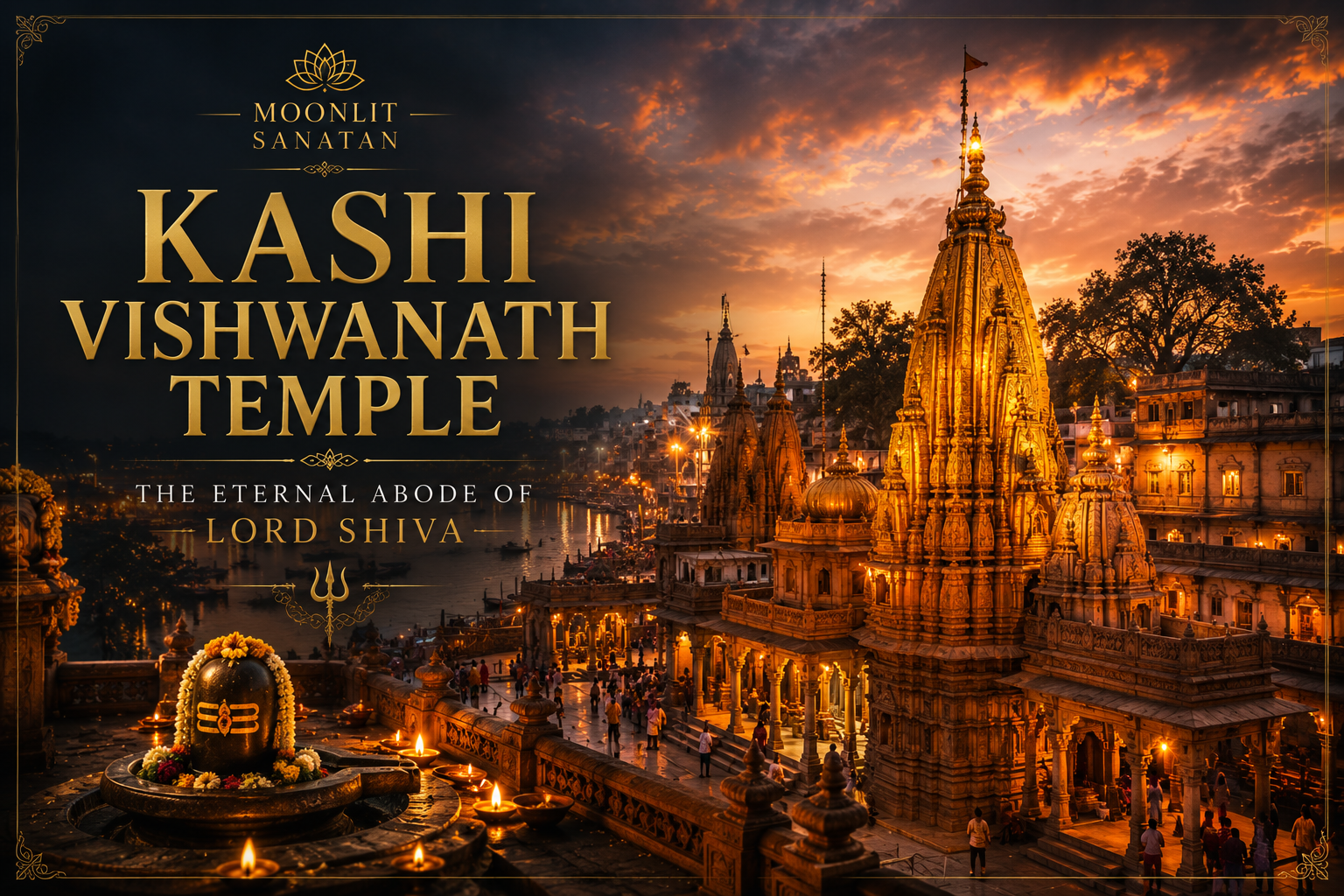
There is a particular kind of stillness that settles over you the moment you step off a boat onto the ghats of Varanasi at dawn — the mist still hanging low over the Ganga, temple bells overlapping with the call of boatmen, and somewhere ahead, glowing faintly gold even in the half-light, the spire of the Kashi Vishwanath Temple. Hindus have called this city Kashi — "the luminous one" — for thousands of years, and this temple is the reason why. It is not simply a temple in Varanasi. For an enormous number of devotees, it is Varanasi, the fixed point around which the entire spiritual geography of the city arranges itself.
This guide covers everything worth knowing about Kashi Vishwanath Temple — its identity as one of Shiva's twelve sacred Jyotirlingas, its extraordinary and painful history of destruction and rebuilding, the transformation brought by the recent Kashi Vishwanath Corridor, and every practical detail you'll need if you're planning your own darshan in Varanasi. Whether you've come here as a devotee, a history enthusiast, or simply someone piecing together a North Indian pilgrimage itinerary, you'll find the complete picture below.
Kashi Vishwanath Temple — Quick Facts
| Deity | Lord Shiva, worshipped here as the Vishweshwara / Vishwanath Jyotirlinga |
| Location | Varanasi (Kashi/Banaras), Uttar Pradesh, on the western bank of the Ganges |
| Significance | One of the 12 Jyotirlingas of Shiva |
| Present structure built | 1780 CE, by Rani Ahilyabai Holkar of Indore |
| Golden spire | Gold plating donated by Maharaja Ranjit Singh in the 1830s |
| Kashi Vishwanath Corridor | Inaugurated December 2021, connecting the temple directly to the Ganga ghats |
| Temple opens | Approx. 2:30 AM |
| Mangala Aarti | 3:00 AM – 4:00 AM (advance booking required) |
| General darshan | 4:00 AM – 11:00 AM and 12:00 PM – 7:00 PM |
| Nearest airport | Lal Bahadur Shastri Airport, Varanasi (approx. 25 km) |
| Nearest railway station | Varanasi Junction / Varanasi Cantt (approx. 5 km) |
What Is a Jyotirlinga? Why Kashi Vishwanath Is One of the 12
To understand why Kashi Vishwanath holds the place it does in Hindu devotion, you have to understand what a Jyotirlinga actually is. The word combines jyoti ("light" or "radiance") with linga (the aniconic form in which Shiva is worshipped). According to the Shiva Purana, these are not ordinary consecrated lingams installed by human hands — they are sites where Shiva is believed to have manifested himself as a column of infinite light, self-formed rather than man-made. There are twelve such sites recognized across India, stretching from Somnath in Gujarat to Rameswaram in Tamil Nadu, and Kashi Vishwanath is counted among the most important of them.
What sets Kashi apart even within this elite group of twelve is its location. Hindu tradition holds Varanasi to be among the oldest continuously inhabited cities on Earth and one of the seven sacred Moksha-puris — cities where dying or being cremated is believed to grant liberation (moksha) from the cycle of rebirth. Devotees often describe Kashi Vishwanath darshan not merely as a blessing, but as an experience so spiritually potent that it is said to cleanse a lifetime's accumulated karma in a single visit. That belief — that light and liberation converge here in a way they do nowhere else — is why this modest-sized temple, tucked into Varanasi's narrow lanes, draws pilgrims in numbers that rival temples many times its physical size.
The Legend of Shiva and Kashi
Beyond its status as a Jyotirlinga, Kashi holds a unique place in Shiva mythology as the god's own chosen city. According to tradition, when Lord Brahma and Lord Vishnu once fell into a dispute over who among them was supreme, a towering column of light suddenly appeared between them, without any visible beginning or end. Both gods set out to find its extent — Brahma flying upward, Vishnu diving down — and neither could locate the source. That infinite column was Shiva himself, revealing his formless, limitless nature, and the sites where this light is said to have touched the earth became the twelve Jyotirlingas, with Kashi Vishwanath among the most revered.
Kashi carries an additional layer of mythology specific to itself: it is described in the Puranas as a city that rests not on ordinary earth but on Shiva's own trident, meaning that even during the dissolution of the universe (pralaya), Kashi is said to remain untouched, protected directly by Shiva. This belief is central to why the city has attracted renunciants, ascetics, and the elderly for millennia — many choose to spend their final years here specifically because of the promise that dying within Kashi's boundaries, under Shiva's direct protection, guarantees liberation regardless of one's past karma. It's a claim unlike almost anything else in Hindu sacred geography, and it's the underlying reason the Kashi Vishwanath Temple carries a gravity that even other Jyotirlinga sites don't quite match.
History & Origins: Destruction, Resilience, and Rebuilding
If Meenakshi Temple's history is a story of dynasties expanding and beautifying, Kashi Vishwanath's history is something rawer — a story of repeated destruction and equally repeated, stubborn reconstruction, spanning nearly a thousand years.
Early Temples and Repeated Destruction
Temples dedicated to Shiva as Vishweshwara are believed to have stood on or near this site for well over a thousand years, referenced in the Skanda Purana and other ancient texts. The historical record of destruction begins in the 12th century: Qutb-ud-din Aibak, a commander under Muhammad of Ghor, destroyed the temple after defeating the Raja of Kannauj in 1194. It was rebuilt by a Gujarati merchant during the reign of Sultan Iltutmish in the early 13th century, only to be demolished again roughly two centuries later, during the rule of either Hussain Shah Sharqi or Sikandar Lodi.
The temple saw a period of restoration under Mughal patronage in the 16th century — first through Raja Man Singh, and then more substantially when Raja Todar Mal rebuilt it at its original site in 1585 with funding from Emperor Akbar. During the reign of Jahangir, Vir Singh Deo of Orchha completed further construction on the temple.
Aurangzeb's Demolition and the Century of Waiting
The most consequential act of destruction came in 1669, when Mughal emperor Aurangzeb ordered the temple demolished. A Persian court chronicle, the Maasir-i-Alamgiri, records the order explicitly. The temple was razed, and the Gyanvapi Mosque was constructed largely from its remains on the same site — a structure that stands adjacent to the present temple to this day. According to long-held local tradition, temple priests managed to save the sacred jyotirlinga itself by hiding it in a nearby well, now known as the Gyanvapi well, before the demolition could reach it.
For nearly a century afterward, the site remained without a proper temple. In 1742, the Maratha chieftain Malhar Rao Holkar attempted to demolish the mosque and rebuild the temple in its place, but was blocked by the Nawab of Awadh, who controlled the region at the time. It would fall to the next generation of his family to finally see the project through.
Ahilyabai Holkar's Reconstruction
In 1777, Rani Ahilyabai Holkar — the widowed queen of the Maratha Holkar dynasty of Indore, and one of the most revered temple-builders in Hindu history — commissioned and funded the construction of the present Kashi Vishwanath Temple, built adjacent to the mosque rather than on its exact former footprint, since that site remained inaccessible. Ahilyabai's reconstruction of Kashi Vishwanath was one of many temple restoration projects she financed across India during her reign, alongside similar work at Somnath and other major Shiva shrines, earning her lasting recognition as a protector of Hindu sacred sites during a turbulent era.
Decades later, in the 1830s, Maharaja Ranjit Singh of the Sikh Empire donated roughly a tonne of gold to plate the temple's domes and spire — the origin of the temple's popular nickname, the "Golden Temple" of Varanasi, and the source of the shimmer visitors notice from the ghats even today.
The Kashi Vishwanath Corridor: The Temple Today
For much of its modern history, reaching Kashi Vishwanath meant navigating a maze of narrow, congested lanes with no direct line of sight between the temple and the Ganga, despite the two sitting barely a few hundred metres apart. That changed dramatically with the Kashi Vishwanath Corridor (also called Kashi Vishwanath Dham), a redevelopment project inaugurated by Prime Minister Narendra Modi in December 2021.
The corridor created a wide, direct pedestrian pathway connecting Lalita Ghat on the Ganga to the temple's main courtyard, spread across a redeveloped area of roughly 5 lakh square feet. It incorporates 24 buildings housing tourist facilitation centres, a Vedic library, a museum, and holding areas designed to manage the enormous crowds the temple draws — particularly important given that the temple complex itself remains relatively compact and had long struggled with pilgrim congestion in its old approach lanes.
Functionally, the corridor means pilgrims can now take a holy dip in the Ganga at Lalita Ghat and walk directly into the temple precinct without threading through the old bazaar lanes — a change that has reshaped the entire pilgrimage experience for the millions who visit each year. For anyone who visited Kashi Vishwanath before 2021 and returns today, the difference in scale, visibility, and ease of movement is often described as the single biggest transformation the temple has seen in generations.
Architecture of Kashi Vishwanath Temple
Unlike the sprawling, gopuram-dominated complexes of South India, Kashi Vishwanath is architecturally modest and intimate — a reflection of the constrained, politically precarious circumstances under which Ahilyabai Holkar was able to rebuild it in the 18th century. The main temple structure is relatively compact, built around a central sanctum where the Vishweshwara Jyotirlinga is enshrined, not at the exact centre of the garbhagriha but slightly toward one corner — a detail architectural historians attribute to the constraints of rebuilding on a tight urban plot adjacent to the mosque.
Its most recognizable external feature is the trio of gold-plated domes and the temple's spire, gleaming above the surrounding rooftops of Varanasi's old city — the gift of Maharaja Ranjit Singh that gave the temple its enduring "Golden Temple" nickname. Inside, the temple historically comprised five mandapas, or pillared halls, each assigned a specific ritual function: the Jnana Mandapa to the east, the Shringar (or Ranga) Mandapa to the west, the Aishwarya Mandapa to the north, and the Mukti Mandapa to the south, with the central Garbhagriha housing the jyotirlinga itself.
What the temple lacks in sheer scale compared to South Indian shrines, it makes up for in atmosphere — the closeness of the sanctum, the near-constant murmur of Vedic chanting, and the proximity of the sacred Ganga just steps away combine into an intensity that visitors consistently describe as unlike any other darshan experience in India. Many first-time visitors, expecting something on the scale of a Meenakshi or Tirupati, are initially surprised by how compact Kashi Vishwanath actually is — and then find that this very intimacy is what makes the darshan feel so immediate and personal.
Religious and Spiritual Significance
Kashi Vishwanath's importance in Hindu theology operates on two levels simultaneously — its status as a Jyotirlinga, and its location within Kashi itself, a city held to be so sacred that dying within its boundaries is traditionally believed to grant moksha regardless of one's accumulated karma. Shiva is said to whisper the Taraka Mantra into the ear of the dying at the moment of death here, guiding the soul directly to liberation — a belief that has made Varanasi one of the primary destinations in India for elderly devotees who choose to spend their final days in the city.
The temple follows a demanding daily ritual schedule built around five aartis, beginning with the pre-dawn Mangala Aarti, when priests ceremonially awaken Lord Vishweshwara, continuing through the midday Bhog Aarti, and culminating with the evening Saptarishi Aarti and the final Shayan Aarti at night, when the deity is ritually put to rest. Many devotees consider the Mangala Aarti, despite requiring advance booking and an arrival time before sunrise, to be the single most spiritually charged moment available at the temple — an intimate, smaller gathering compared to the crowds of daylight hours.
Adjacent to the temple, the Gyanvapi well continues to hold deep symbolic weight for devotees, tied to the tradition that the original jyotirlinga was hidden there during Aurangzeb's demolition — a living reminder, for many pilgrims, of the temple's centuries-long endurance.
Location and How to Reach Kashi Vishwanath Temple
Kashi Vishwanath Temple sits in the heart of Varanasi's old city, Uttar Pradesh, on the western bank of the Ganges, within the dense lane network known as Vishwanath Gali, now directly linked to the river via the Kashi Vishwanath Corridor.
By Air
Lal Bahadur Shastri International Airport is Varanasi's main airport, located roughly 25 km from the temple, with regular domestic flights from Delhi, Mumbai, Bengaluru, and other major Indian cities, along with a small number of international connections.
By Rail
Varanasi Junction (also called Varanasi Cantt) is the city's primary railway station, about 5 km from the temple, and one of the best-connected stations in North India, with direct trains from nearly every major Indian city.
By Road
Varanasi is well connected by national highways to Lucknow, Prayagraj (Allahabad), Patna, and other major North Indian cities. Vehicles cannot enter the narrow Vishwanath Gali itself — autos and taxis typically drop visitors at Godaulia crossing, from where it's a walk of about 10–15 minutes through the old city lanes, or a short ride via the corridor entrance if arriving from the ghats.
Kashi Vishwanath Darshan Timings and Aarti Schedule
The temple runs on an unusually early and demanding ritual clock compared to most Indian temples — a detail every first-time visitor should plan around:
- Temple opens: Approximately 2:30 AM
- Mangala Aarti: 3:00 AM – 4:00 AM (advance booking required, limited spots)
- General morning darshan: 4:00 AM – 11:00 AM
- Bhog Aarti: 11:15 AM – 12:20 PM
- General evening darshan: 12:00 PM – 7:00 PM
- Saptarishi (Sandhya) Aarti: 7:00 PM – 8:15 PM
- Shringar Aarti: 9:00 PM – 10:15 PM
- Shayan Aarti: 10:30 PM – 11:00 PM (temple closes shortly after)
General darshan is free, though the temple trust also offers paid options such as Sugam Darshan (faster queue access) and Sparsh Darshan (which permits devotees to touch the jyotirlinga directly), bookable through the official temple portal. Given how early and ritual-driven the schedule is, it's worth deciding in advance whether you're prioritizing the pre-dawn Mangala Aarti's intimacy or the more visually dramatic evening Saptarishi Aarti — trying to fit both into one day, especially as a first-time visitor, can be genuinely exhausting.
Best Time to Visit Kashi Vishwanath Temple
The most comfortable window to visit Varanasi is between October and March, when temperatures sit in a manageable 10–25°C range. Summers here are severe — April through June regularly sees daytime temperatures above 40°C, made worse by the humidity rising off the Ganges, which can make the early-morning temple queues genuinely difficult to endure. Winter mornings, by contrast, bring a thick, atmospheric mist off the river that many photographers and pilgrims alike consider the most beautiful time to witness the ghats.
If your travel dates are flexible, timing a visit around Maha Shivaratri (typically February or March) delivers an experience unlike any other day of the year — but be prepared for exceptional crowds and extended queue times, since this is by far the temple's busiest single day.
Visitor Guidelines and Dress Code
- Dress modestly — shoulders and knees covered is the general expectation for both men and women.
- Mobile phones, cameras, bags, and any leather items are strictly prohibited inside the temple; free cloakrooms are available near the main entrance.
- Footwear must be removed before entering; paid shoe-storage stands are available just outside.
- Arrive at least 30–45 minutes before your chosen aarti slot, since queues move slowly and space is limited.
- Carrying a valid photo ID is advisable, particularly for foreign visitors, as verification is sometimes required at ticketed darshan counters.
Festivals Celebrated at Kashi Vishwanath Temple
Maha Shivaratri
This is unquestionably the temple's biggest day of the year — an all-night vigil of prayer, fasting, and continuous darshan that draws devotees from across India, with the temple often keeping its doors open through the night to accommodate the sheer volume of pilgrims.
Dev Deepawali
Celebrated on the full moon of Kartik (usually November), this festival transforms the entire riverfront into a sea of lit oil lamps along all of Varanasi's ghats — one of the most visually breathtaking events in the city's religious calendar, often paired with special temple illuminations.
Shravan Month Observances
Throughout the Hindu month of Shravan (typically July–August), Kashi Vishwanath sees a sustained surge in daily pilgrim numbers, as devotees observe fasts and make special offerings of Ganga water — sourced from the river itself — directly onto the jyotirlinga, a ritual known as Kanwar Yatra that culminates in mass processions toward Shiva temples across North India.
Annakut and Diwali
Following Diwali, the temple participates in the Annakut festival, where an enormous offering of food is prepared and presented to the deity, later distributed among devotees as prasad.
Nearby Attractions and Suggested Itinerary
Because Kashi Vishwanath sits inside Varanasi's dense old city, most of the experiences worth having in Varanasi are within easy walking or boating distance of the temple, making it simple to combine your darshan with a broader day (or two) of exploring the ghats.
Dashashwamedh Ghat and the Ganga Aarti
A short walk from the temple, this is Varanasi's main ghat and the site of the spectacular evening Ganga Aarti — a synchronized fire-and-chant ceremony performed by a line of priests each evening, watched by crowds both from the ghat steps and from boats floating on the river itself.
Kaal Bhairav Temple
Dedicated to Kaal Bhairava, considered the fierce guardian deity of Kashi, tradition holds that no pilgrimage to Kashi Vishwanath is fully complete without first seeking this temple's blessings, since Bhairava is regarded as the one who grants permission to enter the sacred city.
Sarnath
About 10 km from the temple, Sarnath is where the Buddha is believed to have delivered his first sermon after attaining enlightenment, and now houses the Dhamek Stupa and an archaeological museum — a compelling contrast to Varanasi's Hindu religious core.
Suggested One-Day Itinerary
- 4:00 AM – 5:30 AM: Boat ride on the Ganga to watch sunrise over the ghats, followed by a holy dip
- 6:00 AM – 8:00 AM: Morning darshan at Kashi Vishwanath Temple via the corridor
- 8:30 AM – 10:00 AM: Breakfast and a walk through the old city lanes around Vishwanath Gali
- 10:30 AM – 12:00 PM: Visit Kaal Bhairav Temple
- 1:00 PM – 3:00 PM: Rest, or a half-day excursion to Sarnath
- 6:30 PM – 8:00 PM: Evening Ganga Aarti at Dashashwamedh Ghat
Shop Your Kashi Yatra Essentials
As an Amazon Associate, Moonlit Sanatan earns from qualifying purchases. This helps support the free guides we publish here.
Original Rudraksha Mala
A 108-bead Rudraksha mala for japa and daily Shiva worship — many pilgrims pick one up as a keepsake of their Kashi darshan.
Check PriceBrass Shiva Lingam Idol
A hand-finished brass lingam for your home altar, ideal for daily abhishekam rituals.
Check PriceCotton Dhoti / Kurta Set
Breathable traditional cotton wear that keeps you comfortable and dress-code-ready through long temple queues.
Check PriceBrass Puja Thali Set
A complete diya, kalash, and incense-holder set for performing your own Shiva puja at home after your trip.
Check PriceCompact Travel Backpack
A lightweight anti-theft daypack, useful for navigating Varanasi's crowded ghats and narrow temple lanes hands-free.
Check PriceShiva Purana (English Translation)
A readable translation of the Shiva Purana, including the Jyotirlinga legends referenced throughout this guide.
Check PriceCotton Stole / Dupatta
A simple stole to cover shoulders inside the temple — light enough for Varanasi's weather, easy to carry in a small bag.
Check PriceFrequently Asked Questions About Kashi Vishwanath Temple
Who built Kashi Vishwanath Temple?
The present structure was built in 1780 CE (with construction sponsored from 1777) by Rani Ahilyabai Holkar of the Maratha Holkar dynasty, after the earlier temple was demolished by Mughal emperor Aurangzeb in 1669. The temple's gold-plated domes were later added by Maharaja Ranjit Singh in the 1830s.
Why is Kashi Vishwanath Temple called the Golden Temple?
The nickname comes from the roughly one tonne of gold that Maharaja Ranjit Singh of the Sikh Empire donated to plate the temple's domes and spire in the 1830s, giving it the distinctive golden glow visible across Varanasi's skyline.
What is the Kashi Vishwanath Corridor?
Inaugurated in December 2021, the Kashi Vishwanath Corridor is a redeveloped pedestrian pathway that directly connects the Ganga's Lalita Ghat to the temple's main courtyard, replacing the old, congested lane network and significantly easing pilgrim movement.
What are the darshan timings at Kashi Vishwanath Temple?
The temple opens around 2:30 AM, with general free darshan available from 4:00 AM to 11:00 AM and again from 12:00 PM to 7:00 PM. Several aartis, including the pre-dawn Mangala Aarti, require advance booking.
Why is Kashi Vishwanath significant among the 12 Jyotirlingas?
Kashi Vishwanath is considered one of the most important of the twelve Jyotirlingas partly because of its location within Varanasi, a city held to be so sacred in Hindu tradition that dying there is believed to grant liberation (moksha) from the cycle of rebirth.
Can non-Hindus visit Kashi Vishwanath Temple?
Access to the inner sanctum is generally reserved for Hindu devotees, a policy in place at many major North Indian temples given the site's sensitive location adjacent to the Gyanvapi Mosque. Visitors should check current entry rules before planning a visit, as they can change.
Continue Exploring Sacred India
Final Thoughts
Few temples anywhere in the world carry a history as relentless as Kashi Vishwanath's — demolished by invading armies not once but repeatedly across a thousand years, and rebuilt, again and again, by devotees and rulers who refused to let it disappear. That resilience is, in a real sense, the whole point of the place. Standing in the queue before dawn, watching the temple's golden spire catch the first light while the Ganga moves quietly a few hundred metres away, it's hard not to feel the weight of everyone who has stood in roughly that same spot across the centuries, in far more uncertain times than these, simply to be here.
Whether you come seeking the specific liberation Kashi is believed to offer, or simply to witness one of Hinduism's most storied and enduring shrines, Kashi Vishwanath rewards visitors who slow down enough to actually take it in — the ritual rhythm of the aartis, the closeness of the sanctum, the sense of a city built entirely around this single, luminous point. Come once, and it's easy to understand why so many devotees find themselves planning a return trip before they've even left.