Festivals & Their Stories
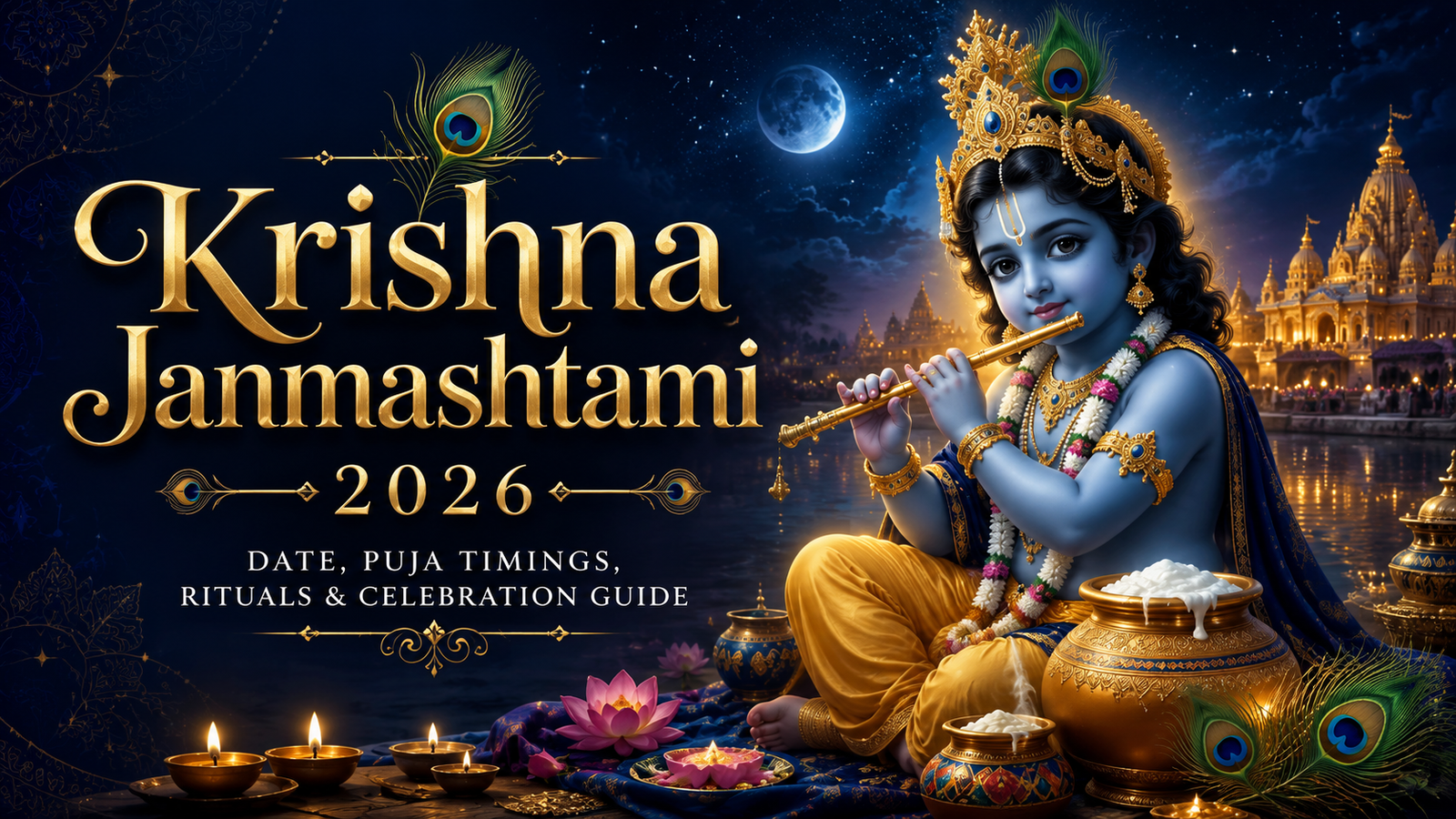
Krishna Janmashtami 2026: Date, Nishita Puja Muhurat & Full Story
Why the same festival falls on two different nights this year, and what happens at the exact moment of midnight
A prison cell. A storm outside heavy enough to make guards fall asleep at their posts. A river swollen past its banks, parting just enough for one man to cross with a newborn balanced in a basket over his head. This is not the gentle opening most festivals get. Janmashtami begins in captivity, in the middle of the night, with a father risking everything to save a child prophecy said would end a tyrant's rule.
That child was Krishna — the eighth avatar of Vishnu, and arguably the most beloved figure in the entire Hindu pantheon, celebrated as much for his mischief and flute-song as for his role steering the Mahabharata's war and delivering the Bhagavad Gita. Krishna Janmashtami marks the night of his birth, and it remains one of the most widely observed festivals across the Hindu world — from a quiet home altar with a small clay idol, to the human-pyramid chaos of Dahi Handi on the streets of Mumbai, to the candlelit midnight arati at ISKCON temples on every continent.
2026 brings a genuine two-date year, which trips up more people than almost any other festival timing question. Here's the exact date for your tradition, the midnight muhurat, the birth story in full, the fasting rules, and how the celebration changes depending on which part of India — or the world — you're in.
Krishna Janmashtami 2026 — Quick Answer
Friday, 4 September (Smarta) / Saturday, 5 September (ISKCON & Vaishnava)
Nishita Kaal Puja: approx. 11:57 PM (4 Sept) – 12:43 AM (5 Sept)
| Detail | Timing |
|---|---|
| Ashtami Tithi begins | 4 September 2026, approx. 10:48 AM |
| Ashtami Tithi ends | 5 September 2026, approx. 11:23 AM |
| Nishita Kaal Puja window | 11:57 PM (4th) – 12:43 AM (5th), roughly 45 minutes |
| Smarta / household observance | Friday, 4 September |
| ISKCON / Vaishnava observance | Saturday, 5 September |
| Parana (fast-breaking time) | After Ashtami ends, morning of 5 September |
| Dahi Handi (Maharashtra) | Saturday, 5 September |
If your family doesn't follow a specific sampradaya, 4 September is the safer default — it's what most Hindu households and general panchangs list as the primary date. If you attend an ISKCON temple or follow a Gaudiya Vaishnava tradition, plan around 5 September instead. Exact minute-level timings shift slightly by city, so cross-check your local panchang close to the date.
The Birth Story: A Prophecy, a Prison, and a River Crossing
The story begins not with Krishna but with his mother's brother — the tyrant king Kansa of Mathura. A celestial voice at his sister Devaki's wedding warned Kansa that her eighth child would be the one to end his life. Terrified, Kansa imprisoned Devaki and her husband Vasudeva, killing each child at birth until six were gone. The seventh was mystically transferred to another womb, surviving as Balarama, Krishna's elder brother. The eighth was Krishna himself.
He was born at midnight, in the depths of Kansa's prison, during a violent storm. As the legend goes, the prison guards fell into an unnatural sleep, the iron chains binding Vasudeva loosened on their own, and the cell doors swung open. Vasudeva understood immediately what needed to happen: the child had to be carried out of Mathura to safety before Kansa learned he had survived.
On the far bank, in the village of Gokul, Vasudeva exchanged the baby for a newborn daughter born that same night to Nanda and Yashoda, a cowherd couple. He carried the girl back to the prison cell; by the time Kansa arrived to kill the eighth child, only an infant girl remained — who, in most tellings, transformed into the goddess Yogamaya and vanished into the sky, warning Kansa that his true nemesis was already safe, growing up elsewhere. Krishna spent his childhood in Gokul and Vrindavan under Nanda and Yashoda's care, far from Mathura, until he was old enough to return and fulfil the prophecy that had shaped his entire birth.
This river-crossing scene is the single most re-enacted moment of the entire festival — every midnight abhishekam, every cradle rocked at a home altar, is a small echo of Yashoda receiving a child that wasn't originally hers, and loving him completely anyway.
If Krishna's later role in the Mahabharata and the Bhagavad Gita interests you, our Epic Tales section covers his part in the great war in more depth, and our Hindu Gods & Goddesses category traces his journey from Vrindavan's cowherd prince to the Gita's charioteer-philosopher.
MythologyGrowing Up in Vrindavan: The Butter Thief
The Krishna most people picture first isn't the newborn from the prison story — it's the mischievous toddler of Vrindavan, forever stealing butter from neighbours' homes, tying up gopis' clothes while they bathed in the river, and charming an entire village into forgiving him for it within minutes. Yashoda is said to have once tied him to a grinding mortar to keep him out of trouble, only for young Krishna to drag it between two trees and uproot them both, freeing two cursed celestial beings trapped inside in the process.
These childhood stories aren't treated as filler between the birth and the Mahabharata — they're central to why Krishna is worshipped the way he is. Unlike most deity-avatars, who are approached with formal awe, Krishna is worshipped with a kind of affectionate familiarity — as a child to be fed, dressed, and delighted in, which is exactly what the Laddu Gopal ritual tradition re-creates every single day in millions of homes, not just on Janmashtami.
The famous Dahi Handi tradition, discussed further below, is a direct, physical re-enactment of this exact period — young men forming human towers specifically to recreate the butter-stealing mischief that defines Krishna's Vrindavan years.
ExplainerWhy Janmashtami Falls on Two Different Dates in 2026
This is the single most common point of confusion every year, and 2026 is a textbook case of it. The disagreement comes down to which calendrical rule a tradition prioritizes when the Ashtami Tithi and Rohini Nakshatra don't sit neatly within one calendar day — a mismatch that happens most years to some degree, but is unusually pronounced for 2026, which is why you'll see the date debated more heatedly than usual on panchang forums and temple noticeboards this year.
Smarta Sampradaya (most households)
Smarta tradition gives priority to whichever day the Ashtami Tithi is active during Nishita Kaal — Hindu midnight. In 2026, Ashtami is in force during the night of 4–5 September, which is why most general households and panchangs list Friday, 4 September as the date.
Vaishnava Sampradaya, including ISKCON
Vaishnava tradition — particularly Gaudiya Vaishnavism, which ISKCON follows — places greater weight on the Udaya Tithi rule and on Rohini Nakshatra aligning with Ashtami at sunrise. That calculation points to Saturday, 5 September for ISKCON temples and Vaishnava households.
Neither date is "wrong" — both are internally consistent within their own tradition's rules, and both trace back to genuinely ancient calendrical texts rather than any modern disagreement. If your family has always celebrated on a particular date, that local practice should take precedence over either explanation above; when in doubt, ask your family temple which convention they follow, since local priests will already have resolved the calculation for your specific city and community.
Nishita Kaal: The Midnight Puja, Explained
Because Krishna was born at midnight, the primary puja of Janmashtami is deliberately held at midnight too — the Nishita Kaal, a roughly 45-minute window centred on the exact tithi-verified moment of "birth." This isn't treated as a symbolic nod to the timing; devotees consider this window the closest a puja can come to witnessing the birth itself.
At the stroke of midnight, a small idol of infant Krishna — often called Laddu Gopal or Bal Gopal — is ceremonially bathed (abhishekam) in milk, curd, honey, ghee, and Ganga jal, dressed in fresh clothes, placed in a decorated cradle, and gently rocked while devotional songs and bhajans are sung. Conch shells and bells sound at the exact moment considered the birth instant, and many households and temples distribute prasad immediately after.
Vrat RulesJanmashtami Fasting Rules
The Janmashtami vrat runs from the morning of the festival day until after the Nishita Kaal puja, and traditionally isn't broken until the following morning once Ashtami Tithi has passed. Many devotees describe this as one of the more demanding fasts on the calendar precisely because the wait extends past midnight rather than ending at sunset like most single-day vrats — the reward, tradition holds, is that the puja performed at the tail end of a genuine fast carries considerably more weight than one performed casually.
Foods Generally Allowed (Phalahar)
- Fresh fruits — bananas, apples, and other seasonal fruit
- Milk, curd, butter, and other dairy products
- Sabudana (tapioca pearls) and singhare (water chestnut) flour preparations
- Dry fruits and nuts
- Rock salt (sendha namak) instead of regular table salt
What to Avoid
- All grains, including wheat and rice
- Onion, garlic, and other tamasic ingredients
- Non-vegetarian food and alcohol
- Eating a full meal before the midnight puja is completed
Parana — breaking the fast — is traditionally done the next morning after sunrise, once Ashtami Tithi has ended. Devotees who find a full two-day observance difficult are permitted, per Dharmasindhu tradition, to break the fast the morning after the main puja instead.
Why Krishna Is Called the "Purna Avatar"
Among Vishnu's ten principal avatars, Krishna holds a distinct title: Purna Avatar, the complete or full incarnation. Where other avatars like Rama or Narasimha are generally understood to embody a specific divine quality or a particular mission, Krishna is considered to have manifested with the full range of divine attributes simultaneously — warrior, philosopher, lover, statesman, mischievous child, and detached yogi, often within the same narrative arc.
This completeness is part of why Krishna's teachings carry such weight beyond his own devotees. The Bhagavad Gita, delivered on the Kurukshetra battlefield as counsel to a paralyzed Arjuna, is studied as philosophy, ethics, and leadership literature well outside strictly religious contexts — a text born from a single conversation inside the same figure whose infancy is re-enacted every Janmashtami midnight. Few festivals ask devotees to hold both ends of a life story quite this wide: a father risking his life to cross a flooded river with a newborn, and, decades later, a charioteer calmly walking a warrior through the nature of duty and the soul.
EtiquetteCommon Mistakes to Avoid on Janmashtami
- Confusing the Smarta and ISKCON dates — check which tradition your family or temple follows before the week arrives, rather than assuming a single universal date.
- Eating a heavy meal before the midnight puja — the fast is meant to hold through the abhishekam; a full meal beforehand is generally considered to break the sankalp early.
- Rushing the abhishekam — the milk-curd-honey-ghee sequence is meant to be unhurried; treating it as a quick formality misses the point of the ritual re-enactment.
- Forgetting panjiri or makhan-mishri as prasad — generic sweets can substitute in a pinch, but these two are the traditional, festival-specific offerings most closely tied to Krishna's own childhood.
- Skipping the Gita reading the next morning — many households treat the midnight puja as the whole festival and skip the closing reading, even though it's traditionally considered part of the same observance.
Celebrating Janmashtami Outside India
For Hindu families living abroad, Janmashtami has become one of the more visible festivals on the international calendar, largely thanks to ISKCON's global temple network. Major temples in London, Los Angeles, Moscow, and Durban regularly draw crowds well beyond the local Hindu community for the midnight abhishekam, kirtan, and Bhagavad Gita discourses that run through the celebration. Many diaspora households without easy access to a temple recreate a simplified version of the ritual at home — a small Laddu Gopal idol, a modest cradle, and a midnight video call with family back in India timed to the Nishita Kaal window has become a common adaptation for the occasion.
Home PujaStep-by-Step Janmashtami Puja Vidhi for Home
- Clean and decorate your puja space in the days before, ideally with a small jhula (swing) as the centrepiece. A well-made decorative wooden or brass Krishna jhula becomes a piece households reuse every year rather than rebuild from scratch.
- Place your Bal Gopal idol at the centre of the altar. If you're setting up a home shrine for the first time, a small brass or marble Laddu Gopal idol is the traditional starting point most families build the rest of the ritual around.
- Take your Sankalp (vow) in the morning, committing to the day's fast and puja with clear intention.
- Dress the idol in fresh clothing ahead of midnight — a well-stitched Laddu Gopal vastra set, sized correctly for your idol, along with a small crown and mor pankh, is worth keeping specifically for this festival.
- At Nishita Kaal, perform the abhishekam — bathe the idol in milk, curd, honey, ghee, and water, each poured in turn while chanting Krishna's names.
- Dress and adorn the idol with the fresh vastra, a peacock feather crown and small decorative flute, and place it gently in the jhula.
- Offer prasad — traditionally makhan-mishri (butter and rock sugar) and panjiri, a roasted-flour and dry-fruit sweet specific to this festival. A ready dhaniya panjiri prasad ingredient kit saves last-minute midnight prep.
- Sing bhajans and rock the cradle gently while conch shells and bells mark the birth moment, then perform aarti.
- Read or recite from the Bhagavad Gita the following morning as part of the closing ritual — many households keep a compact illustrated Bhagavad Gita specifically for festival readings through the year.
How Janmashtami Is Celebrated Across India
- Mathura & Vrindavan: the epicentre of the festival, where temples like Krishna Janmabhoomi and Banke Bihari hold multi-day celebrations, Ras Leela performances re-enacting Krishna's childhood, and midnight crowds that stretch for hours before Nishita Kaal.
- Maharashtra & Gujarat — Dahi Handi: the day after Janmashtami, young men form human pyramids to break a pot of curd and butter hung high above the street, re-enacting young Krishna's mischief of stealing butter from village homes. In 2026, Dahi Handi falls on 5 September.
- Manipur — Ras Leela tradition: Manipuri Vaishnavism has developed its own classical dance form built almost entirely around Krishna's Ras Leela, performed with striking costume and choreography specific to the region.
- Odisha & Puri: celebrations connect closely to the Jagannath tradition, since Jagannath is worshipped as a form of Krishna, adding a distinct regional devotional layer to the festival.
- ISKCON temples worldwide: from London to Los Angeles to Moscow, ISKCON's global temple network holds some of the largest non-Indian Janmashtami celebrations anywhere, often drawing significant non-Hindu attendance for the midnight abhishekam and kirtan.
- South India — Krishna Jayanthi: in Tamil Nadu, Andhra Pradesh, Telangana, and Karnataka, homes mark the day with intricate rice-flour footprint patterns (Krishna's tiny footsteps) drawn from the doorstep to the puja room, symbolizing the infant god walking into the household.
Building or Refreshing a Laddu Gopal Altar for 2026
Unlike festivals centred on a single day's puja, Janmashtami is one of the few occasions where households actively invest in items meant to be reused every year rather than consumed once. A few directions worth considering if you're building out a home altar this year:
Laddu Gopal Idol
A brass or marble Bal Gopal idol, correctly proportioned for your altar space, forms the anchor every other item in this list is built around.
View a Laddu Gopal idol →Decorative Jhula (Cradle)
A wooden or brass swing sized to your idol becomes the visual centrepiece of the midnight puja, and stores easily for next year.
View a decorative jhula →Laddu Gopal Vastra Set
A well-stitched outfit with matching crown gives the idol a fresh look for the festival — sized sets are available for most standard idol heights.
View vastra sets →Illustrated Bhagavad Gita
A clear, well-translated edition is worth keeping specifically for Janmashtami morning readings and year-round reference.
View a Bhagavad Gita edition →A tulsi mala is also worth having on hand for the puja itself — tulsi is considered especially dear to Krishna, and offering or wearing one during Janmashtami worship is a common practice across most regional traditions.
Janmashtami and the Festival Calendar Around It
Janmashtami lands just about a week after Raksha Bandhan closes out the Sawan month, making late August into early September one of the densest devotional stretches on the entire Hindu calendar. If you've just finished the rakhi ceremony, our Raksha Bandhan 2026 guide covers the date and rituals in full, and our Sawan 2026 guide traces the entire month leading up to it.
FAQFrequently Asked Questions About Janmashtami 2026
What is the correct date for Janmashtami 2026?
Most households following Smarta tradition observe it on Friday, 4 September 2026. ISKCON and Vaishnava temples observe it on Saturday, 5 September, based on a different calendrical rule. If unsure, 4 September is the more commonly listed default date.
What time is the Nishita Kaal puja in 2026?
Approximately 11:57 PM on 4 September to 12:43 AM on 5 September — a window of roughly 45 minutes centred on midnight. Exact minute-level timing shifts slightly by city.
Why do some sources list two different dates?
Smarta tradition prioritizes the day Ashtami Tithi is active at Nishita Kaal (midnight), pointing to 4 September in 2026. Vaishnava and ISKCON tradition prioritizes Ashtami aligning with Rohini Nakshatra at sunrise, pointing to 5 September. Both are valid within their own frameworks.
When is Dahi Handi 2026?
Dahi Handi, the human-pyramid pot-breaking tradition popular in Maharashtra and Gujarat, falls on Saturday, 5 September 2026, the day after the main Smarta observance.
What can be eaten during the Janmashtami fast?
Most devotees stick to fruits, milk and dairy, sabudana, singhare flour preparations, dry fruits, and rock salt, while avoiding all grains, onion, garlic, and non-vegetarian food until the fast is broken the following morning.
Why is the puja performed at midnight instead of during the day?
Krishna is believed to have been born at midnight, so the Nishita Kaal puja is timed to coincide as closely as possible with the actual moment of his birth, making it the most sacred window of the entire festival.
What is Laddu Gopal, and why is the idol dressed and rocked in a cradle?
Laddu Gopal, or Bal Gopal, refers to Krishna in his infant form. Bathing, dressing, and cradling the idol at midnight is a ritual re-enactment of his actual birth and the care Yashoda gave him as a newborn.
Why is Krishna called the Purna Avatar?
Krishna is considered the "complete" incarnation of Vishnu because his life encompasses the full range of divine roles — child, warrior, philosopher, and statesman — rather than a single specific mission, unlike most of Vishnu's other avatars.
Can Janmashtami be celebrated without a temple nearby?
Yes. A simplified home version — a small Laddu Gopal idol, a modest cradle, fasting through the day, and the midnight abhishekam and aarti — is a full and widely practiced way to observe the festival without temple access, and is common among diaspora families in particular.
A Festival Built Around a Child, Not a Conqueror
It's worth sitting with what actually gets celebrated at midnight on Janmashtami. Not a victory, not a coronation — a birth, in a prison cell, in the middle of a storm, with everything still uncertain. The triumph Krishna represents was still years away when that river parted for Vasudeva. What devotees mark at Nishita Kaal isn't the end of the story; it's the exact moment it became possible, long before anyone involved knew how it would turn out.
Whichever date your family observes, that's the moment the midnight bell is really ringing for — not the fully grown philosopher of the Gita, but the infant who still had to survive the night first.
For more festival guides through the year, explore our Festivals & Their Stories section, or go deeper into Krishna's role across the epics in our Epic Tales category.
Follow Moonlit Sanatan
Daily puja reminders, temple stories, and festival dates all through the year.
Radhe Krishna.