Festivals & Their Stories
Raksha Bandhan 2026: Date, Shubh Muhurat, Story & Rituals
The thread that has protected siblings across four different legends — and the one morning in 2026 when tying it needs no waiting at all
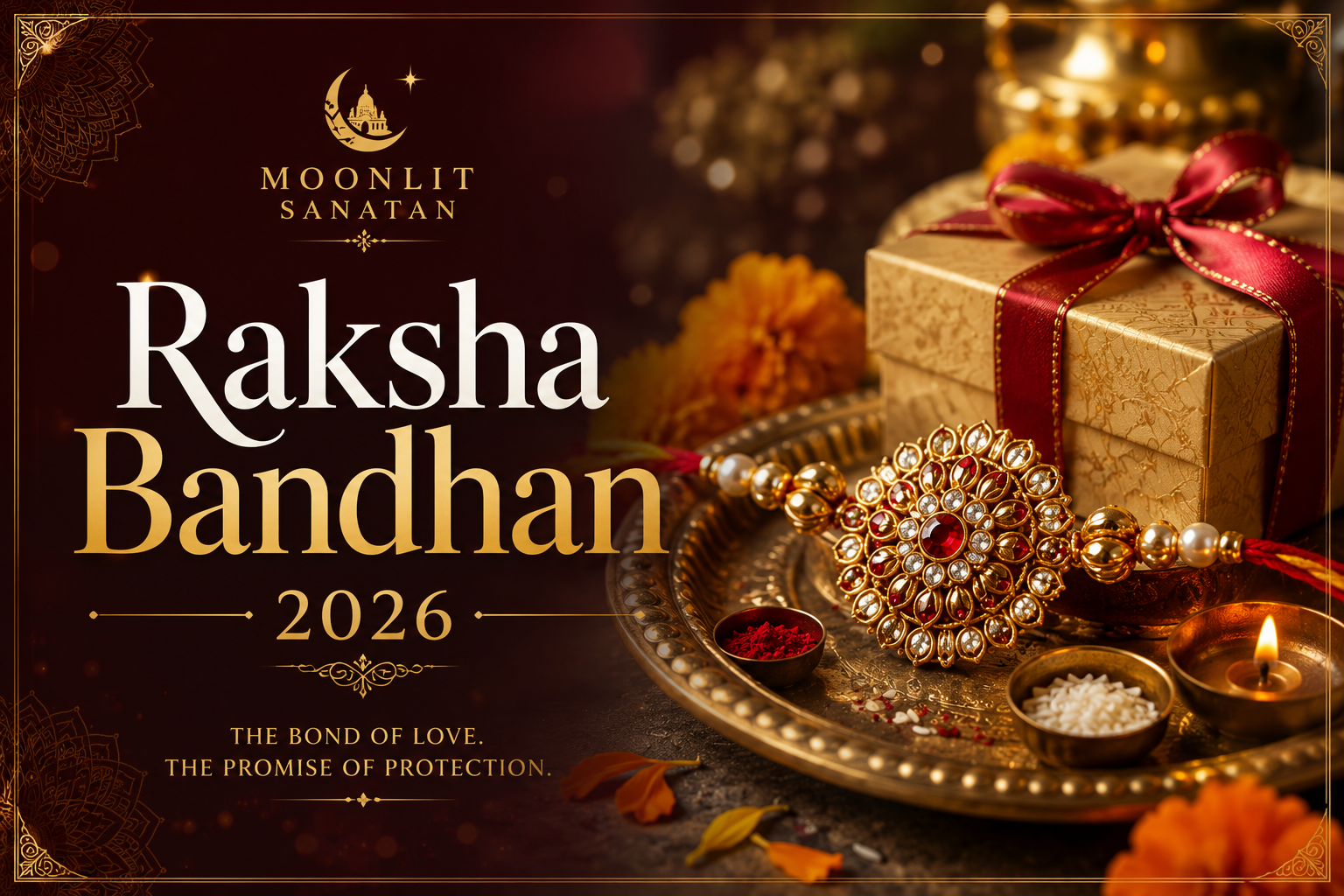
Somewhere in every Indian household, there's a small steel or silver plate that comes out only once a year — a diya, a bowl of rice, a smear of vermilion, a few threads that were probably bought in a hurry from a roadside stall two evenings ago. It looks like almost nothing. And yet, for one morning every August, that plate carries centuries of promises: of protection, of return favours, of a bond that outlasts distance, disagreement, and time itself.
This is Raksha Bandhan — literally, "the bond of protection." A sister ties a sacred thread, a rakhi, around her brother's wrist. He, in turn, promises to protect and stand by her for life. It sounds simple because it is simple; the ritual takes minutes. What it represents has taken four different legends, several thousand years, and one particularly dramatic moment in Mughal-era history to fully build.
2026 also happens to bring one of the cleanest Raksha Bandhan mornings in recent memory — no Bhadra Kaal to wait out, no split-timing confusion, and a Friday date that Vedic astrologers are already calling unusually favourable for family bonds. Here's everything you need: the exact date and muhurat, the stories behind the thread, the full ceremony, gift ideas that go beyond the usual box of sweets, and how the day is marked differently depending on which part of India — or the world — your family celebrates from.
Raksha Bandhan 2026 — Quick Answer
Friday, 28 August 2026
Shravana Purnima · Rakhi-tying muhurat: 5:57 AM – 9:48 AM IST
| Detail | Timing |
|---|---|
| Purnima Tithi begins | 27 August 2026, approx. 9:08 AM |
| Purnima Tithi ends | 28 August 2026, approx. 9:48 AM |
| Bhadra Kaal | Ends before sunrise on 28 August — no conflict this year |
| Shubh Muhurat (recommended) | 5:57 AM – 9:48 AM IST, 28 August |
| Rahu Kaal (avoid) | Approx. 10:46 AM – 12:22 PM, 28 August |
Timings follow the Delhi/national panchang and can shift by 10–25 minutes depending on your city — worth a quick check against your local panchang if your family follows it strictly. And if the morning window genuinely passes you by, the ceremony is still valid later in the day; the muhurat marks the most auspicious result, not a hard deadline.
What Raksha Bandhan Actually Celebrates
Strip away the sweets and shopping, and Raksha Bandhan is built on a fairly radical idea for its time: a mutual, spoken vow between siblings, renewed once a year, in front of family. The sister ties the rakhi and performs a small aarti and tilak; the brother accepts the responsibility of protecting her — historically physical protection, today more often emotional, financial, or simply showing up when it matters — and gives her a gift in return, called shagun.
What makes the festival unusually flexible is that "brother" was never strictly limited to blood relation. Rakhi is tied to cousins, close friends, and — as you'll see below — was historically tied to allies, protectors, and even trees and rivers in some folk traditions. The thread itself, called a Raksha Sutra, is considered in Vedic thought to function almost like a protective seal, guarding the wearer against negative influence.
MythologyFour Stories Behind the Thread
Ask four different families why Raksha Bandhan exists and you may genuinely get four different answers — because unlike most Hindu festivals, this one doesn't trace back to a single canonical myth. It's been rebuilt and re-justified across centuries, each time a new story of protection needed a ritual to carry it.
1. Indra and Sachi — the oldest recorded version
The earliest reference, found in the Bhavishya Purana, isn't about siblings at all. Indra, king of the gods, was losing a long war against the demon king Bali. His wife Sachi tied a sacred thread on his wrist, empowered by prayer, and sent him back into battle — where he turned the war around. This is considered the root of the idea that a thread, tied with intention by someone who loves you, can carry real protective power into a fight you're facing alone.
2. Krishna and Draupadi — the Mahabharata's version
The more emotionally resonant story comes from the Mahabharata. Krishna cut his finger on the edge of a battlefield weapon; Draupadi immediately tore a strip of cloth from her own saree and bound the wound. Krishna, moved by the gesture, promised to protect her for as long as he lived — a promise he famously kept years later, during the attempted disrobing of Draupadi in the Kaurava court, when he is said to have miraculously extended the length of her saree indefinitely.
If this story pulls you further into the Mahabharata, our Epic Tales section covers several more Krishna–Draupadi moments in similar depth, and our Hindu Gods & Goddesses category traces Krishna's role across the wider epic.
3. Yama and Yamuna — protection between siblings specifically
The version most directly tied to brother-sister devotion comes from Yama, the god of death, and his sister Yamuna (the river goddess). Yamuna tied a rakhi on Yama and prayed for his long life; Yama, touched by the gesture, granted her immortality and declared that any brother who receives a rakhi from his sister with genuine love will be blessed with protection. This is the story most often cited as the direct origin of the sibling-specific ritual celebrated today.
4. Rani Karnavati and Humayun — history, not myth
The one account that isn't mythology at all: in the 16th century, the widowed queen of Chittor, Rani Karnavati, is said to have sent a rakhi to the Mughal emperor Humayun when her kingdom faced invasion, asking for his protection as a brother. Whether or not Humayun actually rode to her aid before Chittor fell is disputed by historians, but the story has endured for centuries as proof that the bond of rakhi was, at least symbolically, considered strong enough to cross religion, kingdom, and war.
Understanding Bhadra Kaal — and Why 2026 Is Unusually Simple
In most years, the single biggest scheduling headache around Raksha Bandhan is Bhadra Kaal, a period in the Hindu panchang considered highly inauspicious for ceremonies like tying a rakhi, starting a wedding, or entering a new home. Bhadra is personified in tradition as the sister of Shani (Saturn) and daughter of Surya, and is believed to bring misfortune to any auspicious act performed during her influence.
The caution around Bhadra during Raksha Bandhan specifically traces back to a well-known belief: that Ravana, the antagonist of the Ramayana, once had a rakhi tied on him during Bhadra Kaal — and met his destruction within the year. Since then, families have made a point of waiting for Bhadra to pass before tying the thread.
The good news for 2026: Bhadra Kaal ends before sunrise on 28 August, so there's no waiting required at all. The entire recommended window — 5:57 AM to 9:48 AM — is clear the moment the day begins. If your family's morning schedule genuinely doesn't allow for it, avoid Rahu Kaal (roughly 10:46 AM to 12:22 PM) and tie the rakhi later in the afternoon or evening instead; the ceremony remains valid outside the muhurat, which marks the most auspicious result rather than a strict deadline.
RitualHow to Perform the Raksha Bandhan Ceremony: Step-by-Step
- Prepare the puja thali before the brother arrives or is called to the ceremony spot — it should hold rakhi, roli (vermilion), rice grains, a small diya, and sweets. A ready-made roli-chawal-mauli puja samagri pack is a convenient way to have everything assembled without last-minute shopping.
- Seat the brother facing east if possible, and begin with a short aarti, moving the diya in a circular motion in front of him.
- Apply the tilak on his forehead using roli and a few grains of rice pressed on top.
- Tie the rakhi on the right wrist, ideally while chanting a small prayer for his wellbeing. This year's window (5:57 AM–9:48 AM) is entirely Bhadra-free, so timing pressure is minimal.
- Offer sweets by hand — traditionally the first bite the brother takes on Raksha Bandhan should come directly from his sister.
- The brother offers a gift — the shagun — along with a spoken or implied promise of protection and support.
- Close with a family meal or gathering where possible, since Raksha Bandhan in most households doubles as one of the year's few guaranteed full-family occasions.
Why the Thread Itself Is Considered Protective
Beyond the emotional symbolism, Vedic astrology assigns the Raksha Sutra a fairly specific function: it's treated as a kind of protective seal, or kavach, against the destabilizing effects of Rahu and Ketu — the shadow planets associated in Vedic thought with confusion, sudden setbacks, and ill fortune. Tying the thread on the wrist, close to the pulse, is believed to strengthen the wearer's life force, or prana, for the year ahead.
This is also part of why the timing rules around Bhadra Kaal are taken seriously rather than treated as superstition to be worked around — the thread is thought to carry whatever planetary energy is dominant at the moment it's tied, which is the whole reason families have historically waited out inauspicious windows rather than rushing the ceremony.
2026 adds one more layer worth mentioning: Raksha Bandhan falls on a Friday this year, a day astrologically associated with Venus (Shukra) — the planet linked to harmony, relationships, and emotional closeness. Several Vedic astrologers have flagged this as a particularly favourable alignment for the sibling bond specifically, on top of the already-clear Bhadra-free morning.
TimingsCity-Wise Rakhi Timings for 2026
The muhurat above follows the Delhi/national panchang standard. If your family follows a local panchang strictly, sunrise and tithi transitions can shift by 10–25 minutes depending on your city:
| City | Approx. Sunrise, 28 Aug | Rakhi Window Note |
|---|---|---|
| Delhi | ~5:57 AM | National standard — as listed above |
| Mumbai | ~6:20 AM | Window opens roughly 20 minutes later |
| Kolkata | ~5:20 AM | Earliest sunrise among major metros |
| Chennai | ~6:00 AM | Close to the national standard |
| Bengaluru | ~6:05 AM | A few minutes behind Delhi |
| Hyderabad | ~5:58 AM | Nearly identical to Delhi |
These are approximate offsets rather than precise panchang calculations — if timing precision matters to your family's practice, cross-check against a local panchang for your exact city before the day.
EtiquetteCommon Mistakes to Avoid on Raksha Bandhan
- Tying the rakhi during Bhadra Kaal — not a concern in 2026 specifically, but worth checking every year before assuming the morning is automatically clear.
- Skipping the ceremony because siblings are apart — a video-call rakhi ceremony, with the thread posted ahead of time, is now widely accepted as a full substitute when distance makes an in-person ceremony impossible.
- Treating the gift as the point — an expensive shagun with a rushed, distracted ceremony tends to be remembered far less fondly than a modest gift given with actual presence and attention.
- Forgetting the lumba rakhi for sisters-in-law — in many households, a smaller decorative rakhi tied to the bhabhi alongside the main ceremony is expected, and missing it can feel like an oversight.
- Arguing or carrying tension into the ceremony — Raksha Bandhan is traditionally treated as a day to set aside sibling friction, even if only for the morning.
How Raksha Bandhan Is Celebrated Beyond the North Indian Ritual
- Maharashtra & Gujarat — Narali Purnima: the same Shravan Purnima is celebrated as "Coconut Day," when fishing communities offer coconuts to the sea god Varuna to seek safe waters for the season ahead, alongside the sibling rakhi ritual.
- South India — Avani Avittam: Brahmin communities mark the day by ceremonially changing the sacred thread (janeu/yajnopavita) worn across the chest, a ritual of personal renewal that runs parallel to, rather than replacing, the sibling rakhi custom where it's also observed.
- West Bengal — Jhulan Purnima: the day overlaps with the closing celebrations of Jhulan Yatra, devotional swing festivities for Radha and Krishna, giving Bengali households a more devotional, temple-centred flavour to the same date.
- Border postings and the armed forces: for decades, Indian citizens and school groups have sent or personally tied rakhis on soldiers stationed away from their families, extending the "brother who protects" idea to protectors of the nation itself.
- Diaspora families: for siblings living abroad, video-call rakhi ceremonies and pre-shipped rakhi packets have become the norm — most Indian gifting platforms build in a shipping cutoff roughly 7–10 days before the festival to guarantee delivery in time.
Thoughtful Raksha Bandhan Gift Ideas for 2026
The gift, or shagun, isn't the point of Raksha Bandhan — but it is a genuine part of the tradition, and a little thought goes further than a last-minute chocolate box. A few directions worth considering:
Designer & Lumba Rakhi Set
A set that includes a kundan or silk-thread rakhi for the brother plus a smaller lumba rakhi for the bhabhi keeps the whole ceremony feeling complete rather than an afterthought.
View a rakhi set →Silver Coin or Silver Rakhi Shagun
A small silver coin, often stamped with Lakshmi or Ganesh, is a traditional shagun that doubles as a keepsake long after the festival ends.
View a silver shagun coin →Premium Dry Fruit & Mithai Hamper
A well-packed hamper of dry fruits or assorted mithai works as both the ceremony's sweet offering and a gift the whole household shares.
View a rakhi gift hamper →Personalized Photo Gift
A custom photo frame or engraved keepsake carrying a sibling memory tends to outlast almost every other gift category on this list.
View personalized photo gifts →If you're the brother figuring out a return gift, a well-chosen grooming or perfume set for your sister — or the reverse, a nice grooming kit gifted to a brother alongside the rakhi — has become one of the more popular modern shagun choices, especially for adult siblings who no longer need "kid gifts" but still want the exchange to feel personal. The general rule most families settle into over time: the gift should say something about the specific sibling receiving it, not just fill the shagun slot for the day.
From Cotton Thread to Kundan: How Rakhi Designs Changed
The rakhi itself has quietly gone through its own evolution. Older generations often remember a simple twisted cotton or silk thread, sometimes with a single small motif — a peacock, a bell, or a tiny god idol woven in. That version is still widely used and still considered the most traditional, particularly for the actual ceremony performed at the family altar.
Contemporary rakhi design has expanded considerably: kundan and stone-studded rakhis for a dressier look, rudraksha-thread rakhis that lean into the spiritual-protection angle more explicitly, cartoon and superhero rakhis for young nephews, and minimalist bracelet-style rakhis designed to actually be worn again after the festival rather than removed within days. Lumba rakhis — the smaller decorative version tied to a brother's wife — have also grown into their own distinct product category over the last two decades, reflecting how the ceremony itself has expanded to formally include the wider family rather than just the direct sibling pair.
Modern TraditionsRaksha Bandhan Without a Brother — and Other Modern Adaptations
One question that comes up often, gently, is what Raksha Bandhan looks like for someone without a living brother, or without a sibling at all. In practice, the festival has never been as rigid as it might first appear. Many women tie rakhis on close male cousins, childhood friends, or father figures who have played a protective role in their life. Some families extend the ceremony to tie rakhis on sisters as well, reframing the day as a broader celebration of protective bonds rather than a strictly male-female sibling exchange.
Community and NGO-run rakhi drives, where children tie rakhis on police officers, doctors, or soldiers with no prior family connection, have also become common in recent years, extending the symbolism of the thread to protectors more broadly rather than limiting it to household relationships. None of these adaptations are considered a departure from tradition so much as a continuation of the same idea the Rani Karnavati story pointed to centuries ago — that the rakhi has always been as much about who you choose to trust with your protection as it is about blood relation.
ConnectionsRaksha Bandhan and the End of Sawan
It's worth noticing that Raksha Bandhan always falls on the very last day of the Sawan month — Shravana Purnima — which is why 28 August 2026 also closes out one of the most devotionally packed months on the Hindu calendar. If you're observing Sawan Somwar fasts or planning your Shivratri puja this year, our complete Sawan 2026 guide covers the full month leading up to this date, including the Kanwar Yatra and Mangala Gauri vrat that run alongside it.
FAQFrequently Asked Questions About Raksha Bandhan 2026
When is Raksha Bandhan in 2026?
Raksha Bandhan 2026 falls on Friday, 28 August, observed on Shravana Purnima, the full moon day of the Shravan month.
What is the shubh muhurat for tying rakhi in 2026?
The recommended window is 5:57 AM to 9:48 AM IST on 28 August. Bhadra Kaal ends before sunrise this year, so the entire morning is auspicious with no need to wait.
What is Bhadra Kaal and why is it avoided?
Bhadra, also called Vishti Karana, is a period in the Hindu panchang considered inauspicious for ceremonies like tying a rakhi. The caution traces to a belief that Ravana had a rakhi tied on him during Bhadra Kaal and met his downfall soon after.
Can I tie rakhi after the muhurat window ends?
Yes. If the 9:48 AM window passes, avoid Rahu Kaal (approximately 10:46 AM to 12:22 PM) and tie the rakhi later in the afternoon or evening. The muhurat gives the most auspicious result, but the ceremony remains valid outside it.
Which wrist should the rakhi be tied on?
The rakhi is traditionally tied on the brother's right wrist.
Can rakhi be tied to someone who isn't a blood brother?
Yes. Rakhi is commonly tied to cousins, close friends, and anyone considered a protective figure in a person's life — the Rani Karnavati–Humayun story is often cited as historical precedent for this broader use of the thread.
Is Raksha Bandhan connected to Sawan?
Yes — Raksha Bandhan always falls on Shravana Purnima, the full moon that closes the Sawan month. In 2026, this is the same date, 28 August.
Why does the muhurat shift every year?
Because Raksha Bandhan is tied to the Purnima tithi in the lunar calendar rather than a fixed solar date, both the date and the exact Bhadra timing shift annually, which is why the muhurat needs to be recalculated each year rather than reused.
What if my brother or sister lives in a different country?
A video-call ceremony with the rakhi posted in advance is widely accepted as a full substitute for an in-person ceremony, and most Indian gifting platforms build in shipping cutoffs roughly 7–10 days before the festival to guarantee international delivery in time.
The Thread That Keeps Getting Retied
What's struck people about Raksha Bandhan for centuries isn't the complexity of the ritual — there isn't much of one — but how many completely different stories have all landed on the same small gesture as the right way to express protection. A war-bound god, a wounded Krishna, a river goddess, a queen facing invasion: different centuries, different stakes, same solution. A thread, tied with intention, by someone who means it.
Whatever gift ends up under the rakhi thali this year, that's really the part worth keeping. The muhurat will pass, the sweets will get eaten within the hour, and the rakhi itself will likely come off within the week — but the promise underneath it, renewed for one more year, is the actual point of getting up early on a Friday morning in August.
For more festival guides through the year, explore our Festivals & Their Stories section, or dive deeper into the Mahabharata and other epics in our Epic Tales category.
Follow Moonlit Sanatan
Daily puja reminders, temple stories, and festival dates all through the year.
Raksha karo, bandhan nibhao.