Festivals & Their Stories
Sawan 2026: Complete Guide to Shravan Month
Dates, puja vidhi, and the story of the poison Shiva drank to save the world
There is a smell that arrives before the season does — wet earth, the first fat drops on hot stone, the low rumble of clouds gathering over temple spires. In North India, that smell means one thing: Sawan is close.
For one full lunar month every year, the Hindu world quietly reorganizes itself around a single devotion. Temples that stand half-empty through the rest of the year begin to overflow. Kanwariyas walk hundreds of kilometres carrying river water on their shoulders. Married women fast on Tuesdays for their husbands. Unmarried women fast on Mondays for the husbands they hope to find. And every evening, somewhere in almost every Indian town, a bell rings out as someone pours a lota of water over a Shivling and whispers Om Namah Shivaya.
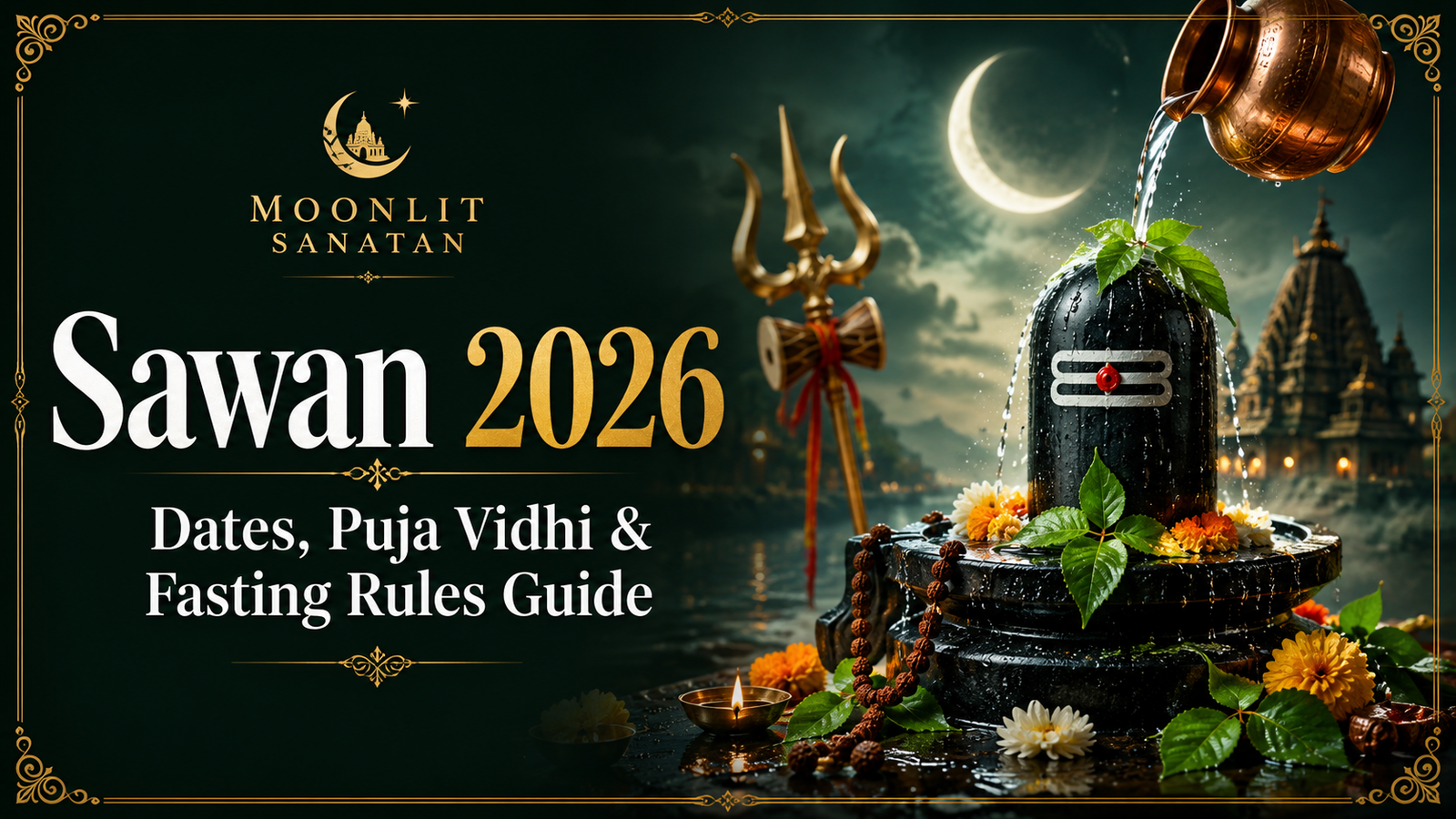
This is Sawan — also called Shravan — the month the entire Shaiva tradition considers Lord Shiva's own. And 2026 brings an unusually rich version of it: a rare overlap between Nag Panchami and a Sawan Somwar, a Shivratri that falls at the emotional midpoint of the month, and a closing day so festival-dense it carries Raksha Bandhan, Shravan Purnima, and Varalakshmi Vratam all at once.
Sawan 2026 — Quick Answer
| Region / Calendar | Start | End |
|---|---|---|
| North India (Purnimanta — UP, Bihar, MP, Rajasthan, Delhi) | Thu, 30 July 2026 | Fri, 28 August 2026 |
| South & West India (Amanta — Maharashtra, Gujarat, Karnataka, AP, Telangana, Tamil Nadu) | Thu, 13 August 2026 | Fri, 11 September 2026 |
| Nepal & parts of Uttarakhand/Himachal (solar reckoning) | Mid-July 2026 | Mid-August 2026 |
If you're unsure which calendar your family follows: North Indian households almost always use the Purnimanta dates above, while most of Maharashtra, Karnataka, Andhra Pradesh, Telangana, and Tamil Nadu follow the Amanta version, starting roughly two weeks later.
What Is Sawan, and Why Is It the Fifth Month?
Sawan — Shravan in its formal Sanskrit form — is the fifth month of the Hindu lunisolar calendar, arriving squarely in the heart of the monsoon. Its name comes from the Shravana nakshatra, the lunar constellation said to preside over the full moon that closes the month. That full moon, Shravan Purnima, is what gives the entire month its identity.
Ask any devotee why this particular month belongs to Shiva more than any other, and you'll usually get the same story — the story of the churning of the ocean.
MythologyThe Story Behind Sawan: Why Shiva Drank the Poison
Long before the Devas and Asuras were enemies, they once worked together. They needed amrita, the nectar of immortality, and the only way to get it was to churn the cosmic ocean of milk using Mount Mandara as the churning rod and the serpent Vasuki as the rope. Both sides pulled — the Devas at the tail, the Asuras at the head — and the ocean began to yield its treasures one by one: the wish-fulfilling cow, the divine horse, the goddess Lakshmi herself.
But before anything good rose from those waters, something terrible did. Halahala — a poison so lethal it threatened to destroy every world at once — surged up from the depths. The Devas panicked. The Asuras panicked. Even the churning stopped. There was only one being creation could turn to.
Shiva stepped forward and drank the poison whole. Rather than swallow it — which would have killed even him — he held it in his throat, refusing to let it pass further into his body or spill back out into the world.
The heat of that poison was unbearable, even for a god. So the other deities poured the coolest thing they had — water from the celestial Ganga — over his head and throat, easing the burning. It's said this act took place during Shravan, and that the monsoon rains of this month echo that same act of cooling, protective devotion.
Every jalabhishek performed today — every lota of water tipped gently over a Shivling — is a small re-enactment of that moment. You are not just praying to Shiva in Sawan. You are, in a quiet way, helping to cool him.
If this story pulls you further into Shiva's mythology, our complete guide to Kashi Vishwanath Temple traces how this same devotion shaped one of his twelve Jyotirlingas in Varanasi, and our Char Dham Yatra planning guide covers Kedarnath, the Himalayan Jyotirlinga many devotees visit right after Sawan ends.
EtymologyWhy "Shravan"? The Nakshatra Behind the Name
Every month in the Hindu lunisolar calendar is named after the nakshatra under which its full moon falls. For this month, that's the Shravana nakshatra, symbolized by an ear, and associated with listening, learning, and receptivity. It's a fitting namesake: Shravan is less a month of grand public spectacle and more one of quiet, repeated, listening devotion — the same mantra chanted Monday after Monday, the same story told at every vrat katha, the same water poured, again and again, over the same Shivling.
Astrologically, this is also the stretch when Vedic tradition considers planetary and lunar energies particularly receptive to devotional practice, which is part of why Sawan sits inside the larger four-month period of Chaturmas — the traditional monsoon retreat when many ascetics pause travel, weddings are paused across most of the Hindu calendar, and spiritual practice takes precedence over worldly undertakings. If you track your personal panchang closely, our Daily/Weekly Panchang section can help you time your Sawan puja around your own local muhurat.
Sawan Somwar 2026: The Monday Vrat Dates
Every Monday that falls inside Shravan is a Sawan Somwar — considered the single most auspicious day of the week to worship Shiva, since "Som" refers to the moon he wears on his head. In 2026, North India's Sawan contains exactly four Mondays.
| Sawan Somwar | North India | South & West India |
|---|---|---|
| 1st Somwar | 3 August 2026 | 17 August 2026 |
| 2nd Somwar | 10 August 2026 | 24 August 2026 |
| 3rd Somwar | 17 August 2026 (also Nag Panchami) | 31 August 2026 |
| 4th Somwar | 24 August 2026 | 7 September 2026 |
Notice something rare in the table above — 17 August and 24 August fall as Sawan Somwars in both calendars, so those two Mondays will see unusually heavy footfall at Shiva temples nationwide, regardless of tradition. Even rarer, the third North Indian Somwar on 17 August coincides exactly with Nag Panchami.
On each Sawan Somwar, devotees typically:
- Wake before sunrise, bathe, and wear clean, simple clothing
- Visit a Shiva temple or set up a small home altar with a Shivling or Shiva image
- Perform jalabhishek — pouring water, and often milk, curd, honey, and ghee for a full Rudrabhishek — over the Shivling
- Offer bilva (bel) leaves in sets of three, smooth side facing the linga
- Observe a day-long fast, usually broken only after the evening aarti
- Chant Om Namah Shivaya through the day, either silently or as a full mala of 108 repetitions
Unmarried women commonly keep this fast too, following the precedent of Goddess Parvati, who is said to have observed every Monday of Shravan while seeking Shiva as her husband — which is why the Sawan Somwar vrat is closely associated with finding or strengthening a marriage.
DatesMangala Gauri Vrat: The Tuesday Fast for Married Women
Where Mondays belong to Shiva, Tuesdays through Sawan belong to Gauri — Parvati in her nurturing form. The Mangala Gauri Vrat is kept mainly by newly married women, praying for their husband's health, longevity, and a harmonious marriage.
| Mangala Gauri Tuesday | North India |
|---|---|
| 1st Tuesday | 4 August 2026 |
| 2nd Tuesday | 11 August 2026 |
| 3rd Tuesday | 18 August 2026 |
| 4th Tuesday | 25 August 2026 |
The ritual typically includes a fast, a haldi-kumkum ceremony among married women, worship of Goddess Gauri with red flowers and vermilion, and the singing of Mangala Gauri songs in the evening.
DatesSawan Shivratri 2026: Date and Significance
The Masik Shivratri that falls within Shravan carries extra weight precisely because it sits inside Shiva's own month. In 2026, Sawan Shivratri falls on Tuesday, 11 August, with the primary Nishita Kaal worship happening around midnight and continuing into the early hours of 12 August — which is also observed as Hariyali Amavasya, the "green new moon" marking the monsoon's full bloom.
Devotees typically observe a night-long vigil on this date, performing Rudrabhishek at four intervals through the night (the char prahar puja), fasting through the following day, and breaking the fast only after sunrise.
CalendarEvery Major Festival Inside Sawan 2026
Sawan isn't just Mondays and Tuesdays — it's threaded through with festivals that build toward its final, most crowded day. Here's the full North Indian sequence for 2026:
| Festival | 2026 Date | Significance |
|---|---|---|
| Sawan Begins | 30 July (Thu) | Start of the Purnimanta Shravan month |
| 1st Sawan Somwar | 3 August (Mon) | First Monday vrat of the month |
| 1st Mangala Gauri | 4 August (Tue) | First Tuesday vrat for married women |
| Kamika Ekadashi | 9 August (Sun) | Fasting day dedicated to Lord Vishnu |
| 2nd Sawan Somwar | 10 August (Mon) | Second Monday vrat |
| Sawan Shivratri | 11 August (Tue) | Monthly Shivratri, extra sacred within Shravan |
| Hariyali Amavasya | 12 August (Wed) | "Green" new moon marking peak monsoon |
| Hariyali Teej | 15 August (Sat) | Women's festival for marital happiness, coincides with Independence Day this year |
| 3rd Sawan Somwar & Nag Panchami | 17 August (Mon) | Rare overlap — Shiva worship and serpent-deity worship together |
| Varalakshmi Vratam | 21 August (Fri) | Observed mainly in Tamil Nadu, Karnataka, AP, Telangana |
| Putrada Ekadashi | 23 August (Sun) | Fasting day for the wellbeing of children |
| 4th Sawan Somwar | 24 August (Mon) | Final Monday vrat of Sawan |
| Shravan Purnima / Raksha Bandhan | 28 August (Fri) | Sawan ends; full moon, brother-sister festival |
That closing day deserves a moment of its own. 28 August 2026 carries the Shravan Purnima, Raksha Bandhan, and — in several regions — the ceremonial changing of the sacred thread, all landing on the same date. It's arguably the single busiest day of devotional activity anywhere in the Hindu calendar's monsoon stretch.
How to Perform Sawan Puja at Home: Step-by-Step Vidhi
Not everyone can reach a crowded Shiva temple every single day of Sawan — and home worship, done with sincerity, is considered every bit as complete. Here is a simple, traditional vidhi you can follow on any day of the month, and especially on the Somwar dates above.
- Bathe and dress simply before approaching your puja space, ideally at sunrise.
- Set up your Shivling or Shiva idol on a clean, raised platform. If you don't already keep one at home, a small Parad or marble Shivling is a meaningful addition to a home altar for this month.
- Light a diya and dhoop. A good natural sandalwood or camphor dhoop set keeps the space fragrant through longer sessions without sharp synthetic smoke.
- Perform jalabhishek — pour clean water (Ganga jal if you have it) slowly over the Shivling using a small copper kalash or lota, considered the purest vessel for ritual water.
- Follow with milk, curd, honey, and ghee if performing a full Rudrabhishek, pouring each in turn while chanting Om Namah Shivaya.
- Offer bilva leaves in threes, smooth side down, along with white flowers — a pre-packed bel patra and puja samagri kit is practical if fresh bilva isn't available where you live.
- Chant the Maha Mrityunjaya mantra on a 108-bead Rudraksha mala, traditionally considered the correct count and material for Shiva mantra japa.
- Perform aarti in the evening, using a proper brass puja thali set with diya, bell, and incense holder, closing with fruit or sweets as prasad.
- Read the Shiva Purana or Sawan vrat katha — many households keep a compact Shiva Purana or Rudra Chalisa book at hand for exactly this purpose.
None of this needs to be elaborate. Tradition is fairly clear that a sincere lota of water offered with devotion carries the same weight as an elaborate Rudrabhishek performed without it.
MythologyA Second Story: Shravan Kumar and the Meaning of Devotion
The Samudra Manthan isn't the only story devotees associate with this month's name. A gentler legend is sometimes told alongside it — Shravan Kumar, a young man whose elderly, blind parents wished to complete a pilgrimage to every sacred river and shrine in the land. Unable to walk such a distance themselves, they were carried the entire way by their son, balanced in two baskets slung across a bamboo pole over his shoulders — an image many devotees quietly recall when they see Kanwariyas carrying their own poles of river water during Sawan today.
Shravan Kumar's devotion to his parents is held up in Hindu tradition as one of the purest expressions of duty and selfless service, and his story is often retold in Sawan to frame the month's fasting and puja as a broader month of restraint, service, and care toward others. If tales like this one interest you, our Epic Tales section covers several more devotional stories from across the Puranas in similar depth.
Vrat RulesSawan Vrat Rules: What You Can and Cannot Eat
Fasting rules vary by family and region, but the broad framework followed across most of North India looks like this:
Foods Generally Allowed
- Fresh fruits of all kinds
- Milk, curd, and paneer
- Sabudana (tapioca pearls) in khichdi or vada form
- Kuttu (buckwheat) and singhare (water chestnut) flour preparations
- Potatoes and other root vegetables permitted during vrat
- Rock salt (sendha namak) instead of regular table salt
- Dry fruits and nuts
What to Avoid
- Onion, garlic, and other tamasic ingredients
- Non-vegetarian food and alcohol, avoided by most devotees through the entire month
- Regular grains (wheat, rice, lentils) on strict fasting days
- Harsh speech, arguments, or negativity — Sawan is treated as a month for restraint in temperament, not only in diet
If you're pregnant, managing a health condition, or new to fasting, it's worth checking with a doctor first — puja and devotion can continue fully even if the fast itself is modified or skipped.
Why It MattersBenefits Devotees Associate With Observing Sawan
- Removal of obstacles — Monday worship of Shiva through Shravan is widely believed to clear blockages in career, health, and relationships.
- Marital harmony and finding a partner — the Parvati precedent makes this the most commonly cited reason unmarried women take up the fast.
- Discipline and self-restraint — the dietary rules and daily ritual structure form a month-long practice in restraint many describe as recentering.
- Protection and longevity — where the Maha Mrityunjaya mantra does its heaviest lifting, chanted for protection and a long, healthy life.
- Family continuity — many households treat Sawan as the month to pass devotional practice down to children.
Common Mistakes Devotees Make During Sawan
- Mixing the two regional calendars — confirm which tradition your household follows before the month starts, not partway through it.
- Treating the fast as the whole practice — puja, mantra chanting, and restraint in speech matter just as much, and can be maintained even by those who can't fast.
- Using synthetic containers for jalabhishek — copper is traditionally preferred and worth the one-time investment if you observe Sawan every year.
- Skipping the evening aarti — the day's puja is traditionally considered incomplete without it, however brief.
- Forgetting secondary vrats — Mangala Gauri Tuesdays, Kamika Ekadashi, and Putrada Ekadashi are easy to miss if you're only tracking Mondays.
How Sawan Is Celebrated Across Different Parts of India
- Telangana — Bonalu: a festival honouring goddess Mahakali, marked by processions carrying decorated pots of food (bonam) across four consecutive Sundays.
- Maharashtra — Shravan Somvar & Mangala Gauri: particular emphasis on home worship and the reading of Shiva stotras through the evening.
- Tamil Nadu, Karnataka, AP, Telangana — Varalakshmi Vratam: worship of a form of Goddess Lakshmi believed to grant the combined merit of all eight forms of Lakshmi.
- Uttarakhand & Himachal Pradesh — Kanwar culture: community rest stops, free food camps (bhandaras), and decorated arches along the pilgrimage route.
- Nepal — Solar Shravan: begins independently of both Indian lunar traditions, marked by its own temple calendar around Pashupatinath.
Kanwar Yatra: Sawan's Great Pilgrimage
Running alongside the whole month is the Kanwar Yatra — one of the largest annual pilgrimages in the world. Devotees known as Kanwariyas, dressed in saffron, walk on foot from rivers like the Ganga at Haridwar or Gaumukh, carrying decorated bamboo poles (kanwars) slung with pots of holy water across hundreds of kilometres, back to their local Shiva temples. The pilgrimage builds through the month and typically peaks around the last Sawan Somwar or Sawan Shivratri.
Regional NoteRegional Variations You Should Know
- North India (Purnimanta): 30 July – 28 August 2026 — the version most commonly referenced online.
- Maharashtra, Gujarat, Karnataka, AP, Telangana, Tamil Nadu (Amanta): 13 August – 11 September 2026, roughly a fortnight later.
- Nepal & parts of Uttarakhand/Himachal: solar reckoning tied to Karka Sankranti, beginning mid-July.
If your family has always celebrated Sawan on a particular set of dates, that local tradition should take precedence over any single calendar quoted online.
Frequently Asked Questions About Sawan 2026
When does Sawan 2026 start and end?
In North India, Sawan 2026 begins on Thursday, 30 July, and ends on Friday, 28 August, which is Shravan Purnima. In South and West India, it runs from 13 August to 11 September.
How many Sawan Somwars are there in 2026?
North India observes four Sawan Somwars in 2026: 3, 10, 17, and 24 August. The third of these, 17 August, also falls on Nag Panchami.
What is the significance of Sawan for Lord Shiva devotees?
Sawan commemorates the moment Shiva drank the halahala poison during the churning of the cosmic ocean to protect creation, becoming Neelkanth. Devotees pour water over the Shivling through the month to symbolically cool him.
Can unmarried women observe the Sawan Somwar fast?
Yes. The practice follows the precedent of Goddess Parvati, who is said to have fasted every Monday of Shravan while seeking Shiva as her husband, making the vrat especially meaningful for unmarried women hoping for a favourable marriage.
What can you eat during a Sawan fast?
Most devotees stick to fruits, milk, curd, sabudana, kuttu and singhare flour preparations, potatoes, dry fruits, and rock salt, while avoiding regular grains, onion, garlic, and non-vegetarian food.
When is Sawan Shivratri in 2026?
Sawan Shivratri falls on Tuesday, 11 August 2026, with the main Nishita Kaal worship extending past midnight into the early hours of 12 August.
Is Raksha Bandhan connected to Sawan?
Yes — Raksha Bandhan always falls on Shravan Purnima, the full moon that closes the month. In 2026, that date is Friday, 28 August.
Why does Sawan fall in the monsoon every year?
Because it's tied to the Hindu lunisolar calendar rather than a fixed solar date, Sawan naturally aligns with the peak of the Indian monsoon each year, reinforcing its symbolic link to Shiva's cooling.
Is there a difference between Sawan and Shravan?
No — they're the same month. "Shravan" is the formal Sanskrit name, while "Sawan" is the more commonly used colloquial Hindi form.
Carrying Sawan's Spirit Forward
Whichever calendar you follow and however elaborate or simple your practice, Sawan asks for very little in return for what devotees believe it gives back — a lota of water, a few bilva leaves, a month of gentler speech, and a willingness to show up, Monday after Monday, for something larger than yourself.
That, in many ways, is the entire teaching of the month compressed into a single gesture. No grand pilgrimage is required to take part in Sawan — a home altar, a little discipline, and thirty days of quiet consistency are enough. Whether you observe every Somwar and Mangala Gauri Tuesday in full, or simply pause each evening to light a diya and remember why the rains fall the way they do this time of year, you are participating in something devotees across the country, and across centuries, have shown up for in exactly the same way.
If this guide helped you plan your month, explore our Festivals & Their Stories section for more Hindu calendar deep-dives, or our Hindu Gods & Goddesses category to go deeper into Shiva's mythology beyond Sawan.
Follow Moonlit Sanatan
Daily puja reminders, temple stories, and festival dates all through the year.
Har Har Mahadev.