Vedic Astrology & Practice
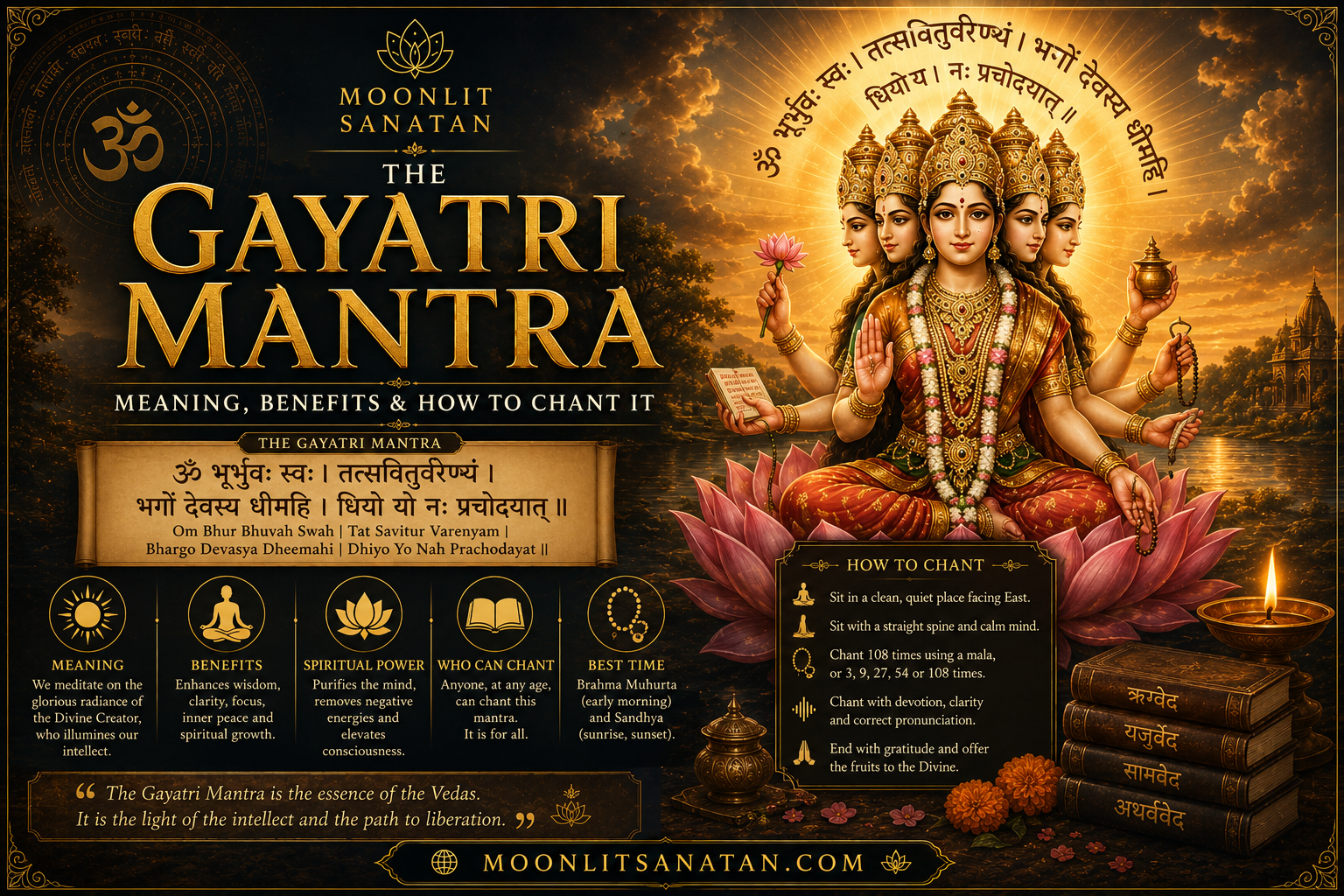
The Gayatri Mantra: Meaning, Benefits & How to Chant It
Twenty-four syllables, composed more than three thousand years ago, still whispered at sunrise in more homes than almost any other line of Sanskrit ever written
Long before it became a mantra recited by rote, the Gayatri was a prayer built with unusual precision — every syllable counted, every sound placed for a reason, addressed not to a single deity demanding worship but to light itself, asking simply for a clearer mind. That's part of why it has survived, largely unchanged, for well over two and a half thousand years: it doesn't ask for wealth, victory, or protection from enemies. It asks to think more clearly. Almost nobody, in any era, has ever had reason to stop wanting that.
And yet for something recited daily by millions, the mantra is also frequently misunderstood — mistaken for a prayer to the literal sun, its name mistaken for a goddess rather than a metre, its opening words treated as decoration rather than a deliberate three-part structure with their own distinct meaning.
This guide gives you the full verse, a genuine word-by-word breakdown rather than a loose paraphrase, the meaning behind its famous opening line, and a clear, honest, practical guide to actually chanting it yourself.
The Verse
Om Bhur Bhuvah Swah
ॐ भूर्भुवः स्वः
तत्सवितुर्वरेण्यं
भर्गो देवस्य धीमहि
धियो यो नः प्रचोदयात्
Om Bhur Bhuvah Swah
Tat Savitur Varenyam
Bhargo Devasya Dheemahi
Dhiyo Yo Nah Prachodayat
"We meditate on the glorious light of that adorable divine Savitr; may it illuminate and inspire our understanding."
This is the Gayatri Mantra in its most widely and commonly chanted form — one of the oldest continuously recited verses in any living language, drawn from the Rig Veda and addressed to Savitr, the aspect of the divine associated with the vivifying, illuminating power of light itself, rather than the physical sun as an object.
Origins
Where the Verse Comes From, and What "Gayatri" Actually Means
The mantra appears in the Rig Veda (3.62.10), traditionally attributed to the sage Vishwamitra, making it one of the oldest verses in continuous religious use anywhere in the world. A detail that surprises most people encountering this for the first time: "Gayatri" isn't originally the name of a deity at all — it's the name of the Vedic poetic metre the verse is composed in, a specific 24-syllable structure (three lines of eight syllables each) used across many Vedic hymns, not just this one.
Over centuries of devotional tradition, the verse's popularity was such that the metre's name became attached to the verse itself, and eventually to a personified goddess, Gayatri Devi, often depicted with five faces representing the five elements and the five senses, and closely associated with — sometimes identified as a form of — Savitri, Saraswati, or the Vedas themselves personified as feminine wisdom. Both readings, the metre and the goddess, coexist comfortably in how the mantra is understood and taught today.
The verse's structure itself is worth appreciating on its own terms: three lines of eight syllables is an unusually tight, disciplined form for a prayer this consequential, and Vedic scholars have long noted that the Gayatri metre's brevity was likely deliberate — a form built for memorization and daily repetition across a culture that transmitted its scripture orally for centuries before any of it was written down. A prayer this important needed to be short enough that everyone could actually carry it in memory.
Reach
Why This Particular Verse, Above Thousands of Others
The Rig Veda alone contains over a thousand hymns, and the wider Vedic corpus holds many thousands more verses — yet the Gayatri Mantra occupies a place in daily practice that almost none of the others share, despite the sheer size of the tradition it belongs to. Several factors compound to explain this: its inclusion in the daily Sandhyavandanam ritual observed for centuries by practicing Brahmins and later by a much wider population, its status as the opening prayer taught to students beginning Vedic study, and a major 20th-century revival led by reform movements — particularly the Arya Samaj under Swami Dayananda Saraswati, who promoted the Gayatri Mantra as a universal prayer accessible to all Hindus regardless of caste, dramatically widening who chanted it and how often.
That reform-era push is a significant part of why the mantra feels, today, less like a specialist's ritual text and more like a genuinely shared piece of Hindu devotional life — recited in schools, referenced in popular culture, and taught to children well before they could read Sanskrit themselves, simply through repetition and family practice.
Word by Word
What Each Syllable Actually Means
Rather than a single paraphrased sentence, here's the verse broken into its individual components — useful both for genuine understanding and for correct pronunciation during chanting.
Read together in order, the sense is roughly: across the physical, mental, and spiritual realms, we meditate on the excellent radiance of that divine illuminator — may it inspire and direct our understanding. Nothing in the verse asks for a possession, a victory, or an outcome. The entire request is for clarity of mind — a notably restrained thing to ask for, in a devotional tradition that otherwise has no shortage of prayers for wealth, health, protection, and victory.
The Opening Line
Understanding "Om Bhur Bhuvah Swah" On Its Own
The mantra's opening three words are searched and quoted so often as a standalone phrase that they deserve their own explanation, separate from the rest of the verse. Bhur, Bhuvah, and Swah are known as the three Vyahritis — sacred utterances representing the three planes of existence in Vedic cosmology.
| Vyahriti | Realm | Represents |
|---|---|---|
| Bhur | Earth | The physical body and material world |
| Bhuvah | Atmosphere | The mind, breath, and subtle intermediate world |
| Swah | Heaven | The spiritual, causal realm beyond material and mental existence |
Chanting these three words first is traditionally understood as consciously moving attention through all three levels of existence before the main prayer even begins — grounding in the body, settling the mind, and opening toward the spiritual, in that order, before asking for illumination of the intellect in the lines that follow.
Practice
How to Actually Chant It
When
Traditional practice ties Gayatri chanting to the three Sandhya periods — sunrise (the most emphasized), midday, and sunset — moments considered naturally suited to reflection as light itself changes. Brahma Muhurta, the roughly 90-minute window before sunrise, is often singled out as the single most favoured time.
How Many Times
108 repetitions, counted on a mala, is the most widely recommended count, tied to the same significance behind 108 in broader Hindu practice. For those short on time, traditional guidance offers smaller acceptable counts — 3, 9, or 28 repetitions — rather than treating 108 as a strict daily minimum.
Who Chants It
Historically, formal Gayatri initiation was associated with the Upanayana (sacred thread) ceremony and restricted along lines of caste and gender in various periods and regions. In contemporary practice, the mantra is widely chanted by people across genders and backgrounds, and most modern teachers and institutions treat it as a universally accessible prayer rather than a restricted one — worth knowing both the historical context and the considerably more open practice that exists today.
Posture and Setting
Traditional guidance favours a seated position, spine upright, facing east toward the rising sun where possible — a practical orientation for sunrise chanting specifically, though not treated as a strict requirement for practice at other times of day. A quiet space, a lit diya, and a japa mala for counting are the traditional minimum setup, though none of these are prerequisites for beginning; consistency of practice matters considerably more than the completeness of the setup around it. Some practitioners keep the same seat and same rough time each day specifically to build the kind of habitual association that makes the practice easier to sustain over months and years, rather than something that has to be willed into happening fresh every morning.
Symbolism
Savitr: Why the Mantra Is Tied to the Sun Without Being About It
Savitr is one of several solar deities referenced across the Rig Veda, distinguished specifically as the aspect of solar divinity associated with the sun's power to stimulate, awaken, and set things in motion — the moment just before sunrise, when light first begins to stir the world into wakefulness, rather than the sun at its full midday strength. This is a meaningful distinction: the mantra isn't primarily a hymn of solar worship in the way a harvest or heat-focused sun prayer might be. It's addressed to the quality of illumination itself — the specific power that turns darkness into clarity — which is precisely why the verse's actual request has nothing to do with warmth, growth, or material fortune, and everything to do with the mind waking up, mirroring the world outside it.
This is also why sunrise remains the most emphasized time for chanting: the sky at that exact moment is a physical enactment of what the prayer is asking for internally — a slow, undeniable movement from darkness into visibility. A companion practice, Suryarghya — offering water to the rising sun while facing east — is common alongside Gayatri chanting for exactly this reason, pairing an external gesture of reverence toward the sun's arrival with the internal request for the same quality of clarity.
Why It Matters
Why the Gayatri Is Called "Veda Mata"
The Gayatri Mantra carries a title few other verses in Hindu tradition share: Veda Mata, "mother of the Vedas" — reflecting the belief that its 24 syllables contain the essential seed of the entire Vedic corpus in condensed form. It's recited at the start of most traditional Vedic study, and its inclusion in the daily Sandhyavandanam ritual observed by many practicing Hindus places it, for a significant number of people, among the most frequently repeated lines of text in their entire lives — recited more times over a single lifetime, in many cases, than any other sentence a person will ever say.
Traditional teaching describes benefits of consistent practice in terms of mental clarity, discipline, and inner steadiness rather than material outcomes — consistent with a prayer whose entire content is a request for a clearer mind rather than a specific favour. If you're looking into the chanting-and-focus research more broadly, it's worth knowing that most rigorous scientific study in this space has looked at mantra repetition and meditation practice in general, rather than the Gayatri specifically — so claims of measurable, mantra-specific effects are best treated as traditional teaching passed down through generations rather than settled, peer-reviewed science.
Beyond Religion
Why Students and Non-Religious Practitioners Chant It Too
Because the mantra's actual content is a request for mental clarity rather than a specifically theistic petition, it has found a genuinely wide audience beyond strictly devotional practice. Many Indian schools open the day with a group recitation, treating it less as a religious observance and more as a shared moment of quiet focus before lessons begin — a practice that predates, and largely sits outside, formal religious instruction in those settings. Students preparing for exams are frequently taught the verse specifically for this reason, with the underlying logic being straightforward even to a skeptical listener: a short, rhythmic recitation genuinely does slow the breath and settle attention, regardless of what belief system a person brings to it, in much the same way any structured breathing exercise might.
This crossover appeal is also why the mantra shows up in contexts with no obvious religious framing at all — yoga studios, meditation apps, and secular mindfulness programs occasionally include it, usually stripped of most surrounding ritual context, valued simply as a well-constructed piece of rhythmic, repeated sound.
Technique
Using the Gayatri as a Concentration Practice
Beyond formal ritual chanting, the verse is also used as a straightforward meditation anchor, similar in mechanism to how a breath count or a single repeated word functions in other contemplative traditions, whether Vedic, Buddhist, or entirely secular. A simple approach for beginners:
- Sit comfortably with your spine reasonably upright, eyes closed or softly lowered.
- Begin with a few slow breaths before starting to chant, allowing the body to settle first.
- Chant slowly, either aloud or silently (mentally) — both are considered valid, with silent (manasik) japa often recommended once the pronunciation is genuinely comfortable.
- Use a mala to count rather than trying to track repetitions mentally, freeing your attention to stay on the sound rather than the counting.
- Let distraction happen without frustration. Attention wandering and gently returning is treated as part of the practice, not a failure of it — a framing shared across most contemplative traditions, not unique to this one.
Over consistent practice, many practitioners describe the verse shifting from something that requires conscious recall to something the mind settles into almost automatically — a genuinely common experience across long-term mantra practice generally, and one of the more concrete, if subjective, benefits people report from sustained daily repetition.
Going Further
The Maha Gayatri and Longer Forms
Beyond the core four-line verse, some traditions chant an extended version, sometimes called the Maha Gayatri Mantra, which adds additional invocatory lines before the core verse, addressing multiple aspects of the divine before arriving at the same central request for illumination. These longer forms are used mainly in specific ritual and initiatory contexts rather than daily practice, where the core verse remains by far the most common form recited.
Clearing Confusion
Common Misconceptions
- "Gayatri is a goddess's name for the mantra." Gayatri is primarily the name of the poetic metre the verse is written in; the personified goddess association developed later, and both readings are used today without contradiction.
- "It's a prayer to the physical sun." Savitr represents the illuminating, vivifying quality of divine light — the verse is closer to an appeal to clarity and consciousness than a literal address to the sun as an astronomical object.
- "You must complete 108 repetitions or it doesn't count." Traditional guidance explicitly allows smaller counts — 3, 9, or 28 — for those unable to complete a full mala; consistency matters more than hitting a fixed number every single day.
- "Only Brahmins can chant it." This reflects a specific historical restriction rather than a universal rule; the mantra is widely and openly practiced across communities today.
- "Chanting in translation works just as well as the Sanskrit." Traditional teaching places real weight on the specific sound and rhythm of the Sanskrit itself, not just its meaning — the vibrational quality of the syllables is considered part of the practice, which is why understanding the translation is treated as a companion to chanting the original, not a substitute for it.
- "The mantra is meant to be rushed through to hit 108 repetitions quickly." Traditional guidance consistently favours slow, deliberate pronunciation over speed; a smaller number of carefully chanted repetitions is generally considered more valuable than a rushed full count.
For Your Practice
Building a Gayatri Chanting Practice
Sphatik (Crystal) Japa Mala
View mala →A 108-bead crystal mala, traditionally associated with clarity and calm, suited to daily Gayatri japa.
Gayatri Yantra
View yantra →A dedicated copper or brass Gayatri Yantra for the home altar, distinct from general planetary yantras.
Copper Suryarghya Vessel
View vessel →A traditional copper vessel for offering water to the rising sun, a common companion practice to sunrise chanting.
Gayatri Devi Brass Idol
View idol →A five-faced Gayatri Devi idol for devotees who worship the personified form alongside daily recitation.
Engraved Copper Gayatri Mantra Plate
View plate →The full verse engraved on a copper plate, a durable devotional piece for a puja room or study wall.
Sandalwood Japa Counting Ring
View counting ring →A finger-worn counter for tracking repetitions discreetly when a full mala isn't practical.
Brahma Muhurta Sunrise Alarm Clock
View clock →A gentle light-simulation alarm timed to the traditional pre-dawn Brahma Muhurta window for morning practice.
Connections
Continue Exploring Vedic Practice
The Gayatri sits inside a much larger tradition of Vedic sound and planetary devotion. Our guide to Rashi and the 12 Vedic Moon Signs and guide to reading a Vedic birth chart cover the astrological system this mantra's solar dedication connects to, and our Bhagavad Gita summary covers another foundational piece of Vedic-era scripture in full depth.
Closing
Twenty-Four Syllables, Still Working
Most prayers this old have either faded from daily use or been preserved mainly as historical curiosity, recited by scholars and specialists rather than ordinary people going about their mornings. The Gayatri Mantra did something different — it stayed genuinely alive, chanted by children before school, by grandparents at dawn, by yoga teachers who've never opened a Sanskrit grammar book, all reciting essentially the same twenty-four syllables composed more than three thousand years ago, in a form barely altered across that entire span of time.
That kind of staying power rarely comes from ritual obligation alone. It tends to come from a prayer that asked for something people never stopped needing — not wealth, not victory, just a clearer way of seeing the world and their place in it. Chanted once or chanted daily for a lifetime, that's still, in the end, the only thing this particular verse has ever actually asked for.
Follow Moonlit Sanatan
Daily puja reminders, temple stories, and festival dates all through the year.
Frequently Asked Questions
What does the Gayatri Mantra actually mean?
It's a prayer for clarity of understanding, addressed to Savitr, the divine principle of illuminating light. Roughly translated, it asks that the glorious radiance of that divine light inspire and direct our intellect, across the physical, mental, and spiritual realms.
Where does the Gayatri Mantra come from?
It appears in the Rig Veda (3.62.10) and is traditionally attributed to the sage Vishwamitra, making it one of the oldest continuously recited verses in any living language.
What does "Om Bhur Bhuvah Swah" mean?
These are the three Vyahritis, representing the physical (Bhur), mental/atmospheric (Bhuvah), and spiritual (Swah) planes of existence, chanted first to move attention through all three levels before the main prayer begins.
How many times should the Gayatri Mantra be chanted?
108 times, counted on a mala, is the most common recommendation, though traditional guidance also allows smaller counts of 3, 9, or 28 repetitions for those with less time available.
What is the best time to chant the Gayatri Mantra?
The three Sandhya periods — sunrise, midday, and sunset — are traditionally favoured, with the pre-dawn Brahma Muhurta window before sunrise considered the single most auspicious time.
Is Gayatri a goddess or a type of mantra?
Gayatri is primarily the name of the Vedic poetic metre the verse is composed in. Over time, a personified goddess, Gayatri Devi, also became associated with the verse, and both understandings are used today without conflict.
Can anyone chant the Gayatri Mantra?
Historically, formal initiation into chanting it was tied to specific ceremonies and restricted along lines of caste and gender in various periods. In contemporary practice, it's widely chanted across genders and communities and is generally treated as an accessible, universal prayer.
Why do schools and non-religious settings sometimes chant the Gayatri Mantra?
Because the verse's content is a request for mental clarity rather than a specific religious petition, it's frequently adopted as a shared moment of focus before lessons or as a general concentration practice, even in settings without a strong religious framing.
What is the Maha Gayatri Mantra?
The Maha Gayatri Mantra is an extended version of the core verse, adding additional invocatory lines before the main prayer. It's used mainly in specific ritual and initiatory contexts, while the shorter core verse remains the standard form for daily practice.
Om Bhur Bhuvah Swah