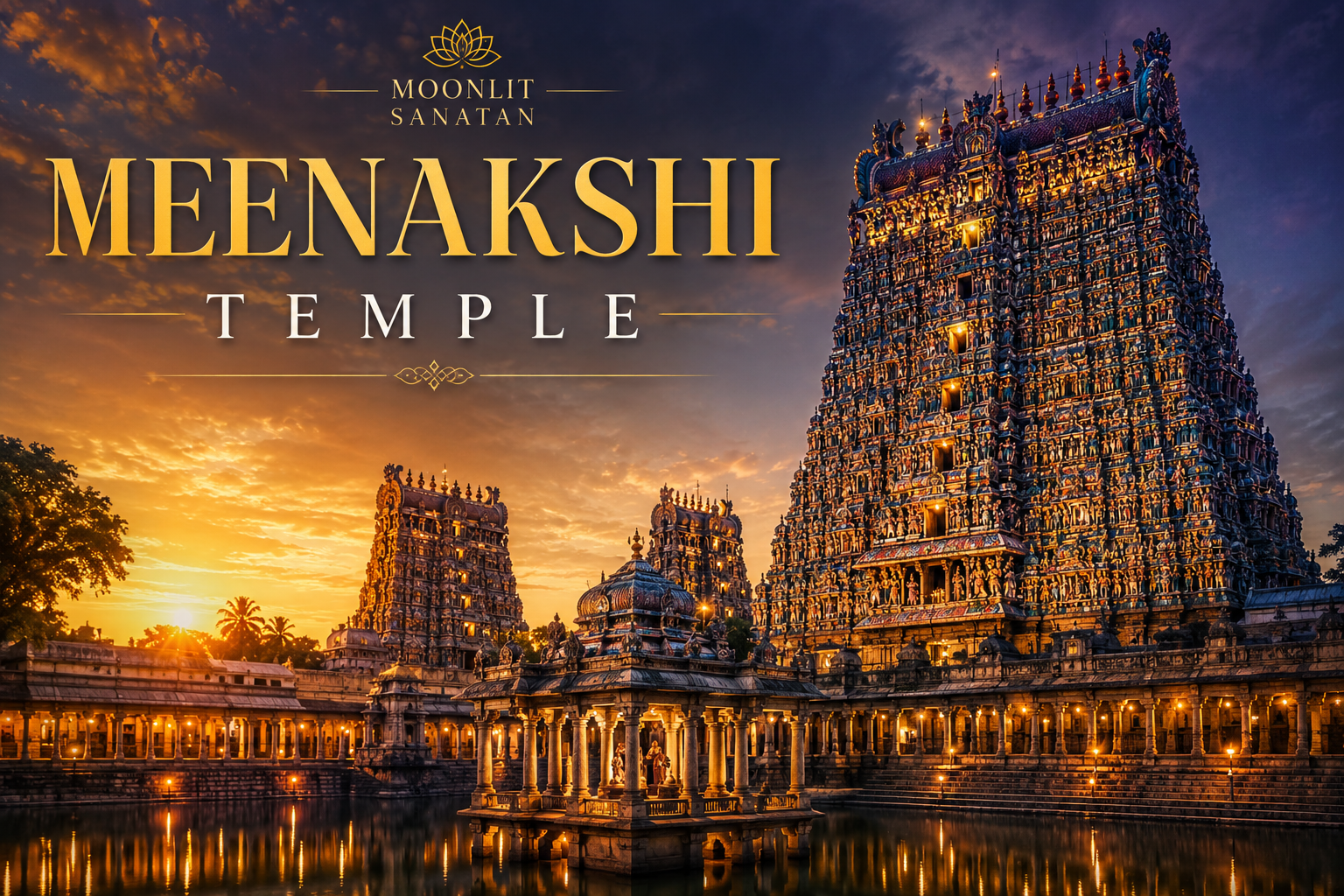
Somewhere in the heart of Madurai, long before the city had roads or railway lines, there was already a temple — and around that temple, a city grew. That is not a poetic exaggeration. Madurai was quite literally planned in concentric circles around the Meenakshi Amman Temple, with streets spiraling outward from its gopurams like petals unfolding from a lotus. Few temples in India can claim to be the literal center of gravity — architectural, spiritual, and civic — of the city around them. Meenakshi Temple can.
This guide walks you through everything the Meenakshi Temple represents — its mythology, its 2,000-plus years of layered history, its staggering Dravidian architecture, and everything you need to know if you are planning an actual visit to Madurai. Whether you've arrived here as a devotee, a history enthusiast, or simply someone who typed "meenakshi mandir" into Google out of curiosity, you're about to get the complete picture — no fluff, no filler, just everything worth knowing before you go.
Meenakshi Temple — Quick Facts
| Deity | Goddess Meenakshi (a form of Parvati) and Lord Sundareswarar (a form of Shiva) |
| Location | Madurai, Tamil Nadu, on the southern bank of the Vaigai River |
| Architecture style | Dravidian, with 14 gopurams (gateway towers) |
| Tallest gopuram | Southern tower, roughly 170 feet (52 metres) |
| Morning darshan | 5:00 AM – 12:30 PM |
| Evening darshan | 4:00 PM – 10:00 PM |
| Entry fee | Free for general darshan; paid options for faster/special darshan |
| Major festival | Chithirai Festival / Meenakshi Thirukalyanam (April) |
| Nearest airport | Madurai Airport (approx. 12 km) |
| Nearest railway station | Madurai Junction (approx. 2 km) |
Who Is Goddess Meenakshi?
The name "Meenakshi" comes from two Tamil-Sanskrit roots — meen, meaning fish, and akshi, meaning eyes. Together, they describe a goddess with eyes shaped like a fish — long, elegant, and slightly elongated at the corners, a form of beauty widely celebrated in classical Tamil literature. She is depicted with green-hued skin, dressed in a green saree, holding a parrot in one hand and a lotus or a weapon in another, depending on the sculpture.
Meenakshi is worshipped as a form of Goddess Parvati, but she isn't simply a consort figure here — in Madurai, she is the primary, ruling deity. According to temple legend, Meenakshi was born to the Pandya king Malayadhwaja and Queen Kanchanamalai after years of childless prayer. She arrived already fully grown, armed, and — unusually for temple mythology — with three breasts, a mark that was prophesied to vanish the moment she met her destined husband. She went on to conquer kingdoms and even challenge the gods of the heavens, until she met Lord Shiva at Mount Kailash, at which point the third breast disappeared exactly as foretold, and she recognized him as her divine match.
Before that meeting at Kailash, however, Meenakshi's story includes a chapter that rarely makes it into simplified retellings: she was raised and trained as a warrior-queen. Crowned successor to her father, she is said to have led military campaigns across the subcontinent, conquering kingdom after kingdom in every direction, undefeated in every battle — until she marched toward Mount Kailash itself and came face to face with Shiva. In that instant, tradition says, her fierce composure gave way to shyness, her third breast vanished exactly as prophesied, and the invincible warrior-queen recognized her destined husband. It's a striking narrative arc: a goddess defined first by conquest and sovereignty, and only afterward by marriage — which is precisely why, even after the wedding, Meenakshi is worshipped in Madurai as the primary ruling deity of the city rather than as a secondary consort figure.
Shiva then took the form of Sundareswarar ("the handsome one") and traveled to Madurai, where the two were married in a grand celestial ceremony attended by gods, sages, and the people of the city. This wedding — the Meenakshi Kalyanam — is not just an old story; it is re-enacted every single year during the Chithirai Festival, drawing over a million devotees to Madurai.
What makes this mythology unusual, and important for understanding the temple, is the reversal of the usual divine hierarchy. In most Shiva temples, Shiva is the primary deity and his consort is worshipped alongside him. In Madurai, it is the other way around — Meenakshi is the ruling monarch of the city, and Sundareswarar is honored as her royal consort. Every evening, in one of the temple's most beloved rituals, a procession carries Sundareswarar's image to Meenakshi's chamber to "sleep" beside her — a nightly reunion of the divine couple that devotees travel long distances just to witness.
History and Origins of Meenakshi Temple
Piecing together the Meenakshi Temple's origin story means piecing together nearly 2,500 years of South Indian history, because the temple as it stands today is really the product of several dynasties building, rebuilding, and expanding on top of each other's work.
The Earliest Legends
Temple tradition holds that the site was sacred long before any structure stood on it. As the story goes, the god Indra himself, seeking forgiveness for a past transgression, discovered a naturally formed Shiva lingam here beneath a kadamba tree and built a small shrine over it. Other celestial beings are said to have followed his example, and a human devotee who witnessed gods worshipping at this spot reported it to the local Pandya king, prompting the construction of an actual temple. Whether or not you take the legend literally, it reflects something real: this location has been treated as uniquely sacred for a very, very long time. References to the presiding deity of Madurai appear in Tamil Sangam literature and in the 7th-century devotional hymns of the Nayanars, confirming the temple's importance well over a thousand years ago.
The Pandya Foundation
The historical temple is generally credited to the Pandya dynasty, with King Kulasekara Pandya identified in tradition as the ruler who formalized the shrine into a proper temple complex. Madurai itself was the Pandya capital, and the temple functioned as both the spiritual and civic heart of the kingdom — the point around which the city's streets were laid out in concentric squares, a planning philosophy that is still visible in Madurai's street map today.
Chola Contributions and a Period of Destruction
When the Chola dynasty took control of the Madurai region around the 10th century, they added several shrines and mandapams (pillared halls) to the temple complex, drawing on their own considerable expertise in temple architecture. Later, during the turbulent 14th century, Madurai suffered significant destruction, and the temple complex was damaged in the process — a period that very nearly erased much of what earlier dynasties had built.
The Nayak Dynasty: The Temple's Golden Age
The Meenakshi Temple owes most of its current grandeur to the Nayak rulers of the 16th and 17th centuries. After the Vijayanagara Empire appointed Nayak governors to oversee the Madurai region, King Vishwanatha Nayaka rebuilt the temple following the earlier destruction, reviving it as the city's central landmark.
It was his successor, Thirumalai Nayak (who ruled from 1623 to 1659), who transformed the temple into the sprawling architectural showpiece it is today. Thirumalai Nayak commissioned most of the temple's towering gopurams, each covered in thousands of painted stucco sculptures, and expanded the complex with new mandapams, corridors, and shrines. Additional renovations followed under Tirumala Nayaka's contemporaries and successors, including Kumara Krishnappa Nayaka, who worked on the granite structures in the late 16th century. What visitors see today is the layered result of Pandya foundations, Chola additions, and Nayak grandeur — three dynasties, separated by centuries, all contributing to a single continuous act of devotion.
Architecture of Meenakshi Temple: A Dravidian Masterpiece
If there is one thing that stops first-time visitors in their tracks, it is the sheer scale and detail of the Meenakshi Temple's architecture. This is not a single shrine — it is a walled temple city spread across roughly 14 acres, built as a series of concentric enclosures, each layer fortified with its own masonry walls.
The 14 Gopurams
The temple's most iconic feature is its collection of 14 gopurams — towering gateway structures that dominate Madurai's entire skyline. These gopurams range between roughly 45 and 52 metres in height, with the southern tower standing as the tallest at approximately 170 feet. Every inch of every gopuram is covered in thousands of brightly painted stucco figures depicting gods, goddesses, demons, celestial beings, and scenes from Hindu mythology — effectively turning each tower into a vertical, three-dimensional storybook. As a living ritual, these sculptures are traditionally repainted and repaired roughly every twelve years to preserve their vibrancy, a restoration cycle that has continued for generations.
Among the most significant is the Kadaka Gopuram, the five-storeyed gateway that leads directly to the sanctum of Goddess Meenakshi, rebuilt by Tumpichi Nayakkar in the mid-16th century. The temple has four main gopurams on its outer walls — one facing each cardinal direction — allowing devotees to enter the complex from any side.
The Hall of a Thousand Pillars
Inside the complex stands the famed Aayiram Kaal Mandapam, or Hall of a Thousand Pillars — a breathtaking pillared hall where every single column is carved with a different sculptural theme, no two exactly alike. Today, part of this hall functions as an art museum, displaying temple sculpture, bronze icons, and artifacts collected over centuries. Walking through it slowly, row after row, is one of the few places in India where you can trace the evolution of a single artistic tradition across hundreds of years without leaving one room. Look closely and you'll spot sculpted horses mid-gallop, mythical beasts called yalis rearing on their hind legs, and depictions of dancers frozen mid-movement — all carved from single blocks of granite using tools that, by modern standards, seem almost impossibly modest for the precision achieved.
The Musical Pillars
Elsewhere in the complex, visitors can find a set of stone pillars that produce distinct musical notes when struck — an engineering feat achieved purely through the density and carving of the stone itself, long before anyone had the vocabulary of "acoustic architecture."
The Golden Lotus Tank
At the center of one courtyard lies the Porthamarai Kulam, or Golden Lotus Tank, a sacred pond named after a golden lotus structure believed to sit at its center. According to temple lore, Lord Shiva blessed the tank and decreed that no marine life would ever grow in it. In Tamil literary tradition, the tank held an additional, almost magical role — new works of Tamil poetry were said to be tested by being placed on its waters, with genuine literary merit determining whether they floated or sank.
Shrines Within the Complex
Beyond the two principal shrines dedicated to Meenakshi and Sundareswarar, the temple complex houses numerous smaller shrines to deities including Ganesha, Murugan, Lakshmi, Rukmini, and Saraswati — making the temple a self-contained universe of Hindu worship rather than a single-deity site.
Because of this scale and craftsmanship, the temple is frequently discussed as one of the finest surviving examples of Dravidian temple architecture anywhere in India, and its candidacy for UNESCO World Heritage recognition has been raised repeatedly by heritage bodies and historians.
Meenakshi Temple in Tamil Literature and Culture
It's difficult to overstate how deeply this temple is woven into Tamil cultural memory. Long before it appears in temple inscriptions or dynastic records, references to Madurai's presiding deity show up in Tamil Sangam literature — some of the oldest surviving literary works in any Dravidian language, composed in the centuries around the turn of the millennium. The temple's presiding god also appears in the Tevaram, a body of 7th-century devotional hymns composed by the Nayanar saints, poet-devotees who traveled across Tamil Nadu singing praises of Shiva at each of the sacred sites they visited.
This literary connection isn't just historical trivia — it's part of why the Golden Lotus Tank inside the temple carries such cultural weight. In Tamil literary tradition, the Sangam academies were said to test new poetic works by placing them on the tank's waters: verses of genuine merit would float, while inferior compositions would sink. Whether taken literally or as symbolic legend, the story reflects just how tightly this temple was bound up with Tamil identity, scholarship, and artistic standards, not merely religious ritual. Even today, Madurai is often referred to as the "Athens of the East" partly because of this deep historical association between the temple, the city, and Tamil literary flowering.
Religious and Spiritual Significance
For devotees, the Meenakshi Temple is far more than an architectural landmark — it is a living, breathing center of daily worship where ritual has continued uninterrupted for centuries. The temple follows an elaborate daily schedule of poojas, including the Thrikala Pooja performed at set hours of the morning, afternoon, and evening, the Uchikkala Pooja around midday, the evening Maalai Aarti, and the deeply symbolic Palliarai Pooja at night — the ritual in which Lord Sundareswarar is ceremonially escorted to Goddess Meenakshi's chamber, re-enacting their divine union each and every night.
Devotees visit Meenakshi Temple seeking blessings connected to marital harmony, family prosperity, and fertility, given the goddess's central role as both a fierce, sovereign warrior-queen and a nurturing consort. The temple is also counted among the Paadal Petra Sthalams — the temples of Lord Shiva glorified in the devotional Tevaram hymns composed by the Tamil Nayanar saints between the 6th and 9th centuries CE, placing Meenakshi Temple within one of the oldest continuous traditions of Shaiva devotional literature in India.
What draws people back, again and again, isn't only ritual or mythology — it is the sensory intensity of the place itself. The scent of camphor and jasmine, the sound of temple bells and nadaswaram music echoing off centuries-old stone, the sight of oil lamps flickering across painted gopuram figures at dusk — the temple engages every sense simultaneously, which is precisely why so many visitors describe their darshan here as transformative rather than merely touristic.
Location and How to Reach Meenakshi Temple
Meenakshi Temple sits in the very center of Madurai city, Tamil Nadu, on the southern bank of the Vaigai River — a location so central that the city itself is often described as having grown outward from the temple in the shape of a lotus.
By Air
Madurai Airport is the closest airport, located roughly 12 km from the temple, with regular domestic connections to major Indian cities including Chennai, Bengaluru, and Mumbai.
By Rail
Madurai Junction is the primary railway station, just about 2 km from the temple, and is well connected to most major cities across South India and beyond.
By Road
Madurai has excellent road connectivity via national highways linking it to Chennai (around 460 km), Coimbatore, Tiruchirappalli, and other major Tamil Nadu cities, with regular state-run and private buses operating overnight services for travelers coming from within the state. Local autos and cabs are readily available from the airport and railway station directly to the temple, and given how central the temple is, most hotels in Madurai's old city area are within easy walking distance of it — a detail worth factoring in when choosing where to stay, since navigating central Madurai's narrow, temple-radiating streets by vehicle during peak hours can take considerably longer than walking.
Meenakshi Temple Darshan Timings and Pooja Schedule
Meenakshi Temple follows a two-session daily schedule, with a midday closure reserved for ritual preparation and the deity's rest period:
- Morning darshan: 5:00 AM to 12:30 PM
- Evening darshan: 4:00 PM to 10:00 PM
General darshan is free for all devotees, while paid special and VIP darshan options exist for those seeking a faster, less crowded route to the sanctum — useful during peak season or festival days when queues can stretch considerably. Timings may shift slightly during major festivals such as Chithirai, when the temple often extends its hours well into the night to accommodate the enormous crowds.
A practical tip: Early morning hours, roughly between 5:00 AM and 7:00 AM, tend to be the least crowded window for a calmer, more contemplative darshan experience, before tour groups and the midday rush arrive.
Best Time to Visit Meenakshi Temple
The ideal window to visit is between October and March, when Madurai's temperatures sit comfortably between 20°C and 30°C. Madurai is a warm city year-round, but from April onward, daytime temperatures can climb to around 40°C, making long hours of walking through open courtyards genuinely exhausting. Winter also happens to be peak tourist season, so booking flights and hotels a little in advance is advisable if you're travelling between December and February.
If you want to witness the temple at its most spectacular, though, timing your visit around the Chithirai Festival in April is unmatched — just be prepared for extraordinary crowds, since this is when Madurai's population effectively multiplies for the duration of the celebrations.
Visitor Guidelines and Dress Code
- Dress conservatively — shoulders and legs should be covered for both men and women.
- Footwear must be removed and left at the designated counters outside the temple.
- Handbags, belts, wallets, and any items made of animal leather are not permitted inside the complex.
- Photography is restricted inside the inner sanctum, though it is generally allowed in the outer corridors and mandapams.
- Plan for at least two to three hours to comfortably explore the complex and take in a proper darshan without rushing.
Festivals Celebrated at Meenakshi Temple
Chithirai Festival (Meenakshi Thirukalyanam)
This is the temple's grandest celebration — a twelve-day festival held in April that re-enacts the divine wedding of Meenakshi and Sundareswarar. It culminates in a massive procession through the streets of Madurai and draws well over a million devotees, making it one of the largest religious gatherings in South India.
Teppotsavam (Float Festival)
Held at the Mariamman Teppakulam tank, this festival sees the temple deities placed on elaborately decorated floats that are paraded across the illuminated water — a visually stunning event that draws large crowds, particularly in the evening.
Navaratri
Like most major Shakti-associated temples, Meenakshi Temple observes Navaratri with nine nights of special worship honoring the goddess in her many forms, culminating in Vijayadashami celebrations.
Aadi Pooram and Other Monthly Observances
Beyond the major annual festivals, the temple maintains a packed ritual calendar, with special poojas occurring on new moon and full moon days, and additional observances tied to the Tamil lunar calendar throughout the year.
Nearby Attractions and Suggested Itinerary
Because Meenakshi Temple sits at the literal center of Madurai, almost everything else worth seeing in the city radiates outward from it — making it easy to combine your darshan with a broader day of sightseeing.
Thirumalai Nayak Palace
Built in 1636 by the same king who commissioned much of the temple's grandest architecture, this palace is a short ride away and showcases a striking blend of Dravidian and Rajput architectural styles, centered around a vast pillared courtyard.
Vaigai Dam and River
For a quieter, more scenic stop, the Vaigai River — on whose banks the temple itself sits — offers pleasant riverside views, particularly toward the evening.
Gandhi Memorial Museum
Housed in the historic Tamukkam Palace, this museum documents India's freedom struggle and holds a section of the blood-stained garment Mahatma Gandhi was wearing at the time of his assassination.
Suggested One-Day Itinerary
- 5:00 AM – 8:00 AM: Early morning darshan at Meenakshi Temple, before the crowds build up
- 8:30 AM – 10:00 AM: Breakfast at a local Madurai eatery, followed by a walk through the Hall of a Thousand Pillars
- 10:30 AM – 12:30 PM: Visit Thirumalai Nayak Palace
- 1:00 PM – 3:30 PM: Lunch and rest during the temple's midday closure
- 4:00 PM – 6:00 PM: Return for evening darshan and witness the Maalai Aarti
- 6:30 PM onward: Explore the bustling streets and markets surrounding the temple, famous for jasmine flowers, silk, and traditional Madurai sweets
Frequently Asked Questions About Meenakshi Temple
Who built Meenakshi Temple?
The temple's foundation is credited to the Pandya dynasty, with King Kulasekara Pandya traditionally identified as its founder. The temple was later expanded significantly by the Chola dynasty and reached its present architectural grandeur under the Nayak rulers, particularly Thirumalai Nayak in the 17th century.
What is the significance of Meenakshi Temple's architecture?
The temple is considered one of the finest surviving examples of Dravidian temple architecture in India, known for its 14 elaborately sculpted gopurams, the Hall of a Thousand Pillars, musical pillars, and the sacred Golden Lotus Tank.
What are the visiting hours of Meenakshi Temple?
The temple is open daily from 5:00 AM to 12:30 PM for morning darshan, and again from 4:00 PM to 10:00 PM for evening darshan, with timings occasionally extended during major festivals.
Is there an entry fee for Meenakshi Temple?
General darshan is free for all visitors. Paid special and VIP darshan tickets are available for those who prefer a faster route through the queues, particularly useful during festival season.
Where exactly is Meenakshi Temple located?
The temple is located in the heart of Madurai city, Tamil Nadu, on the southern bank of the Vaigai River, roughly 12 km from Madurai Airport and 2 km from Madurai Junction railway station.
What is the best time of year to visit?
October through March offers the most comfortable weather for a relaxed visit. If you want to experience the temple's biggest celebration, plan around the Chithirai Festival in April, keeping in mind that crowds are extremely high during this period.
Why is Goddess Meenakshi worshipped before Lord Shiva at this temple?
Unlike most Shiva temples, Meenakshi is regarded as the primary ruling deity of Madurai, with Sundareswarar (Shiva) honored as her consort. This reversal traces back to her mythology as a warrior-queen who ruled and conquered in her own right before her marriage to Shiva.
Can non-Hindus visit Meenakshi Temple?
Yes, the temple's outer courtyards, gopurams, and mandapams are open to visitors of all backgrounds. However, access to the innermost sanctum sanctorum is generally restricted to Hindu devotees, a policy common across many major South Indian temples.
Continue Exploring Sacred India
Final Thoughts
Meenakshi Temple is not a place you simply visit and check off a list. It is a place that has been continuously alive — in ritual, in architecture, in civic identity — for well over two thousand years, through the rise and fall of the Pandya, Chola, and Nayak dynasties, and into the present day. Every gopuram, every painted figure, every evening procession carrying Sundareswarar to Meenakshi's chamber is part of an unbroken thread of devotion that stretches back further than most nations have existed.
Whether you come as a pilgrim seeking blessings, a traveler chasing extraordinary architecture, or simply someone curious about one of India's most storied cities, Meenakshi Temple has a way of leaving an impression that outlasts the visit itself. Long after you've left Madurai, it's the small sensory details that tend to stay with you — the particular gold light that falls across the Golden Lotus Tank in the late afternoon, the echo of the musical pillars, the sight of a gopuram disappearing into monsoon clouds. Few places manage to be this historically important and this alive at the same time.