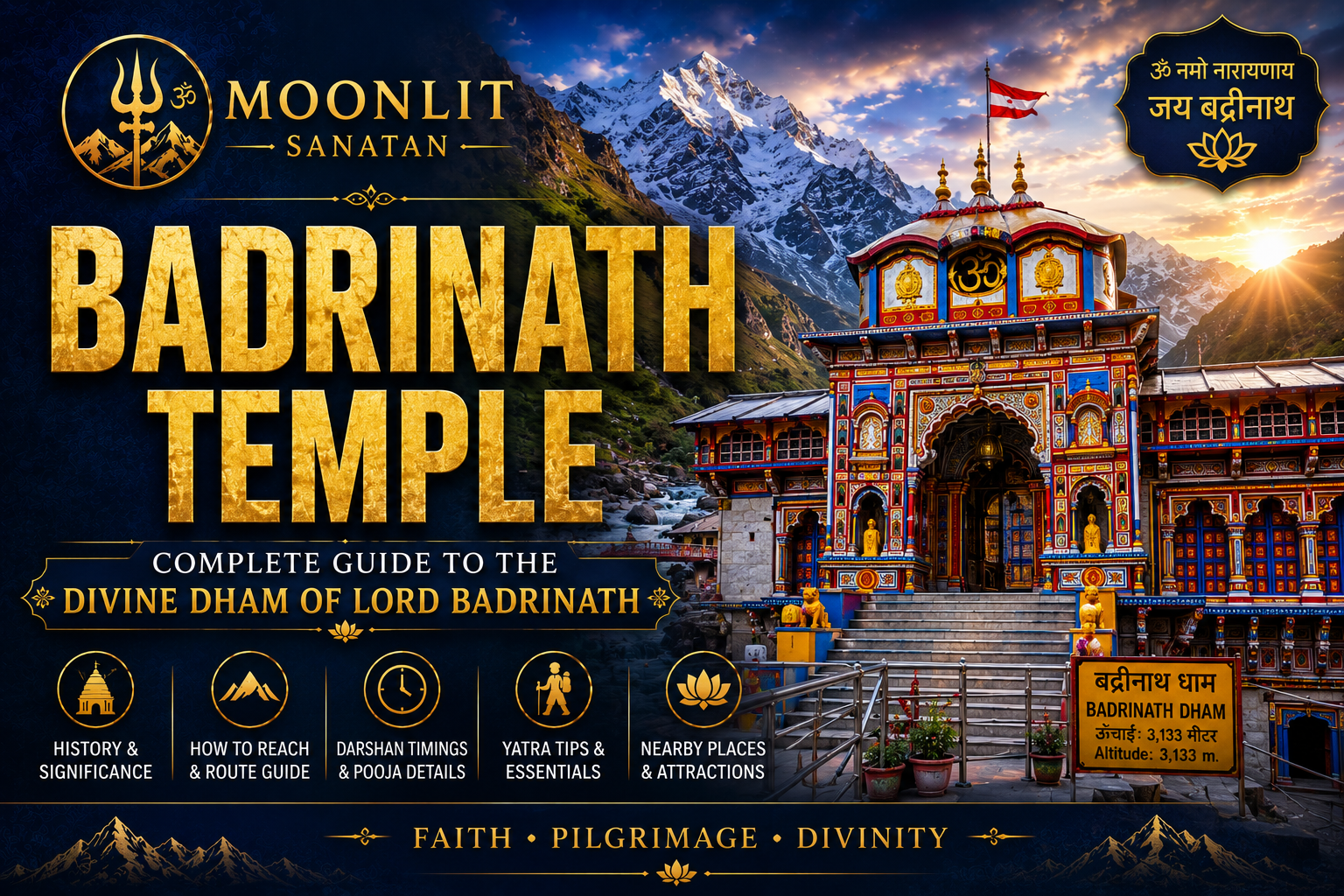
Badrinath Temple: The Complete Guide to the Sacred Dham of Lord Vishnu
History, legend, 2026 opening dates, darshan and aarti timings, how to reach, and everything else you need to plan your journey to Badrinarayan.
Quick Facts
Flanked by the twin peaks of Nar and Narayan, with the glacial Alaknanda River running past its steps and Neelkanth Parvat rising like a backdrop behind it, Badrinath Temple is where Hindu tradition places Lord Vishnu himself, seated in eternal meditation for the welfare of the world. It is one of the very few pilgrimage sites in India honoured twice over — once as a stop on the pan-India Char Dham circuit established by Adi Shankaracharya, and again as the final and most revered stop of Uttarakhand's own Chota Char Dham Yatra.
This guide walks through Badrinath's mythology, its architecture and rituals, the practicalities of the 2026 season, and the sites around it worth building extra days into your itinerary for — everything you need whether you're planning your first Char Dham journey or simply researching the temple's story.
The Story of Badrinath Temple
Long before it was called Badrinath, this valley in the high Himalayas was known as Badrikashram — the hermitage of the badri, or wild jujube tree. The Vishnu Purana and Skanda Purana both place Lord Vishnu here, sitting in penance for the welfare of humankind through an age so harsh that even a god needed shelter from it. According to the legend most widely told at the temple, Goddess Lakshmi watched her consort endure the brutal Himalayan cold during his meditation and, unable to bear it, transformed herself into a badri tree, spreading her branches over him to provide shade and shelter. Moved by her devotion, Vishnu named the place Badri Ashram in her honour — and the name has carried through more than a thousand years of pilgrimage since.
A second, closely linked legend explains the deeper theology of the site. The Vishnu Purana describes Nar and Narayan as twin sons of the sage Dharma, who performed intense tapasya (penance) at this very spot for the good of the world. Vishnu is worshipped here as Badrinarayan specifically because this is understood to be the place of that penance — which is also why the two mountain ranges cradling the temple are named Nar Parvat and Narayan Parvat to this day.
Badrinath's connection to the Mahabharata runs deeper still. Tradition holds that sage Ved Vyasa composed the great epic in a cave near the neighbouring village of Mana, and that the five Pandava brothers, at the end of their earthly life, walked from this valley toward the Swargarohini peak on their final journey toward the heavens — making Badrinath not just a place of worship, but a place many devotees consider to be the threshold between this world and the next.
The temple's more recent, documented history is tied closely to Adi Shankaracharya, the 8th-century philosopher-saint who is credited with reviving and systematising Hindu pilgrimage across the subcontinent. Tradition holds that Shankaracharya discovered the black stone idol of Vishnu in the Narad Kund, a pool in the Alaknanda River near the temple, and personally established and consecrated it at its current location — a moment considered the formal founding of the temple as it exists today. Local tradition also holds that worship at the site had lapsed for a period before Shankaracharya's arrival, and that his rediscovery and re-consecration of the idol was as much a revival as a founding — a detail that adds weight to why he's remembered so centrally in the temple's story rather than simply as an early patron.
Like many Himalayan shrines, the structure itself has been rebuilt and repaired multiple times since, following earthquakes and the extreme weather the region is known for, most substantially by the kings of the Garhwal dynasty, who are responsible for much of the temple's present appearance. Despite these rebuilds, the site's sanctity has never been treated as diminished — Badrinath is regarded as one of only eight Svayam Vyakta Kshetras, self-manifested shrines of Vishnu believed to have appeared on their own rather than been installed by human hands, a status shared with very few other temples in India.
Badrinath's significance also extends well beyond North Indian tradition. It is counted among the 108 Divya Desams — the sacred Vishnu temples celebrated in the devotional hymns of the twelve Alvars, the Tamil poet-saints whose verses form the scriptural foundation of Sri Vaishnavism. Of the 108, the overwhelming majority sit in Tamil Nadu and South India; Badrinath is one of the few in the Himalayas, making it a pilgrimage destination not just for Uttarakhand's Char Dham travellers but for Vaishnava devotees completing the much longer Divya Desa Yatra across the length of the country.
Architecture, Deity & Rituals
Badrinath's exterior is unmistakable among Himalayan temples for its brightly painted facade — a departure from the bare grey stone of nearby Kedarnath — built in a style typical of Garhwali temple architecture, with a tall, conical shikhara rising above the sanctum and a gilded roof that catches the light against the surrounding snowfields. The temple complex is organised into three main sections: the Garbha Griha (sanctum sanctorum), where the deity resides; the Darshan Mandap, the hall where the closest general viewing takes place; and the larger Sabha Mandap, the assembly hall where pilgrims gather before and after darshan.
The presiding deity is a roughly one-metre black stone idol of Lord Vishnu as Badrinarayan, seated in a meditative posture and adorned daily with elaborate ornaments, flowers, and sacred fabrics. The idol is traditionally described as a Saligram — a stone naturally sacred to Vishnu worship — and is believed, per temple tradition, to have been recovered from the Narad Kund before Adi Shankaracharya installed it in the sanctum.
Tapt Kund: The Hot Spring Before the Sanctum
Just below the temple, on the bank of the Alaknanda, lies Tapt Kund — a natural hot spring that maintains a near-constant temperature of around 45°C regardless of the freezing air around it. Pilgrims traditionally bathe here before entering the temple, treating the dip as a purification ritual that prepares both body and mind for darshan. Given the altitude and cold, many first-time visitors underestimate how genuinely welcome that warm water is after the journey to reach it.
Brahma Kapal: Rites for the Departed
A short walk from the temple, a flat rock platform on the Alaknanda's banks known as Brahma Kapal is considered the most sacred site in India for performing shraddha and pind-daan — rites offered in memory of deceased ancestors. Many pilgrim families build this ritual into their Badrinath visit specifically, making it one of the more emotionally significant stops on the yatra for those who come to honour family members who have passed.
Daily Rituals
The temple's ritual calendar runs from before dawn until late evening. The day opens with the Maha Abhishek — a closed-door bathing ceremony for the deity using sixteen sacred substances — followed by the Abhishek Puja, after which the sanctum opens for general public darshan. Midday brings the Rajbhog Aarti, an offering of food to the deity, and the evening is marked by the Geet Govind recitation, a musical offering unique to Badrinath in which verses from Jayadeva's 12th-century devotional poem are sung before the deity. The day closes with the Shayan Aarti, the ritual that puts the deity "to rest" for the night.
Subsidiary Shrines in the Temple Complex
Beyond the main sanctum, the Badrinath complex houses more than a dozen smaller shrines, each with its own place in the temple's daily worship and pilgrim tradition. Most visitors move through these after their main darshan, and knowing what they are helps you get more out of the walk around the complex rather than hurrying past unmarked doorways.
- Kuber Shrine: dedicated to Kuber, the treasurer of the gods, worshipped alongside Vishnu as a guardian of the sanctum's wealth and offerings.
- Uddhava Shrine: honours Uddhava, Krishna's close friend and disciple in the Bhagavata Purana, said to have accompanied Vishnu to this Himalayan retreat.
- Garud Shrine: dedicated to Garuda, Vishnu's eagle mount, typically positioned facing the main sanctum in the manner of Vishnu temples across India.
- Adi Shankaracharya's Shrine: a small memorial shrine to the saint credited with consecrating the temple, honouring his role in the site's living history.
- Sheshnetra: a rock near the temple bearing a natural formation devotees interpret as an eye, associated with Vishnu's serpent couch, Shesha.
These shrines are compact and quick to visit, but for many pilgrims they round out the experience — a reminder that Badrinath isn't a single point of worship so much as a small universe of connected figures from the wider Vaishnava tradition, gathered around one central sanctum.
Panch Badri: The Five Sacred Badris
Few first-time visitors realise that Badrinath is only the principal shrine of a group of five related temples collectively known as the Panch Badri, spread across the Garhwal Himalayas and connected by shared legend and, in most cases, a shared priesthood tradition. Pilgrims aiming for a truly complete Badrinath-region pilgrimage sometimes plan for all five over multiple trips.
| Shrine | Significance |
|---|---|
| Vishal Badri | The main Badrinath Temple itself — the principal and most visited of the five. |
| Yogadhyan Badri | Located at Pandukeshwar; associated with King Pandu's penance and a meditating form of Vishnu. |
| Bhavishya Badri | Near Subain village; believed to be the site where Vishnu will be worshipped in the future, once access to the main temple is eventually lost to the mountains. |
| Vridha Badri | At Animath; depicts Vishnu in his aged (vridha) form and is considered one of the oldest of the five shrines. |
| Adi Badri | Near Karnaprayag; a cluster of ancient temples believed to be the very first site where Badrinath was worshipped. |
You don't need to know the Panch Badri circuit to have a complete Badrinath pilgrimage — the overwhelming majority of pilgrims visit only Vishal Badri (the main temple) and consider their yatra fulfilled. But if you're the kind of traveller who likes to go a layer deeper than the standard itinerary, the other four are a rewarding, much quieter alternative to the main season's crowds.
Location & Geography
Badrinath Temple sits in the Chamoli district of Uttarakhand, at an altitude of 3,133 metres, on the banks of the Alaknanda River — one of the two headstreams that join further downstream to form the Ganga. The temple is cradled between the Nar and Narayan mountain ranges, with the sharp, glacier-clad summit of Neelkanth Parvat (6,597 m) visible rising directly behind it, a view so striking it's become one of the most photographed backdrops in the entire Char Dham circuit. Unlike Kedarnath, Badrinath is connected by a motorable road all the way to the temple town itself, which makes it considerably more accessible despite its remote, high-altitude setting.
Badrinath & the Two Char Dhams
Badrinath holds a distinction no other Himalayan shrine shares: it belongs to two entirely separate pilgrimage circuits, both called "Char Dham," which frequently confuses first-time visitors researching the yatra.
Don't Confuse the Two Circuits
- The (Chota) Char Dham of Uttarakhand: Yamunotri, Gangotri, Kedarnath, and Badrinath — a regional Himalayan pilgrimage circuit, typically completed in that order over 10–12 days.
- The (Bada) Char Dham of India: Badrinath (north), Puri's Jagannath Temple (east), Dwarka (west), and Rameswaram (south) — a pan-India circuit established by Adi Shankaracharya to represent the four cardinal directions of the subcontinent.
Badrinath is the only site that appears on both lists, which is a large part of why it's treated as the most significant single stop of the Uttarakhand yatra, even though Kedarnath's trek tends to get more attention for its difficulty. If you've already read our guide to Kedarnath Temple, Badrinath is the natural next stop on the same circuit — most pilgrims visit the two back to back via Joshimath.
Opening & Closing Dates 2026
Like the rest of the Char Dham circuit, Badrinath Temple closes completely for the winter months, when the region is cut off by heavy snowfall and road access becomes impossible. During this period, worship of Lord Badrinarayan continues at the temple's winter seat, the Narsimha Temple in Joshimath, roughly 45 km away.
| Milestone | 2026 Date |
|---|---|
| Opening date decided | Basant Panchami (traditional) |
| Temple opens (Kapat Khulna) | 23 April 2026, 6:15 AM |
| Best visiting window | Mid-May to mid-June, mid-Sept to late Oct |
| Closing date decided | Vijayadashami (traditional) |
| Temple closes (tentative) | ~13 November 2026 (Bhai Dooj) |
| Winter seat | Narsimha Temple, Joshimath |
Exact dates shift slightly year to year based on the Hindu Panchang and weather conditions — always confirm the current season's dates on the official BKTC portal before booking travel.
Darshan & Aarti Timings
On a typical day during the open season, the temple follows a fairly consistent daily rhythm, broken into a morning session and an evening session, with a midday break for the deity's own meal (bhog).
| Ritual / Session | Typical Timing |
|---|---|
| Maha Abhishek (booking required) | 4:30 AM – 6:30 AM |
| General darshan (morning) | 7:00 AM – 1:00 PM |
| Rajbhog Aarti | Around 11:30 AM |
| Midday break | 1:00 PM – 4:00 PM |
| General darshan (evening) | 4:00 PM – 9:00 PM |
| Geet Govind & evening aarti | 6:00 PM – 7:30 PM |
| Shayan Aarti (temple closes) | 8:30 PM – 9:00 PM |
Special Pujas
Beyond general darshan, the temple offers a range of paid special pujas booked through the official BKTC portal or the temple counter, including the Maha Abhishek, Ved Path, Geeta Path, Vishnu Sahasranam Path, Swarna Aarti, Kapoor Aarti, and Shayan Aarti seva — prices generally range from around ₹150 for simpler offerings up to several thousand rupees for the most elaborate morning Abhishek slots. Only one pilgrim is typically permitted per booked puja slot, and bookings are non-refundable, so confirm your travel dates before paying.
Insider tip: if you're hoping for a quieter, less rushed darshan, the 7:00 PM–8:30 PM evening window tends to be noticeably calmer than the morning rush.
How to Reach Badrinath Temple
Unlike Kedarnath, Badrinath is connected by road all the way to the temple town, which makes it one of the more accessible high-altitude Himalayan shrines despite the distance involved.
- Reach Haridwar, Rishikesh, or DehradunBy train, flight (Jolly Grant Airport, Dehradun), or road from Delhi — these are the standard gateway towns for the entire Char Dham circuit.
- Travel via Rishikesh and JoshimathBy road, roughly 320 km from Haridwar, taking about 10–12 hours depending on traffic and road conditions.
- Arrive in BadrinathThe road runs directly into the temple town — no trek is required, unlike Kedarnath.
- Optional: fly in by helicopterHelicopter services connect from select sectors during peak season; book only through the official BKTC or IRCTC HeliYatra portals.
Many pilgrims combine the journey with a stop at Auli, near Joshimath, home to India's longest cable car (a roughly 4 km ropeway) — a natural add-on if you have a flexible extra day either before or after your Badrinath darshan.
Registration & 2026 Rules
As with the rest of the Char Dham Yatra, registration is mandatory for every pilgrim visiting Badrinath in 2026, primarily for crowd management and safety tracking. Registration can be completed online through the Uttarakhand Tourism portal, with a small fee reportedly being introduced to help reduce fraudulent bookings — carry a valid photo ID (Aadhaar, passport, or voter ID) for both registration and entry checkpoints.
New for the 2026 Season
- No cameras or phones near the sanctum: devices are not permitted beyond the Singhdwar, roughly 100 metres before the Garbha Griha, to preserve the sanctity of the shrine and improve crowd flow.
- Entry restrictions for non-Hindus: the Badrinath-Kedarnath Temple Committee has approved restrictions on non-Hindu entry into the temple complex and sanctum, verified through the registration system; the rule does not affect non-Hindu staff working in pilgrimage logistics such as mule handlers and transport operators.
Because these rules were newly introduced for the 2026 season, it's worth checking the official portal close to your travel dates in case of further updates.
Mana Village & Nearby Places
Badrinath's setting makes it easy to turn a single darshan into a fuller day or two of exploring — most of the sites below sit within a few kilometres of the temple, and several can comfortably be combined into a single afternoon.
Mana Village
Roughly 3 km away and often marketed as the last inhabited Indian village before the Tibet border. A cluster of stone houses and tea shops set against the mountains, and the starting point for several of the other sites on this list.
Vyas Gufa & Ganesh Gufa
Two caves in Mana Village — Vyas Gufa is said to be where sage Ved Vyasa composed the Mahabharata, while the neighbouring Ganesh Gufa is linked to Lord Ganesha's role as the epic's scribe.
Bhim Pul
A massive natural rock bridge over the Saraswati River in Mana, said in legend to have been placed there by Bhima of the Pandavas so his wife Draupadi could cross safely.
Vasudhara Falls
A roughly 400-foot waterfall about 6 km from the temple, reached via a moderate trek beyond Mana. Local belief holds its waters won't touch an impure soul.
Charanpaduka
About 3 km from the temple, a rock bearing what's revered as Lord Vishnu's footprint, with sweeping valley views along the short walk up.
Saraswati-Alaknanda Confluence
Near Mana, the point where the mostly-underground Saraswati River briefly surfaces and merges with the Alaknanda — a quietly striking spot most tour groups skip.
Beyond these immediate sites, Joshimath — the gateway town you'll pass through either way — makes a convenient base for the Auli ropeway, India's longest cable car, if you're extending your trip by a day. Pilgrims travelling the full Char Dham circuit often treat Badrinath as their final stop, looping back through Joshimath and Rudraprayag toward Rishikesh once darshan is complete.
Where to Stay
Badrinath town itself has a reasonable spread of accommodation for a high-altitude pilgrimage site, ranging from GMVN (Garhwal Mandal Vikas Nigam) guesthouses and dharamshalas run by various trusts, to private hotels and lodges clustered near the temple approach road. Rooms fill up quickly during the opening week and around major festivals, so booking a few weeks ahead for peak-season travel (May–June) is strongly advised.
Accommodation Options
- Dharamshalas & ashrams: the most budget-friendly option, often run by religious trusts, with basic but clean rooms close to the temple.
- GMVN guesthouses: government-run lodging with mid-range comfort, available in Badrinath and en route in Joshimath and Pandukeshwar.
- Private hotels: the widest range of comfort levels, concentrated along the main market road leading up to the temple.
- Joshimath as a base: some travellers prefer staying in Joshimath (about 45 km away) and visiting Badrinath as a day trip, particularly if combining the visit with Auli.
Weather by Season
Badrinath's high altitude means the weather can shift quickly even within a single day, and conditions vary meaningfully across the open season.
| Period | Conditions |
|---|---|
| Late April – May | Cold, with daytime temperatures of 5–15°C and nights frequently below freezing; occasional late-season snow. |
| June | Milder and generally pleasant, one of the most popular months to visit before the monsoon sets in. |
| July – August | Monsoon season; frequent rain, fog, and a higher risk of landslides on mountain roads. |
| September – October | Clear, stable, and cool — widely considered the best window for visibility and comfort. |
| November (until closing) | Sharply colder, with snowfall becoming likely as the season winds down. |
Regardless of when you travel, carry warm layers — thermals, a windproof jacket, and good footwear are non-negotiable at this altitude, even on days that start out sunny.
Best Time to Visit & Travel Tips
The most comfortable windows to visit Badrinath fall in mid-May to mid-June and mid-September to late October, when the weather is at its calmest between the opening rush and the monsoon, and again after the monsoon clears. July and August bring heavy rain and a higher risk of landslides along the mountain roads, so it's generally best avoided unless necessary.
Practical Tips
- Pack proper layered woollens even in summer — nights at this altitude regularly drop close to freezing.
- Carry altitude-sickness medication (such as Diamox, on a doctor's advice) and rehydration salts, especially if you're arriving quickly from lower elevations.
- Book your Tapt Kund dip and temple darshan early in the day to avoid the largest crowds.
- Avoid weekends if your schedule is flexible — queues are noticeably longer on Saturdays and Sundays during peak season.
Continue Your Pilgrimage Reading
Frequently Asked Questions
Where is Badrinath Temple located?
Badrinath Temple is located in the Chamoli district of Uttarakhand, on the banks of the Alaknanda River, at an altitude of 3,133 metres.
What is the story behind Badrinath Temple?
Badrinath is where Hindu tradition places Lord Vishnu's penance for the world's welfare, sheltered by Goddess Lakshmi in the form of a badri (jujube) tree. It's also linked to the twin sages Nar and Narayan, after whom the surrounding mountains are named. The idol was later consecrated by Adi Shankaracharya in the 8th century.
How tall is Badrinath Temple?
The temple sits at an altitude of 3,133 metres (10,279 feet), with a shikhara (spire) rising roughly 15 metres above the sanctum, and the surrounding Neelkanth Parvat peak reaching 6,597 metres behind it.
What is the Badrinath Devasthanam?
The temple and its associated shrines are administered by the Shri Badrinath-Kedarnath Temple Committee (BKTC), sometimes referred to as the Badrinath Devasthanam — the official body responsible for rituals, bookings, and yatra management.
When does Badrinath Temple open and close in 2026?
Badrinath Temple opened on 23 April 2026 at 6:15 AM and is tentatively scheduled to close around 13 November 2026, with the exact closing date confirmed on Vijayadashami.
Is Badrinath part of the Char Dham Yatra?
Yes — uniquely, Badrinath is part of both the pan-India Char Dham (alongside Puri, Dwarka, and Rameswaram) and Uttarakhand's regional Chota Char Dham (alongside Yamunotri, Gangotri, and Kedarnath).
Do I need to trek to reach Badrinath Temple?
No. Unlike Kedarnath, Badrinath is connected by a motorable road directly to the temple town, so no trek is required to reach it.
Is registration mandatory for the Badrinath Yatra?
Yes, registration is compulsory for all pilgrims and can be completed online through the Uttarakhand Tourism portal or offline at registration centres along the route.
What is Panch Badri?
Panch Badri refers to five related Vishnu shrines in the Garhwal Himalayas — Vishal Badri (the main Badrinath Temple), Yogadhyan Badri, Bhavishya Badri, Vridha Badri, and Adi Badri — connected by shared legend and tradition.
What is a Divya Desam, and is Badrinath one?
Divya Desams are 108 sacred Vishnu temples celebrated in the hymns of the Tamil Alvar saints. Badrinath is one of the few Divya Desams located in the Himalayas, making it significant for Vaishnava pilgrims well beyond Uttarakhand.
What is the best time to visit Badrinath Temple?
Mid-May to mid-June and mid-September to late October are generally considered the best windows, offering calmer weather than the monsoon months of July and August.
Where can I stay near Badrinath Temple?
Options range from budget dharamshalas and GMVN guesthouses to private hotels near the temple approach road, with some travellers basing themselves in Joshimath, about 45 km away, instead.
Follow Moonlit Sanatan
For more temple guides, festival stories, and Sanatan Dharma content — follow along here.