Char Dham Yatra: The Complete Planning Guide (2026)
Everything you need to know before you set out for Yamunotri, Gangotri, Kedarnath and Badrinath — routes, best time, costs, permits, packing, and the spiritual meaning behind the journey.
High in the folds of the Garhwal Himalayas, four ancient shrines wait each summer for the ice to melt and the gates to open. The Char Dham Yatra is not simply a trip — it is one of Sanatan Dharma's oldest acts of surrender, a physical journey mirrored by an inward one. This guide walks you through every practical and spiritual detail so your pilgrimage begins with clarity instead of confusion.
- What Is the Char Dham Yatra?
- Spiritual Significance of the Yatra
- The Four Dhams Explained
- Best Time to Undertake the Yatra
- Yatra Route & Recommended Order
- How to Reach — Base Points & Transport
- Registration, Biometric E-Pass & Permits
- Char Dham Yatra Packages & Cost
- Essential Packing List
- Health, Altitude & Safety Tips
- Where to Stay Along the Route
- Do's and Don'ts During the Yatra
- Helicopter Yatra Option
- Frequently Asked Questions
1. What Is the Char Dham Yatra?
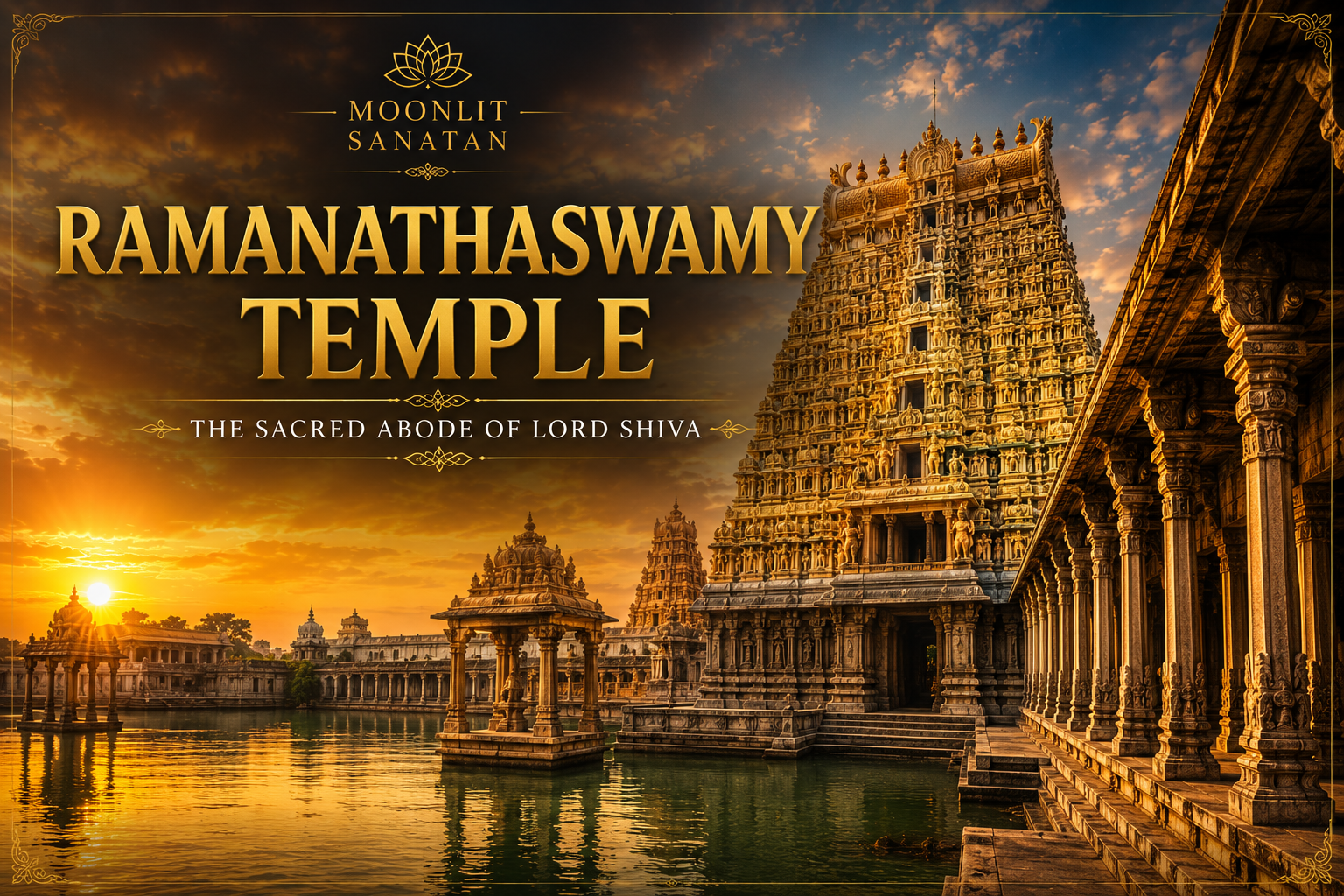
Ask ten pilgrims what "Char Dham" means and you may get two different answers — and both are correct. The original Char Dham, established by Adi Shankaracharya in the 8th century, refers to four sacred abodes spread across the four corners of India: Badrinath in the north, Rameswaram in the south, Dwarka in the west, and Puri (Jagannath) in the east. If you'd like to explore that pan-India circuit in depth, our guide to Ramanathaswamy Temple at Rameswaram is a good place to start.
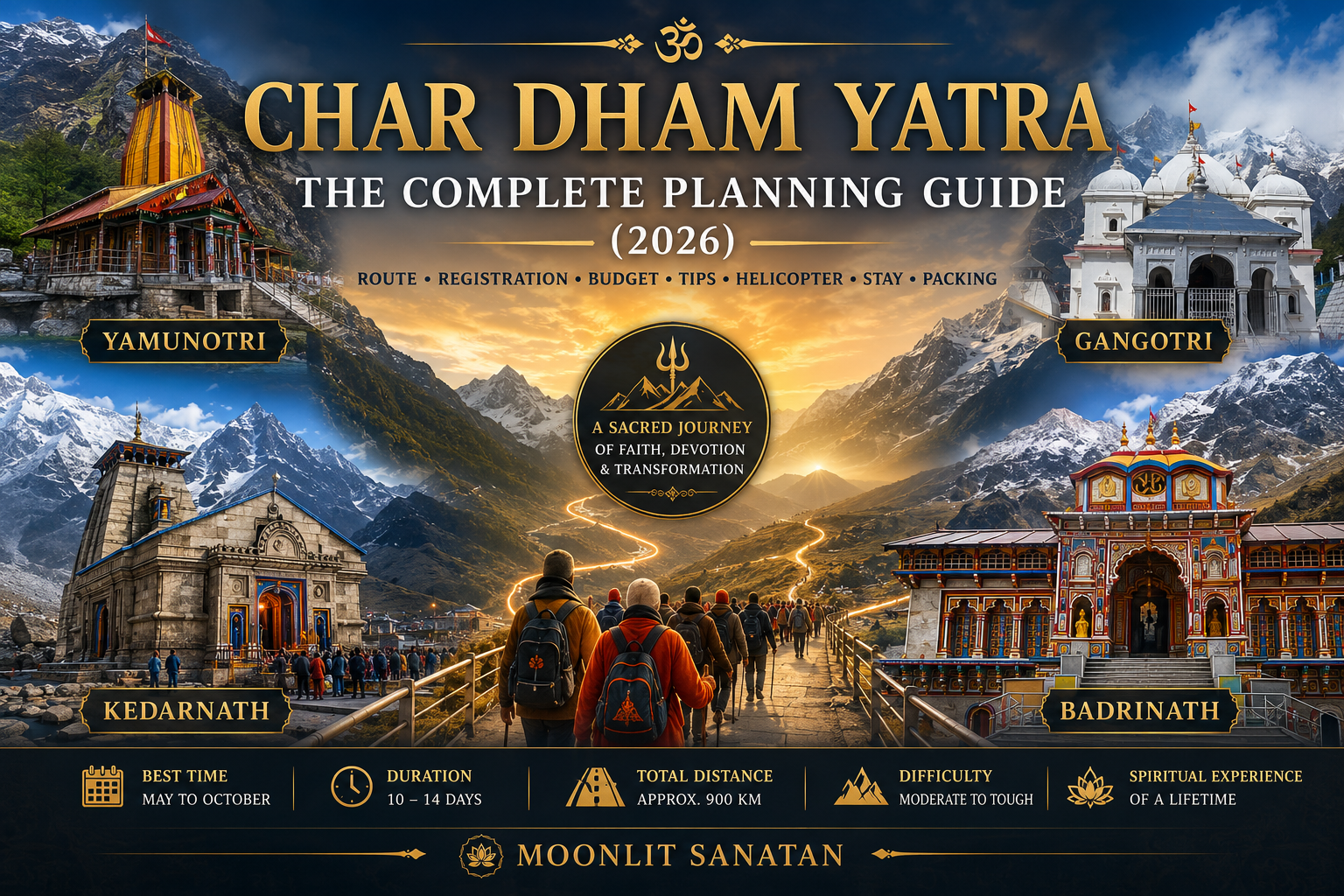
The Char Dham Yatra that most people search for today, and the one this guide focuses on, is the Chota Char Dham — the Himalayan circuit confined to the state of Uttarakhand. It covers four shrines nestled in the Garhwal Himalayas: Yamunotri, Gangotri, Kedarnath, and Badrinath. These four points trace the origins of two of India's most sacred rivers and the abodes of Shiva and Vishnu, making the journey a concentrated dose of Himalayan devotion, usually completed over 9 to 14 days.
Every year between late April and mid-November, when the mountain passes are free of snow, lakhs of pilgrims travel this circuit — some by road, some on foot for the final stretches, and a growing number by helicopter. It is physically demanding, logistically complex, and, by every account of those who complete it, transformative.
New to Char Dham temples? Start with our deep-dive on the Badrinath Temple: History, Significance & Complete Guide, or browse the full Char Dham category on Moonlit Sanatan for more temple-by-temple stories.
2. Spiritual Significance of the Yatra
In Sanatan thought, geography itself is sacred text. The Himalayas are not merely mountains — they are Devbhoomi, the abode of the gods, where Shiva is said to have retreated in meditation and where the Ganga first touched Indian soil. Undertaking the Char Dham Yatra is understood as a tirtha — literally a "crossing point" — where the boundary between the human and the divine grows thin enough to step through.
Traditionally, the yatra is believed to grant moksha (liberation from the cycle of birth and death) when completed with sincere devotion. Many pilgrims undertake it to honour deceased parents, fulfil a vow, or mark a major life transition. Whatever the personal reason, the four dhams are visited in a fixed order — not arbitrarily, but because the sequence itself carries meaning, moving from the river goddesses toward Vishnu's final abode.
3. The Four Dhams Explained
Each of the four shrines carries its own legend, altitude, and character — together they form a journey that moves from river-source worship in the west to Vishnu's high-altitude sanctuary in the east. Here's what awaits at each stop.
🏔️ Yamunotri — Source of the Yamuna
The westernmost and often the starting point of the yatra, Yamunotri sits at roughly 3,293 metres and is dedicated to the goddess Yamuna, daughter of the Sun god Surya and twin sister of Yama, the god of death. Legend holds that bathing in the Yamuna here frees a devotee from an untimely or painful death — a belief that draws pilgrims to the icy waters despite the cold. The temple lies a steep 5–6 km trek (or pony/palki/doli ride) from Janki Chatti, and pilgrims traditionally tie rice or potatoes in a cloth and boil them in the nearby thermal springs of Surya Kund as an offering before entering the shrine. The idol itself is carved from black marble and is usually the first stop for those following the classical west-to-east route.
🏔️ Gangotri — Origin of the Ganga
Gangotri, at about 3,100 metres, marks the mythological point where the Ganga descended to earth through Shiva's matted locks, tamed from a force that could have shattered the planet into a gentle, life-giving river — the story of King Bhagirath's penance to bring the Ganga down to liberate his ancestors is inseparable from this place. Unlike Yamunotri, the temple here is accessible by road, though the actual glacial source — Gaumukh — requires an additional 18 km trek for those who wish to go further upstream. The temple, built by Gorkha commander Amar Singh Thapa in the early 19th century, sits beside the swirling Bhagirathi river against a backdrop of granite peaks.
⛰️ Kedarnath — Abode of Shiva
The most physically demanding of the four, Kedarnath sits at 3,583 metres and is reached by a 16–18 km trek (or helicopter, pony, or palki) from Sonprayag/Gaurikund. According to the Mahabharata, the Pandavas sought Shiva here to atone for the sin of killing their own kin at Kurukshetra; Shiva, avoiding them, took the form of a bull and dove into the earth — the hump is said to have resurfaced here as the object of worship. One of the twelve Jyotirlingas, Kedarnath's stone temple survived the devastating June 2013 flash floods almost untouched, an image of quiet resilience that has since become part of its living legend.
🛕 Badrinath — Abode of Vishnu
The final and most accessible of the four dhams, Badrinath sits at 3,100 metres beside the Alaknanda river, flanked by the Neelkanth peak. Dedicated to Lord Vishnu in his Badrinarayan form, it is one of the four sacred Char Dhams and one of the 108 Divya Desams of Vaishnavism — a rare dual distinction. Local legend says the goddess Lakshmi took the form of a badri (Indian jujube) tree to shield Vishnu from harsh weather as he meditated here, giving the site its name. For full temple architecture, mythology, and the fascinating story of its idol, read our complete Badrinath Temple guide.
Distances & Trek Length at a Glance
| Dham | Altitude | Nearest Roadhead | Trek Distance |
|---|---|---|---|
| Yamunotri | 3,293 m | Janki Chatti | ~5–6 km (one way) |
| Gangotri | 3,100 m | Gangotri town | Road accessible; Gaumukh trek +18 km |
| Kedarnath | 3,583 m | Sonprayag/Gaurikund | ~16–18 km (one way) |
| Badrinath | 3,100 m | Badrinath town | Road accessible |
4. Best Time to Undertake the Yatra
The temples are open only for about seven months a year — the rest of the time, snow makes the region impassable and the deities are ceremonially moved to winter seats in the valleys below (Kedarnath's to Ukhimath, Badrinath's rituals shift toward Joshimath). Timing your yatra correctly changes the entire experience.
| Period | Conditions | Best For |
|---|---|---|
| Late April – June | Cool, clear mornings; opening ceremonies (Akshaya Tritiya) | First-time pilgrims, families, pleasant weather |
| July – August | Monsoon; landslide-prone, roads frequently blocked | Generally avoided by tour operators |
| September – mid-November | Post-monsoon clarity, crisp air, thinning crowds | Photographers, those who prefer fewer pilgrims |
| Late November – April | Temples closed for winter | Not applicable — plan elsewhere |
5. Yatra Route & Recommended Order
The classical route, followed by most pilgrims and tour operators, moves from west to east:
Haridwar/Rishikesh → Yamunotri → Gangotri → Kedarnath → Badrinath → Haridwar/Rishikesh
This sequencing is practical as much as spiritual — it minimises backtracking across the mountain roads that connect the four valleys. Depending on time and budget, pilgrims typically choose one of these formats:
- Full Char Dham Yatra (9–12 days): All four shrines, by road, with rest days built in for acclimatisation.
- Do Dham Yatra (5–6 days): Kedarnath and Badrinath only — the two most-visited shrines, popular with pilgrims short on time.
- Ek Dham Yatra: A single shrine, usually Kedarnath, often done as a shorter dedicated trip.
- Helicopter Char Dham Yatra (4–5 days): All four dhams covered by air, cutting travel time drastically — see the dedicated section below.
6. How to Reach — Base Points & Transport
Nearly every yatra begins from one of two gateway towns: Haridwar or Rishikesh, both well connected to the rest of India.
By Air
Jolly Grant Airport in Dehradun is the nearest airport, with regular flights from Delhi and other major cities. From there, it's roughly a 30–45 minute drive to Haridwar or Rishikesh.
By Rail
Haridwar Junction and Rishikesh Railway Station are both well served by trains from Delhi, Mumbai, Kolkata, and most major cities, making rail the most economical way to reach the base.
By Road
Haridwar is about 220 km from Delhi (roughly 5–6 hours by car or bus) via a well-maintained highway. From Haridwar/Rishikesh, private taxis, shared cabs, and state transport (GMOU/KMOU buses) run daily to Yamunotri, Gangotri, Kedarnath, and Badrinath base points.
7. Registration, Biometric E-Pass & Permits
Since 2022, the Uttarakhand government has made online registration mandatory for every pilgrim undertaking the Char Dham Yatra, largely to manage crowd flow and improve safety in the fragile Himalayan terrain.
Registration typically opens a few weeks before the yatra begins each year (usually announced around the Mahashivratri period), and slots for peak months can fill quickly, so registering early is strongly advised.
8. Char Dham Yatra Packages & Cost
Costs vary widely depending on mode of travel, accommodation grade, and whether you include helicopter transfers. Here's a realistic breakdown for planning purposes:
| Package Type | Duration | Approx. Cost (per person) |
|---|---|---|
| Budget (shared taxi, dharamshala stays) | 10–12 days | ₹12,000 – ₹20,000 |
| Standard (private cab, 2–3 star hotels) | 10–12 days | ₹22,000 – ₹35,000 |
| Premium (private cab, 3–4 star hotels, guide) | 9–11 days | ₹40,000 – ₹65,000 |
| Helicopter Char Dham Yatra | 4–5 days | ₹1,50,000 – ₹2,50,000+ |
Most packages price separately for the Do Dham (Kedarnath–Badrinath) option, which typically runs 40–50% lower than the full Char Dham given the shorter duration.
9. What's Included in a Standard Package
A typical mid-range Char Dham package includes: private or shared vehicle transport for the full circuit, hotel/guesthouse accommodation on double or triple sharing, driver allowances and toll/parking charges, and assistance with registration formalities. It usually excludes: pony/palki/porter charges for the temple treks, helicopter tickets (if opted separately), personal expenses, meals beyond what's specified, and travel insurance — so budget for these separately.
10. Essential Packing List
Mountain weather at 3,000+ metres shifts fast — bright sun at noon can give way to near-freezing winds by evening. Packing right isn't about comfort alone; at altitude, the wrong gear becomes a genuine safety issue. Here's what experienced pilgrims never leave home without:
Thermal Inner Wear Set
Layering is everything on the Char Dham route. A moisture-wicking thermal base layer keeps you warm at Kedarnath and Yamunotri without the bulk of heavy woollens underneath your outer jacket.
Check on AmazonAdjustable Trekking Pole
The final stretches to Yamunotri and Kedarnath involve steep, uneven trails. A collapsible trekking pole takes real pressure off your knees on the descent — pilgrims of every age use one.
Check on AmazonPortable Oxygen Canister
At altitudes above 3,000 metres, even fit travellers can feel breathless. A compact, pocket-sized oxygen canister is cheap insurance against altitude discomfort, especially for elderly pilgrims.
Check on AmazonWaterproof Rain Poncho
Mountain weather can turn in minutes, particularly around Gangotri and Kedarnath. A full-body waterproof poncho that covers your backpack too is far more practical than an umbrella on narrow trails.
Check on AmazonInsulated Steel Water Bottle
Staying hydrated at altitude helps combat mild AMS symptoms, and an insulated flask keeps water from turning icy cold overnight at the higher shrines like Kedarnath.
Check on AmazonCompact First-Aid & Medicine Kit
With the nearest pharmacy sometimes hours away, a compact kit with basics — pain relief, altitude sickness tablets (as advised by your doctor), bandages, and antiseptic — is non-negotiable.
Check on AmazonHigh-Capacity Power Bank
Charging points are scarce along the route, especially near Kedarnath and Yamunotri. A high-capacity power bank keeps your phone alive for navigation, photos, and emergency calls.
Check on Amazon11. Health, Altitude & Safety Tips
Altitude Mountain Sickness (AMS) is the most common health issue pilgrims face, particularly at Kedarnath and Yamunotri. Symptoms include headache, nausea, and breathlessness, and while mild cases are common, they should never be ignored.
It's also worth carrying a copy of your medical history and any regular prescriptions, and informing your tour operator of pre-existing conditions in advance.
12. Where to Stay Along the Route
Accommodation ranges from basic dharamshalas (pilgrim rest houses run by trusts, often free or donation-based) to GMVN/state tourism guesthouses and private hotels of varying comfort levels. In peak season (May–June), advance booking is essential — rooms near Kedarnath and Badrinath fill up weeks ahead. Rishikesh and Haridwar, as base towns, offer everything from budget stays to premium riverside hotels, making them sensible places to rest before and after the mountain leg of the journey.
13. Do's and Don'ts During the Yatra
Do: Register online well in advance, carry warm layers even in summer, respect queue systems at temples, carry cash (ATMs are sparse in the higher reaches), and follow your guide's pacing on treks.
Don't: Skip acclimatisation days to "save time," attempt the trek in inadequate footwear, litter on the trail or near water sources, or ignore early symptoms of altitude sickness hoping they'll pass on their own.
14. Helicopter Yatra Option
For pilgrims short on time, travelling with elderly parents, or simply wanting to avoid the physically taxing treks, helicopter services connect Sersi/Phata to Kedarnath, and similar shuttle services operate for the other dhams. A full helicopter Char Dham circuit can be completed in as little as 4–5 days, though it comes at a significantly higher cost and is subject to weather-related delays, which are common in the mountains — always build a buffer day into your schedule if booking this option.
15. Frequently Asked Questions
What is the correct order of the Char Dham Yatra?
The traditional order is Yamunotri, followed by Gangotri, then Kedarnath, and finally Badrinath — moving roughly west to east through the Garhwal Himalayas.
How many days does the full Char Dham Yatra take?
By road, most pilgrims complete it in 9 to 12 days, including travel and rest days. The helicopter option can shorten this to 4–5 days.
Is registration mandatory for the Char Dham Yatra?
Yes. Online registration through the official Uttarakhand Tourism portal is compulsory for all pilgrims and is checked at multiple points along the route.
What is the difference between Char Dham and Do Dham Yatra?
Char Dham covers all four shrines — Yamunotri, Gangotri, Kedarnath, and Badrinath. Do Dham covers only Kedarnath and Badrinath, and is a shorter, more time-efficient option.
Can senior citizens undertake the Char Dham Yatra?
Yes, many senior citizens complete the yatra every year, often opting for pony, palki, or helicopter services for the steeper treks, along with a prior medical check-up and a doctor's clearance.
What is the best month to go on the Char Dham Yatra?
May–June and September–October generally offer the most favourable weather, with clearer skies and lower risk of monsoon-related road closures compared to July–August.
Do I need a guide or can I travel independently?
Both are possible. Independent travel is common and can be more economical, but a guided package simplifies logistics — transport, permits, and accommodation booking — especially for first-time pilgrims.
Final Thoughts
The Char Dham Yatra asks something of everyone who undertakes it — patience on the trail, humility before the mountains, and faith when the path grows steep. Whether you complete it by road over twelve unhurried days or by helicopter in four, the destination is the same: four ancient shrines that have watched over the Himalayas for centuries, waiting quietly for the next pilgrim to arrive.
For more temple guides, mythology, and Sanatan wisdom, explore our Temples section or head back to the Moonlit Sanatan homepage.
Follow Moonlit Sanatan for more temple stories, mythology, and pilgrimage guides
Instagram Facebook PinterestOm Namah Shivaya. Har Har Mahadev. 🙏