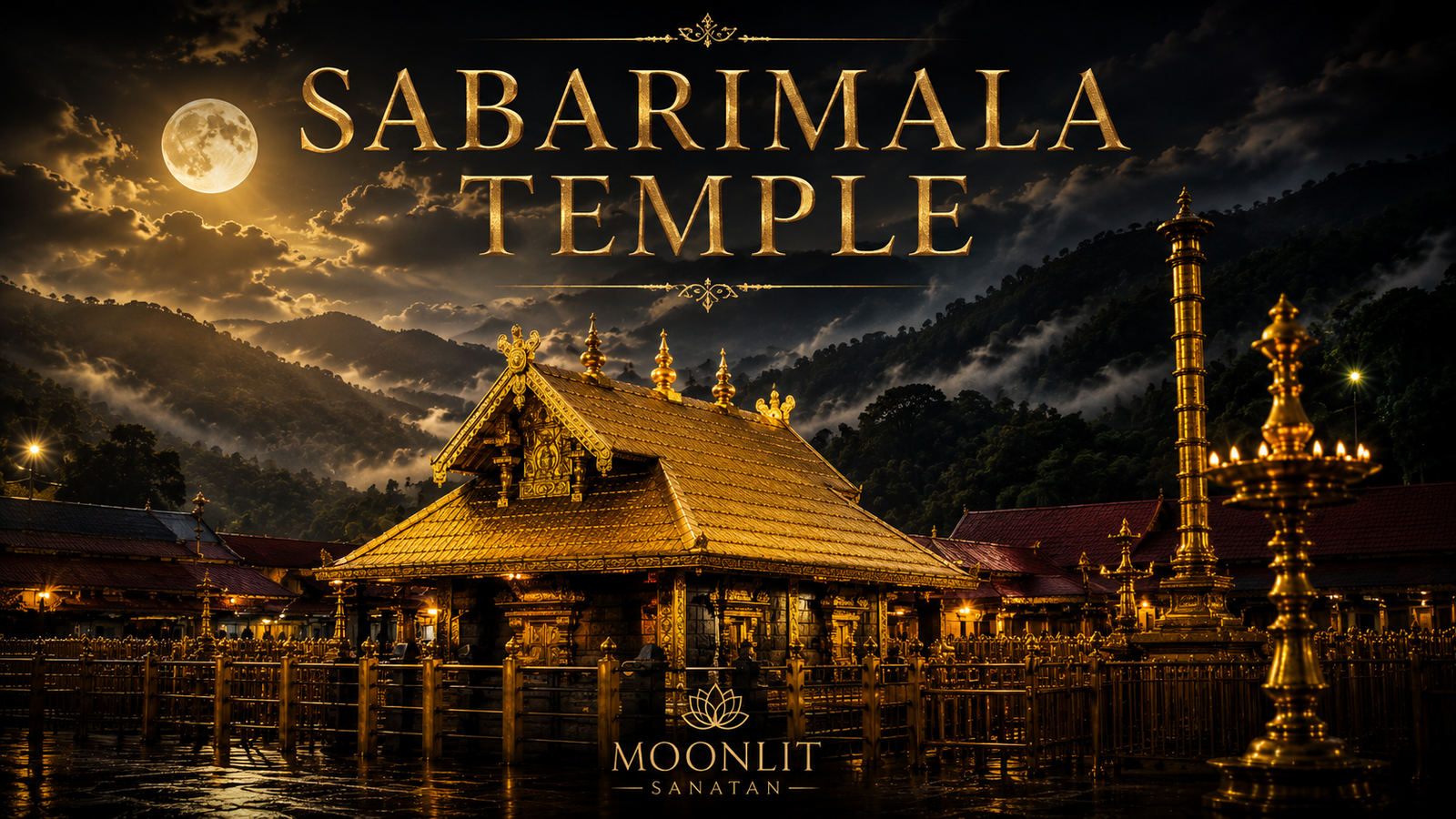
Sabarimala Temple: The Complete Guide to Lord Ayyappa's Sacred Hill Shrine
Temple Guides Series · Pathanamthitta District, Kerala
Somewhere deep in the Western Ghats of Kerala, eighteen forested hills rise around a small hilltop shrine that, for a few months each year, becomes the destination of one of the largest pilgrimages on earth. This is Sabarimala Temple, home to Lord Ayyappa — also called Dharma Shasta or Manikandan — a deity whose story of celibacy, discipline, and unity across faiths has drawn tens of millions of devotees, known as Ayyappans, up its sacred 18 steps for centuries.
Unlike most major Hindu temples, Sabarimala is not simply visited — it is earned. Devotees observe a 41-day vow before they ever set foot on the hill, and the pilgrimage itself, on foot through forest paths, rivers, and steep climbs, is treated as inseparable from the darshan at the end of it. In this guide, we cover the legend of Ayyappa, the temple's history, the 41-day Vratham, the pilgrimage season, how to reach Sabarimala, and everything you need to plan this journey respectfully and safely.
Quick Facts: Sabarimala Temple
| Deity | Lord Ayyappa (Dharma Shasta), son of Shiva and Mohini (Vishnu's female form) |
| Location | Sabarimala Hills, Pathanamthitta District, Kerala, within the Periyar Tiger Reserve buffer |
| Administered by | Travancore Devaswom Board (TDB) |
| Pilgrimage season | Mainly Mandala-Makaravilakku season: mid-November to mid-January; also opens for 5 days each Malayalam month |
| Major festivals | Mandala Pooja (mid-November), Makaravilakku / Makara Jyothi (mid-January), Vishu, Painguni Uthram |
| Sacred steps | 18 Pathinettam Padi steps, gold-plated, climbed only with Irumudi Kettu |
| Trek distance | Approx. 4–5 km uphill from Pamba to Sannidhanam |
| Nearest airport | Cochin International Airport (~160 km) |
| Nearest railway station | Chengannur Railway Station (~90 km) |
| Booking | Virtual Q booking via sabarimalaonline.org, mandatory for most darshan slots in peak season |
Table of Contents
- The Legend of Lord Ayyappa
- Why Sabarimala Is Spiritually Unique
- History of Sabarimala Temple
- The 41-Day Ayyappa Vratham & Irumudi Kettu
- The 18 Sacred Steps (Pathinettam Padi)
- Pilgrimage Season, Mandala Pooja & Makaravilakku
- Virtual Q Booking & Darshan Timings
- Note on Women's Entry & Temple Tradition
- Dress Code & Pilgrimage Etiquette
- How to Reach Sabarimala
- Places to Visit Near Sabarimala
- What to Pack for the Sabarimala Yatra
- Frequently Asked Questions
The Legend of Lord Ayyappa
The story of Sabarimala begins with a divine mission. According to tradition, the demoness Mahishi could only be destroyed by a child born of Shiva and Vishnu together. To fulfil this, Vishnu took the form of Mohini, and from this union with Shiva was born Manikandan — a name that comes from the golden bell (mani) found around the infant's neck, and which also gave him the title Hariharaputra, "son of Hari (Vishnu) and Hara (Shiva)."
The infant was found abandoned on the banks of the Pamba river by King Rajasekhara of Pandalam, who, along with his queen, had long prayed for a child. A sage advised the childless king to raise the boy as his own, and Manikandan grew up as the prince of Pandalam, trained in the Kalari martial arts and known even in childhood for his wisdom and extraordinary abilities.
When the king later wished to name his own biological son as heir, ministers conspired to have the queen feign illness, with physicians claiming that only tigress milk could cure her — a request meant to send young Manikandan into the forest to die. Instead, the prince returned riding a tigress, having defeated the demoness Mahishi along the way and fulfilled his divine purpose. Realising his true, divine nature, the king offered him the throne, which Manikandan declined, asking instead that a temple be built for him at Sabarimala, at the spot his arrow landed after being shot from the palace.
This is one of the reasons Sabarimala holds a distinct place among Hindu pilgrimage sites — a deity whose own mythology insists on cutting across caste and even religious lines, welcoming devotees from all backgrounds who observe the vow with sincerity.
Why Sabarimala Is Spiritually Unique
Among South India's great pilgrimage centres, Sabarimala occupies an unusual place. Lord Ayyappa is worshipped as Dharma Shasta, a guardian of righteousness, and the temple is often described as radically egalitarian — open historically to devotees of all castes and, through the enduring legend of Vavar, understood as welcoming worshippers regardless of religion, provided they undertake the Vratham with sincerity. Few major Hindu shrines carry quite this explicit a founding narrative of crossing social boundaries.
The philosophy embedded in the pilgrimage is also unusually direct for a temple experience. Above the inner sanctum, an inscription reads "Tat Tvam Asi" — "You are That" — a Vedantic declaration that the divine sought through 41 days of austerity, a punishing trek, and the climb up eighteen steps was never separate from the seeker in the first place. Many pilgrims describe the moment of finally standing before Lord Ayyappa, utterly spent from the journey, as less a plea to an external deity and more a recognition of something already within.
This blend of rigorous discipline and inclusive philosophy is part of why Sabarimala continues to draw such enormous numbers each season, cutting across state, caste, and even religious lines in a way that few other pilgrimages attempt as openly.
History of Sabarimala Temple
Sabarimala's association with the Pandalam royal family, believed to be descendants of the Pandya dynasty who settled in present-day Pathanamthitta, anchors the temple's history to a real, traceable lineage rather than legend alone. The temple itself sits deep within what is now the Periyar Tiger Reserve buffer zone, on a hill roughly 3,000 feet above sea level, encircled by eighteen hills that are themselves considered sacred and are symbolically represented by the temple's 18 steps.
The temple has been rebuilt more than once over the centuries, most notably after a major fire in 1950 that destroyed much of the original sanctum, following which the shrine was reconstructed and reconsecrated. Today, it is administered by the Travancore Devaswom Board (TDB), a statutory body responsible for the temple's day-to-day management, its priests (the hereditary Thantri of the Thazhamon family holds final authority on ritual matters), and the logistics of hosting what has become one of the largest annual pilgrim gatherings in the world — with millions of devotees, overwhelmingly from the five southern Indian states, arriving during the Mandala-Makaravilakku season alone.
Even heads of state have made the pilgrimage in recent years. In October 2025, President Droupadi Murmu became the first woman President of India to offer prayers at Sabarimala, carrying the Irumudi Kettu and climbing the 18 sacred steps — only the second sitting Indian president, after President V.V. Giri in the 1970s, to visit the shrine.
The 41-Day Ayyappa Vratham & Irumudi Kettu
No account of Sabarimala is complete without the Vratham — the 41-day vow of austerity that devotees undertake before setting out for the temple. This is not a light commitment. During these 41 days, devotees, referred to respectfully as Ayyappans regardless of age or background, observe strict celibacy, sleep on the floor, eat only simple satvik vegetarian food once or twice a day, avoid alcohol and non-vegetarian food entirely, go barefoot when possible, and wear a black, blue, or saffron dhoti along with a Tulsi or Rudraksha mala initiated by a guru or elder devotee (Guruswamy).
The Vratham is understood as a period of inner purification — the pilgrimage to Sabarimala is considered less a physical journey and more the final, outward step of a much longer internal one. Devotees often describe the discipline of these 41 days as more transformative than the trip itself.
At the end of the Vratham, the devotee prepares the Irumudi Kettu — a sacred two-compartment cloth bundle carried on the head for the final ascent. One compartment holds offerings for the temple, most importantly ghee-filled coconuts for the abhishekam (ritual anointing) of the deity; the other holds the pilgrim's personal provisions for the journey. Custom holds that only pilgrims carrying a properly prepared Irumudi Kettu, typically tied with the guidance of a Guruswamy, may ascend the 18 sacred steps. Those without one may still have darshan, but through the northern gate rather than the traditional steps — a practice upheld by a Kerala High Court judgment in 1991.
The 18 Sacred Steps (Pathinettam Padi)
The final approach to the sanctum is via the Pathinettam Padi — eighteen steps, now covered in panchaloha (a five-metal alloy) since 1985 to protect them from centuries of wear. Each step is said to represent one of the eighteen hills surrounding Sabarimala, and in a broader sense, eighteen virtues or inner obstacles a devotee must overcome — among them the five senses, the eight forms of desire (Ashta Raga), the three gunas, and the dualities of knowledge and ignorance.
Climbing these steps, after 41 days of Vratham and days of trekking, is treated as the culmination of the entire pilgrimage. Many devotees pause at each step, and the moment of reaching the top and setting eyes on the deity is, by nearly every pilgrim's account, an overwhelming one after such sustained physical and spiritual discipline.
Malikappuram & Nearby Shrines
Beside the main sanctum stands the shrine of Malikappurathamma, worshipped as a form of the Goddess, honoured with the Guruthi ritual at the close of Makaravilakku. Nearby are also the shrines of Valiya Kadutha and Kochu Kadutha Swami, believed to have been commanders in Ayyappa's army, and the Naga Devatas shrine — each carrying its own layer of Sabarimala's rich devotional geography.
Pilgrimage Season, Mandala Pooja & Makaravilakku
Sabarimala is not open year-round in the way most major temples are. Outside its main season, it opens only for the first five days of each Malayalam month for monthly poojas, along with a few festival windows such as Vishu (April) and the Painguni Uthram festivities (March-April).
The temple's most significant period by far is the Mandala-Makaravilakku season, running roughly from mid-November to mid-January. This 41-day-plus window opens with Mandala Pooja (typically around mid-November) and builds toward its climax at Makaravilakku, observed around January 14th, when the celestial phenomenon known as Makara Jyothi is traditionally sighted on the eastern horizon near Ponnambalamedu — the single most crowded and spiritually charged day of the Sabarimala calendar.
During this window, the hills around Sabarimala effectively become a small, temporary city, with the Travancore Devaswom Board, Kerala Police, and state health and disaster-management authorities coordinating everything from crowd flow and medical camps to drinking water and sanitation for the millions who pass through. For many first-time visitors, the scale of this operation is as striking as the temple itself — a reminder of just how enormous and logistically complex the Sabarimala pilgrimage has become in the modern era, while still retaining its centuries-old ritual core.
Along the traditional forest route, particularly around Erumeli, devotees performing the ecstatic Petta Thullal dance is a common and striking sight during this season — a spontaneous, trance-like expression of devotion accompanied by the chant "Swamiye Saranam Ayyappa."
Virtual Q Booking & Darshan Timings
Given the scale of pilgrim traffic, the Travancore Devaswom Board mandates Virtual Q booking for most darshan slots during peak season, managed through the official portal, sabarimalaonline.org. Booking windows typically open around a month or two before each major season — for instance, ahead of the Mandala season in November. On regular days, tens of thousands of Virtual Q slots are released daily, though numbers are deliberately reduced on the most crowded festival dates, such as Makaravilakku, under Kerala High Court directives to manage crowd safety.
If online slots are exhausted, spot booking counters at Nilakkal and nearby Satram centres offer limited walk-in options, though availability is far from guaranteed during peak dates. It is strongly advisable to book well in advance, carry valid ID proof, and follow all crowd-management instructions issued by TDB officials and Kerala Police at Pamba and Sannidhanam.
Plan Ahead
Because Virtual Q slots, festival dates, and access rules are reviewed and updated by the Travancore Devaswom Board each season, always confirm the current year's opening dates, booking windows, and any last-minute circulars on the official TDB website before finalising your travel plans.
Note on Women's Entry & Temple Tradition
Sabarimala's tradition has historically restricted entry to women in the 10-to-50 age group, rooted in the belief that Lord Ayyappa is an eternally celibate (Naishtika Brahmachari) deity; women outside this age range, including young girls and women past menopause, have long been permitted to visit and worship at the temple.
This custom became the subject of a significant legal debate in India. In September 2018, a five-judge Constitution Bench of the Supreme Court ruled, by a 4:1 majority, that the age-based restriction was unconstitutional, opening the temple to women of all ages. The ruling was met with both support and strong protest, and numerous review petitions followed. As of 2026, a nine-judge Constitution Bench of the Supreme Court has taken up a fresh reference on the matter, with hearings that began in April 2026 examining broader constitutional questions about religious freedom, essential religious practices, and the scope of judicial review over temple customs. The matter remains under consideration by the Court at the time of writing.
Given that this is an active, evolving legal matter, we'd encourage readers to check the latest updates from the Supreme Court of India and the Travancore Devaswom Board's official channels for the current position before planning a visit.
Dress Code & Pilgrimage Etiquette
Sabarimala's dress code is closely tied to the 41-day Vratham rather than being a separate temple rule:
- Men and boys observing the Vratham typically wear a plain black, blue, or saffron-coloured dhoti (mundu) throughout the 41 days and during the pilgrimage itself, along with the sacred Tulsi or Rudraksha mala.
- Footwear is traditionally avoided on the final stretches of the pilgrimage, particularly the ascent to Sannidhanam, as a mark of humility and austerity.
- Devotees are expected to maintain the vows of the Vratham right up to the point of darshan — strict vegetarian food, no alcohol, and continued celibacy.
- Loud behaviour, littering, and disrespect toward fellow pilgrims are strongly discouraged; the chant "Swamiye Saranam Ayyappa" is used as a greeting and expression of shared devotion throughout the journey.
How to Reach Sabarimala
By Air
Cochin International Airport (Nedumbassery) is the nearest major airport, roughly 160 km from Sabarimala, with excellent domestic and international connectivity. Trivandrum International Airport is another viable option depending on your route.
By Rail
Chengannur Railway Station, about 90 km away, is the most commonly used rail gateway, well connected to major cities across South India. From here, buses and taxis run to the base points of Pamba or Nilakkal.
By Road & Trek
Most pilgrims travel by road to Pamba, the last vehicle-accessible base camp, from where the final ascent to Sannidhanam is on foot — a trek of roughly 4 to 5 km uphill along a paved pilgrimage pathway. Alternatively, some devotees choose the longer, traditional forest route beginning at Erumeli, passing through Azhutha and Karimala before reaching Pamba, a path steeped in ritual significance but considerably more physically demanding, typically covering over 40 km on foot.
During peak Mandala-Makaravilakku season, private vehicles are often restricted closer to Pamba, with pilgrims transferred via designated shuttle services from parking areas at Nilakkal and other checkpoints, as part of the Kerala Police and TDB's crowd and traffic management measures. Given the sheer volume of pilgrims on the road during this period, it's wise to build in extra travel time and expect queues at multiple checkpoints well before you even reach the base of the trek.
Places to Visit Near Sabarimala
Erumeli
The traditional starting point of the forest pilgrimage route, Erumeli is home to both a Shiva temple and the Vavar Mosque, where devotees pay respects before beginning the trek — a powerful early stop that captures Ayyappa's story of unity across faiths.
Pandalam Palace
The ancestral home of the Pandalam royal family, closely tied to the legend of young Manikandan's upbringing, and an important stop for those wanting to trace the human side of Ayyappa's story before heading to the hills. The palace and its surrounding temples host their own devotional calendar tied to Ayyappa's legend, including ceremonies connected to the annual sending of the sacred ornaments (Thiruvabharanam) to Sabarimala ahead of Makaravilakku — a procession that is itself considered deeply auspicious by devotees along its route.
Pamba River
The river where the infant Ayyappa is said to have been found, and where pilgrims traditionally bathe before beginning the final ascent. The riverside base camp is also the logistical heart of the pilgrimage, with facilities, transport links, medical aid stations, and the starting point of the trek to Sannidhanam. During peak season, Pamba transforms into a small, temporary township, with thousands of pilgrims passing through daily, making it worth arriving with patience and a clear sense of the queues and checkpoints you'll need to navigate.
Achankovil
Roughly a day's journey from Sabarimala, Achankovil houses another Ayyappa shrine and is sometimes visited by pilgrims extending their trip through the wider sacred geography associated with the deity.
If you're planning a longer South Indian pilgrimage circuit around Sabarimala, our detailed guides to the Ramanathaswamy Temple in Rameswaram, the Meenakshi Temple in Madurai, and the Tirupati Balaji Temple cover nearby shrines that many devotees combine into a single South Indian temple trip. You can also browse our full Temple Guides collection and our section on Hindu Gods & Goddesses for more on Ayyappa and other deities.
Where to Stay
Given Sabarimala's remote, forested setting, accommodation directly at Sannidhanam is limited and largely reserved for those observing the pilgrimage in its traditional form. Most pilgrims instead base themselves at Pamba, Nilakkal, or nearby towns like Erumeli and Chengannur, where the Travancore Devaswom Board and Kerala Tourism operate dormitories, guest houses, and tented accommodation during peak season, alongside private lodges of varying comfort levels. During Mandala-Makaravilakku, rooms fill up quickly, so booking well ahead, or arranging accommodation through a local Guruswamy familiar with the season's logistics, is strongly advisable.
Food Along the Route
In keeping with the Vratham's strict vegetarian discipline, food stalls and community kitchens (annadanam counters) along the pilgrimage route, particularly at Pamba and Nilakkal, serve simple satvik meals free or at nominal cost, often run by devotee organisations and temple trusts. It's common to see long, well-organised queues for these meals during peak season, and carrying your own light provisions in the Irumudi Kettu remains standard practice for the final stretch of the trek.
What to Pack for the Sabarimala Yatra
Between the 41-day Vratham, the trek through forest terrain, and the crowds of peak season, a well-prepared pilgrim has a noticeably smoother journey. Here are some genuinely useful essentials for the Sabarimala pilgrimage:
Tulsi / Rudraksha Ayyappa Mala
The sacred mala worn throughout the 41-day Vratham and pilgrimage, typically received from a Guruswamy at the start of the vow.
View on AmazonBlack/Blue Cotton Dhoti (Mundu) Set
A breathable, traditional dhoti in the customary black or blue, worn through the Vratham period and the final ascent.
View on AmazonIrumudi Kettu Cloth Bundle
The traditional two-compartment cloth bundle used to carry temple offerings and personal provisions for the climb to Sannidhanam.
View on AmazonTrekking Shoes / Grip Sandals
For the sections of the trek where footwear is used, sturdy, high-grip trekking shoes make a real difference on steep, sometimes wet, forest terrain.
View on AmazonLightweight Waterproof Backpack
Useful for carrying personal essentials, a change of clothes, and provisions comfortably over the multi-kilometre uphill trek.
View on AmazonPortable First-Aid & Blister Care Kit
Given the distances covered on foot, a compact first-aid kit with blister plasters and pain relief is one of the most practical things a pilgrim can carry.
View on AmazonCompact Ayyappa Swamy Travel Idol
A small, travel-friendly idol or framed image of Lord Ayyappa, popular as both a devotional keepsake and a gift for fellow Ayyappans back home.
View on AmazonDisclosure: Some links on this page are Amazon affiliate links. As an Amazon Associate, Moonlit Sanatan may earn from qualifying purchases, at no extra cost to you. (Replace the placeholder Amazon search links above with your own tagged affiliate links before publishing.)
Frequently Asked Questions
What is Sabarimala Temple famous for?
Sabarimala is famous as the hilltop shrine of Lord Ayyappa, known for its 41-day pre-pilgrimage Vratham, the Irumudi Kettu ritual, the 18 sacred steps, and being one of the largest annual pilgrimages in the world during the Mandala-Makaravilakku season.
What is the 41-day Ayyappa Vratham?
It is a vow of celibacy, strict vegetarian diet, and simple living observed for 41 days before the Sabarimala pilgrimage, undertaken by devotees known as Ayyappans as a period of spiritual and physical purification leading up to the darshan.
What is Irumudi Kettu and why is it needed?
The Irumudi Kettu is a sacred two-compartment cloth bundle carrying temple offerings and personal provisions, traditionally required to climb the 18 sacred steps at Sabarimala. Pilgrims without one can still have darshan through the temple's northern gate.
When does the Sabarimala pilgrimage season take place?
The main season runs from Mandala Pooja in mid-November through Makaravilakku around mid-January. The temple also opens for the first five days of every Malayalam month, along with a few additional festival windows through the year.
How do I book darshan at Sabarimala?
Darshan during peak season requires Virtual Q booking through the official Travancore Devaswom Board portal, sabarimalaonline.org. Booking windows typically open a month or two before each major season, and slots can fill quickly, so early booking is recommended.
How do I reach Sabarimala?
The nearest airport is Cochin International Airport (~160 km), and the nearest railway station is Chengannur (~90 km). From the base camp at Pamba, pilgrims trek roughly 4-5 km uphill to reach Sannidhanam, the main temple complex.
Is entry to Sabarimala restricted for women?
Traditionally, women in the 10-to-50 age group were restricted from entering, based on the temple's belief in Lord Ayyappa's eternal celibacy. This custom has been the subject of an ongoing Supreme Court legal process since 2018, including a fresh nine-judge bench review that began hearings in 2026, and the matter remains under consideration by the Court.
What should I wear during the Sabarimala pilgrimage?
Devotees observing the Vratham traditionally wear a plain black, blue, or saffron dhoti along with a Tulsi or Rudraksha mala, maintaining the vow's discipline through diet, dress, and conduct right up to the darshan.
What does "Swamiye Saranam Ayyappa" mean?
It is the traditional chant of Sabarimala pilgrims, roughly translating to "I surrender to you, Lord Ayyappa." It is used as a greeting between fellow devotees throughout the Vratham and pilgrimage, and is central to the mood of surrender and shared devotion that defines the Sabarimala experience.
Can first-time pilgrims go to Sabarimala without a Guruswamy?
While it isn't a formal requirement, first-time pilgrims (Kanni Ayyappans) traditionally undertake the Vratham and pilgrimage under the guidance of an experienced devotee known as a Guruswamy, who helps with the mala initiation, the tying of the Irumudi Kettu, and guidance through the rituals along the way.
Final Thoughts
Sabarimala is unlike almost any other pilgrimage in India in how much it asks of a devotee before the temple itself even comes into view. The 41 days of the Vratham, the Irumudi Kettu carried on the head, the long trek through forest and river, and finally the eighteen steps — each stage is designed to strip away distraction until only devotion remains. It is this accumulation of discipline, more than any single ritual, that pilgrims describe as the true heart of the Sabarimala experience, and why the chant of "Swamiye Saranam Ayyappa" continues to echo through these hills every pilgrimage season.
Continue Exploring on Moonlit Sanatan
Follow Moonlit Sanatan
For more temple guides, mythology, and daily Sanatan wisdom, follow along on our social channels: