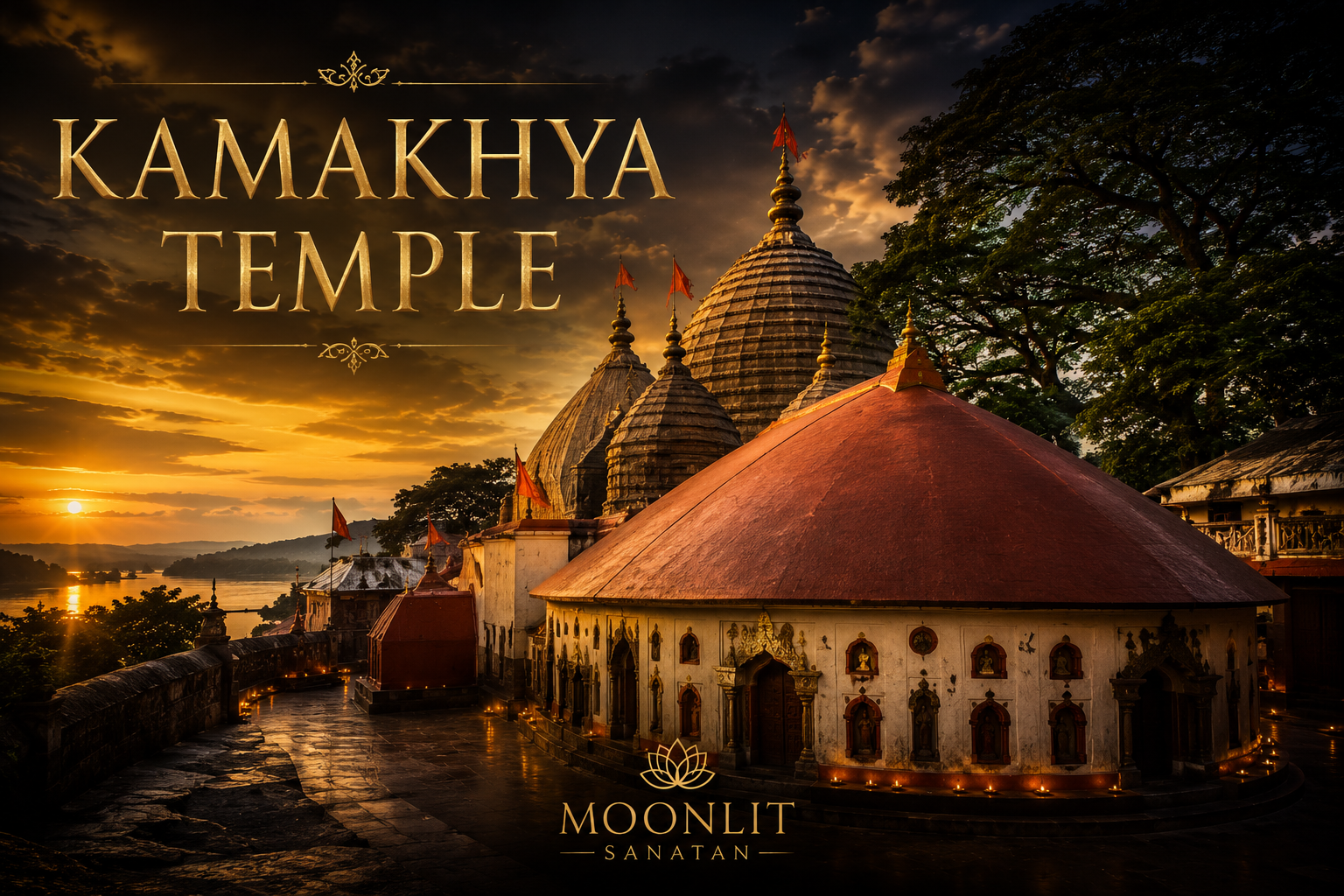
Kamakhya Temple: The Complete Guide to India's Most Powerful Shakti Peetha
Inside the ancient seat of the Divine Mother — history, legend, the Das Mahavidyas, the Ambubachi Mela, and everything you need for your pilgrimage to Nilachal Hill.
On a hill overlooking the Brahmaputra river in Guwahati, Assam, stands a temple unlike any other in India. There is no idol here, no carved face of the goddess to gaze upon. Instead, in a dark, spring-fed cave beneath the sanctum, pilgrims descend to worship a natural rock formation believed to be the womb of the Goddess herself. This is Kamakhya Temple, revered as the most powerful of the 51 Shakti Peethas, and one of the oldest living centres of Tantric and Shakta worship anywhere in the world.
In this guide, we cover the legend of Sati's yoni and the birth of the Shakti Peethas, Kamakhya's layered history through the Koch dynasty, its distinctive Nilachal architecture, the Das Mahavidya shrines that surround it, the famous Ambubachi Mela, and everything you'll need to plan your own pilgrimage to this extraordinary hilltop shrine.
Quick Facts
| Deity | Goddess Kamakhya, worshipped as an aniconic yoni-shaped stone, no fixed idol |
| Significance | One of the 51 Shakti Peethas · Foremost centre of Tantric & Shakta worship in India |
| Location | Nilachal Hill, Guwahati, Assam – 781010, overlooking the Brahmaputra river |
| Architecture | Distinctive Nilachal style — beehive-shaped dome, Nagara & Mughal influences |
| Present structure built | 1565 CE, by King Naranarayan & his brother Chilarai of the Koch dynasty |
| Complex includes | Shrines for the Das (ten) Mahavidyas, plus the 64 Yoginis and 18 Bhairavas |
| Major festival | Ambubachi Mela — "Mahakumbh of the East," held every June |
| Darshan timings | 5:30 AM – 1:00 PM and 2:30 PM – 5:30 PM (regular days) |
| Nearest airport | Lokpriya Gopinath Bordoloi International Airport, Guwahati (~20 km) |
| Nearest railway station | Kamakhya Railway Station, at the base of Nilachal Hill |
Inside This Guide
- The Legend: Sati's Yoni & the Birth of the Shakti Peethas
- The Kamadeva Legend & the Name "Kamakhya"
- Why Kamakhya Is the Most Powerful Shakti Peetha
- History: From Ancient Origins to the Koch Dynasty
- Architecture: The Nilachal Style
- Inside the Sanctum: The Yoni Stone & the Underground Spring
- The Ten Mahavidyas & the Temple Complex
- Ambubachi Mela: The Mahakumbh of the East
- Darshan Timings & Rituals
- Dress Code & Temple Etiquette
- How to Reach Kamakhya Temple
- Places to Visit Near Kamakhya Temple
- What to Pack for Your Kamakhya Yatra
- Frequently Asked Questions
The Legend: Sati's Yoni & the Birth of the Shakti Peethas
Every Shakti Peetha begins with the same story of grief. Sati, daughter of King Daksha, married Lord Shiva against her father's wishes. When Daksha later held a grand yajna and deliberately excluded Shiva, Sati attended anyway, only to witness her father publicly insult her husband. Unable to bear the humiliation, she gave up her life in the sacrificial fire.
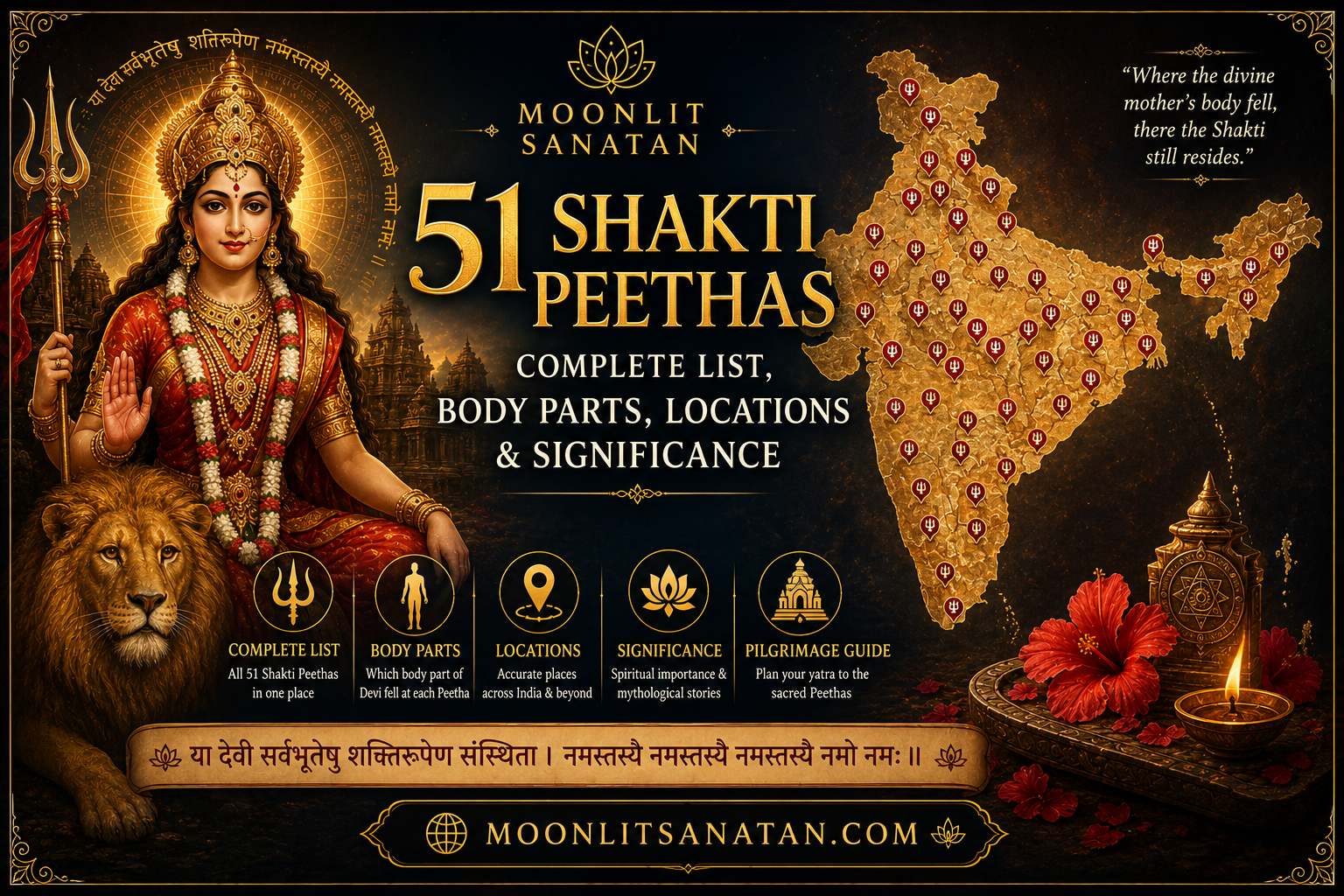
Consumed by grief and rage, Shiva lifted Sati's body and began the Tandava, his cosmic dance of destruction, threatening to unmake the universe in his sorrow. To calm him and prevent catastrophe, Lord Vishnu released his Sudarshan Chakra, cutting Sati's body into pieces as Shiva carried her across the skies. Wherever these fragments fell to earth, a Shakti Peetha was born — a sacred site where the Goddess is believed to reside in her most primal form.
At Kamakhya, tradition holds that it was Sati's yoni — her womb, the very source of creation — that fell upon Nilachal Hill. This is why Kamakhya is widely regarded as the most powerful and significant of all the Shakti Peethas: not a fragment of the Goddess's form, but the seat of her generative power itself.
Unlike most Shakti Peethas, which enshrine a stone or idol representing the fallen body part, Kamakhya's sanctum contains no anthropomorphic image at all. In its place is a natural rock cleft, perpetually moistened by an underground spring, worshipped directly as the yoni of the Goddess — a form of worship as old as, and some traditions argue older than, organised temple Hinduism itself.
The Kamadeva Legend & the Name "Kamakhya"
A second, equally important legend explains how this hill came to be sacred, and how the region and goddess both received their names. When Kamadeva, the god of love, shot his arrow at Shiva to awaken desire in him toward Parvati, an enraged Shiva opened his third eye and reduced Kamadeva to ashes. His grieving wife, Rati, pleaded with Shiva for his revival, and Shiva relented — but Kamadeva was restored without his former radiance and beauty.
Seeking to regain his lost form, Kamadeva undertook penance at this very hill and worshipped the Goddess here, eventually regaining his divine beauty through her grace. In gratitude, the land came to be called Kamarupa ("the form of desire") and the goddess herself became known as Kamakhya — "the beloved of Kama." This legend, layered atop the story of Sati, is part of why Kamakhya is so closely associated with fertility, desire, and the creative force of the universe, rather than with austerity or renunciation alone.
Why Kamakhya Is the Most Powerful Shakti Peetha
Kamakhya's standing among the 51 Shakti Peethas comes down to a combination of factors found nowhere else. It is the only major Peetha where the Goddess is worshipped in her aniconic, unmediated form — no face, no crown, no ornamented idol standing between devotee and deity, only the raw stone itself. This absence of representation is, paradoxically, part of what makes the site feel so immediate to many pilgrims and Tantric practitioners.
The temple is also the foremost centre of Tantric worship in India, practiced here continuously for over a thousand years by a lineage of Tantric adepts, sadhus, and scholars. Kamakhya is identified in Tantric tradition with Tripura Sundari, one of the Das Mahavidyas (the ten wisdom goddesses), and the temple complex is considered one of the very few places on earth where shrines to all ten Mahavidyas exist together in a single sacred landscape — a distinction almost no other temple in India can claim.
Historians and scholars also note that worship on Nilachal Hill likely predates the arrival of organised, textual Hinduism in the region altogether, rooted in far older indigenous traditions of the Khasi and Koch communities of Assam. What later became the Kamakhya Temple may, in this sense, be one of the longest continuously worshipped sacred sites on the subcontinent.
This layered history also explains why Kamakhya feels distinct from most other major Hindu pilgrimage sites. Rather than a single, unified tradition imposed from one direction, the temple carries the imprint of successive waves of belief — tribal goddess worship, classical Puranic mythology, medieval Tantric philosophy, and royal patronage from the Koch and Ahom dynasties — all converging on the same hill. Few sites in India offer such a visible, physical record of how devotional traditions can accumulate and coexist over centuries rather than replace one another outright.
History: From Ancient Origins to the Koch Dynasty
The precise age of worship at Kamakhya is impossible to pin down with certainty, but historical references to the site go back at least to the 8th century, and the hill itself — sometimes described in scripture as comprising three segments known as the Brahma, Shiva, and Varaha hills, collectively called Nilachala — has carried sacred status for far longer still.
An earlier stone temple structure, dated to around the 11th-12th century, once stood here before being destroyed, with some accounts attributing the destruction to the 16th-century invader Kalapahar and others to natural calamity. For a period afterward, the upper structure of the temple remained in ruins.
Its revival came under the Koch dynasty. Local legend holds that King Vishwa Singha, having lost his way during a military campaign near Nilachal Hill, was guided by an elderly woman to the site and urged to build a golden temple for the Goddess. His attempts to fulfil this vow with brick construction reportedly failed until the Goddess herself appeared in a dream, advising him to combine gold with brick. It was ultimately his successor, King Naranarayan, together with his brother Chilarai, who completed the temple's major reconstruction between 1555 and 1565 CE.
The Beehive Dome
Temple lore recounts that Naranarayan's chief architect, Meghamukdam, twice attempted to rebuild the temple's dome using the original stone blocks recovered from the earlier structure, and twice failed. He eventually succeeded only after switching to brick, constructing the distinctive beehive-shaped dome that remains one of the temple's most recognisable features today.
In the centuries that followed, under the Ahom dynasty (17th-19th century), the wider temple complex continued to expand, with numerous surrounding shrines to the Mahavidyas, forms of Shiva, Ganesha, and other deities constructed, renovated, and re-consecrated. The Natamandira, a hall built for ritual music and dance, was added by the Ahom king Rajeshwar Singha. Today, the temple complex is administered by the Border Samaj, a responsibility formally assigned by the Supreme Court of India in July 2015.
Architecture: The Nilachal Style
Kamakhya's architecture is distinctive enough to have its own name: the Nilachal style, a fusion of the North Indian Nagara temple tradition with Mughal-era architectural elements, layered atop older indigenous building forms. The result is a temple that looks unlike almost any other major shrine in India — a polygonal, beehive-shaped brick dome rising over a cruciform stone base, richly decorated with sculptural carvings depicting deities, floral motifs, and scenes from Hindu mythology.
The temple complex includes several distinct chambers beyond the main sanctum: the Garbhagriha (inner sanctum, partly underground), ritual halls used for daily worship, and the Natamandira, historically used for devotional music and dance performances offered to the Goddess. Surrounding the main shrine, a dense cluster of smaller temples — dedicated to the Mahavidyas, various forms of Shiva, and other deities — forms what scholars often describe as one of the most complete and unified goddess-worship landscapes anywhere in the world.
Inside the Sanctum: The Yoni Stone & the Underground Spring
The heart of Kamakhya Temple lies below ground level. Pilgrims descend a short flight of stone steps into a dark, cave-like Garbhagriha, where, rather than an idol, they find a natural rock cleft, shaped like a yoni, resting in a shallow depression that is perpetually kept moist by an underground spring. There is no fixed statue to be photographed or garlanded here — the stone itself, in its raw, natural state, is the object of worship.
This spring, and the stone's constant moisture, is central to the temple's most distinctive belief: that the Goddess undergoes an annual menstrual cycle, observed each June during the Ambubachi Mela. During this period, devotees believe the spring's water briefly runs red, a phenomenon explained by some as a natural mineral occurrence and understood by devotees as the Goddess's own menstruation — treated here not with taboo or discomfort, but with open, celebratory reverence, a genuinely rare stance in most traditional religious contexts worldwide.
The Ten Mahavidyas & the Temple Complex
Few places on earth allow a pilgrim to visit shrines dedicated to all ten of the Das Mahavidyas — the ten wisdom goddesses of Tantric tradition — within a single sacred hill. Kamakhya is one of them, and many devoted pilgrims treat a visit here as incomplete without paying respects at as many of these individual shrines as time allows.
Beyond the Mahavidya shrines, the wider complex also honours the 64 Yoginis and 18 Bhairavas (fierce forms of Shiva who guard the Goddess), alongside temples for Lakshmi, Saraswati, and Ganesha — making Nilachal Hill less a single temple and more an entire small city devoted to the divine feminine in all her forms.
A Note on Ritual Traditions
As one of India's most significant Shakta and Tantric sites, some daily rituals at Kamakhya continue to include animal sacrifice, most commonly of goats, offered by devotees as part of long-standing local tradition. This is not required of visiting pilgrims, and the vast majority of devotees participate through flowers, red cloth (chunri), sweets, and prayer instead. If this aspect of temple life is not something you wish to witness, it's worth being mindful of the areas and timings where such rituals typically take place.
Ambubachi Mela: The Mahakumbh of the East
If there is one event that defines Kamakhya's yearly calendar, it is the Ambubachi Mela, often called the "Mahakumbh of the East." Held annually during the monsoon month of Ashar (June) according to the Assamese calendar, the festival marks the belief that Goddess Kamakhya undergoes her annual menstrual cycle during this period — a celebration of fertility, creation, and feminine power observed nowhere else in Hindu tradition with quite this level of openness and reverence.
In 2026, Ambubachi Mela runs from the night of June 22nd to the morning of June 26th. The festival follows a precise ritual structure: the Pravritti ceremony marks the closing of the main sanctum doors on the evening of June 22nd, after which the temple remains completely closed to the public for three days (June 23rd-25th) while the Goddess is believed to be in her menstrual seclusion. The temple reopens at sunrise on June 26th with the Nivritti ritual and purification rites, after which pilgrims are able to receive darshan and the sacred prasad known as rakta bastra (literally, "red cloth").
The festival draws lakhs of devotees, sadhus, and Tantric practitioners from across India and beyond, transforming Nilachal Hill into one of the largest spiritual gatherings in Northeast India. For travellers planning around this window, know that the temple itself is inaccessible during the three closed days — plan to arrive either well before the closure or specifically for the reopening on the final day, and expect very large crowds throughout the festival period.
What makes Ambubachi genuinely distinctive, beyond its scale, is its underlying philosophy. Where most major Hindu festivals mark a birth, a victory, or a harvest, Ambubachi centres a natural biological process — treating menstruation not as something to be hidden or considered impure, but as the very source of creation, celebrated openly by lakhs of devotees at one of the country's most revered temples. For many visitors, understanding this framing in advance transforms the festival from a curiosity into one of the more thoughtful expressions of the divine feminine found anywhere in Hindu tradition.
Darshan Timings & Rituals
On regular, non-festival days, Kamakhya Temple generally follows this schedule:
- Morning darshan: Approximately 5:30 AM – 1:00 PM
- Afternoon closure: Roughly 1:00 PM – 2:30 PM
- Evening darshan: Approximately 2:30 PM – 5:30 PM
General darshan is free, though queues can be lengthy, particularly on weekends and during auspicious days in the Hindu calendar. Special, faster-track darshan options are sometimes available for a fee through temple counters, and priests (pandas) on site can assist with personalised pujas for a separate offering.
Plan Ahead
Given the scale of the Ambubachi Mela and other major festival days, timings, closures, and any special darshan arrangements are best reconfirmed through official temple or Assam Tourism channels shortly before your visit.
Dress Code & Temple Etiquette
- Modest, traditional attire is expected of all visitors; sleeveless or overly casual western clothing is best avoided within the temple complex.
- Footwear is removed before entering the temple's inner areas, including the descent to the underground sanctum.
- Photography is often restricted in and around the inner sanctum itself; check current signage or ask temple staff before photographing near the Garbhagriha.
- Some areas of the complex, particularly around the sacrificial altars, may not be comfortable viewing for all visitors; it's entirely acceptable to focus your visit on the main sanctum and Mahavidya shrines instead.
- Given the hill's steps and the underground descent to the sanctum, comfortable, sturdy footwear (worn until the point of removal) is worth planning for, especially for elderly pilgrims.
How to Reach Kamakhya Temple
By Air
Lokpriya Gopinath Bordoloi International Airport in Guwahati, roughly 20 km from the temple, is well connected to major cities across India and offers the most convenient gateway for most pilgrims.
By Rail
Remarkably, Kamakhya has its own dedicated railway station, Kamakhya Railway Station, located at the base of Nilachal Hill itself, with direct connections to Delhi, Kolkata, Mumbai, and other major cities — making the train an especially convenient option for this pilgrimage.
By Road
The temple is well connected to central Guwahati by road, roughly 8 km away, with taxis, auto-rickshaws, and local buses running regularly to the base of the hill. From there, a short but steep road leads up to the temple complex, with vehicle and shared-taxi options available for those who prefer not to walk the ascent.
Places to Visit Near Kamakhya Temple
Umananda Temple
A Shiva temple located on Peacock Island in the middle of the Brahmaputra river, reachable by a short ferry ride from Guwahati — one of the smallest inhabited river islands in the world to host a temple, and a striking contrast to Kamakhya's hilltop setting.
Navagraha Temple
Perched on Chitrachal Hill, this temple is dedicated to the nine celestial bodies (Navagrahas) of Vedic astrology and is considered one of the most important astrological pilgrimage sites in India.
Basistha Ashram
An ancient hermitage associated with the sage Vashistha, set beside a scenic waterfall and stream on the outskirts of Guwahati — a peaceful, natural counterpoint to the intensity of Nilachal Hill.
Brahmaputra River Cruise
Many visitors round out their Guwahati trip with an evening cruise on the Brahmaputra, offering sweeping views of the river, Umananda Island, and the city skyline — a relaxed way to close out a day that began at dawn on Nilachal Hill.
Since this is our first guide in the Shakti Peethas series, you might also enjoy exploring our broader coverage of goddess worship in our Hindu Gods & Goddesses section, or browse our full Temple Guides collection for more pilgrimage destinations across India.
Where to Stay & What to Eat
Guwahati offers accommodation across every budget, from simple guesthouses near the base of Nilachal Hill to comfortable hotels throughout the city, generally a short drive from the temple. Staying in central Guwahati gives you easy access to both Kamakhya and the city's other attractions, while a few properties closer to the hill itself cater specifically to pilgrims wanting an early start for the Mangla-hour darshan. As with any major festival, rooms around Ambubachi Mela fill up quickly, so booking well ahead for a June visit is strongly advised.
Assamese cuisine, built around rice, fish, and a distinctive use of herbs and fermented flavours, is well worth exploring during your stay, alongside simple vegetarian prasad and thali options available near the temple itself for pilgrims observing a purely satvik diet during their visit.
What to Pack for Your Kamakhya Yatra
Between Assam's monsoon-prone climate, the hill's steps, and the temple's underground sanctum, a little preparation makes for a much smoother pilgrimage. Here are some genuinely useful essentials:
Compact Travel Umbrella / Rain Poncho
Guwahati sees frequent rain, especially around the June Ambubachi season — a packable umbrella or poncho is one of the most practical things you can carry.
View on AmazonRed Chunri / Devi Offering Cloth Set
A traditional red chunri, bangles, and sindoor set for offering to the Goddess, in keeping with Kamakhya's distinctive worship traditions.
View on AmazonRudraksha or Kamakhya Devi Mala
A mala for personal japa and meditation, popular among devotees and Tantric practitioners visiting Kamakhya's shrines.
View on AmazonNon-Slip Trekking Sandals
With the hill's steps and often-wet stone surfaces during monsoon season, sturdy, non-slip footwear makes a real difference on the ascent and inside the sanctum area.
View on AmazonLightweight Waterproof Backpack
Useful for carrying essentials comfortably between the temple, the Mahavidya shrines, and nearby Guwahati sightseeing spots.
View on AmazonPortable Brass Puja Thali Set
A compact brass thali with diya and kumkum box is handy for personal prayers at your hotel each morning before setting out for darshan.
View on AmazonCompact Devi Travel Idol or Yantra
A small Kamakhya or Devi Yantra makes a meaningful keepsake from one of India's most powerful Shakti Peethas.
View on AmazonDisclosure: Some links on this page are Amazon affiliate links. As an Amazon Associate, Moonlit Sanatan may earn from qualifying purchases, at no extra cost to you. (Replace the placeholder Amazon search links above with your own tagged affiliate links before publishing.)
Frequently Asked Questions
What is the history of Kamakhya Temple?
Worship at Kamakhya likely predates recorded Hindu history, rooted in ancient indigenous traditions of Assam. Historical references to the temple go back to at least the 8th century, with the present structure built between 1555 and 1565 CE by King Naranarayan and his brother Chilarai of the Koch dynasty, after an earlier temple was destroyed.
What is the story or legend of Kamakhya Temple?
Kamakhya is one of the 51 Shakti Peethas, believed to mark the spot where the yoni of Goddess Sati fell after Lord Vishnu's Sudarshan Chakra divided her body. A second legend tells how Kamadeva regained his divine beauty here through the Goddess's grace, giving the region the name Kamarupa and the goddess the name Kamakhya.
Where is Kamakhya Temple located?
Kamakhya Temple is located on Nilachal Hill in Guwahati, Assam, overlooking the Brahmaputra river, roughly 8 km from the city centre.
What is the significance of Kamakhya Temple?
Kamakhya is considered the most powerful of the 51 Shakti Peethas, as it enshrines the Goddess's yoni, or generative power, in its most primal, aniconic form. It is also the foremost centre of Tantric worship in India and one of the few sites housing shrines to all ten Das Mahavidyas together.
Why doesn't Kamakhya Temple have an idol?
The sanctum enshrines a natural rock cleft, shaped like a yoni and kept perpetually moist by an underground spring, worshipped directly as the Goddess in her primal, formless power, rather than through a sculpted representation.
What is the Ambubachi Mela?
Ambubachi Mela is Kamakhya's largest annual festival, held every June, marking the belief that the Goddess undergoes her annual menstrual cycle. The temple closes for three days during the festival and reopens with special rituals; in 2026 it runs from June 22nd to 26th.
How do I reach Kamakhya Temple?
The nearest airport is Guwahati's Lokpriya Gopinath Bordoloi International Airport (~20 km). Kamakhya has its own dedicated railway station at the base of Nilachal Hill, and the temple is also easily reached by road from central Guwahati.
What other temples are near Kamakhya on Nilachal Hill?
The complex includes shrines to all ten Das Mahavidyas, along with temples to the 64 Yoginis, 18 Bhairavas, Lakshmi, Saraswati, and Ganesha, making the hill one of the most complete goddess-worship landscapes in India.
Final Thoughts
Few pilgrimages in India offer quite the same encounter as Kamakhya. There is no serene, garlanded face of the Goddess waiting at the end of the climb up Nilachal Hill — only a dark cave, a wet stone, and centuries of unbroken devotion to something far older and more elemental than any single image could hold. For pilgrims willing to sit with that mystery rather than resolve it, Kamakhya tends to leave an impression unlike almost anywhere else on the Shakti Peetha circuit — a reminder that some of India's oldest sacred traditions never needed a face at all.
"Where creation begins, the Goddess needs no form" — the quiet truth at the heart of Nilachal Hill.
Continue Exploring on Moonlit Sanatan
Follow Moonlit Sanatan
For more temple guides, mythology, and daily Sanatan wisdom, follow along on our social channels: