Festivals & Their Stories
Ganesh Chaturthi 2026: Date, Muhurat, Story & Visarjan Guide
Ten days, one elephant-headed god, and a chant that turns entire cities into one long procession
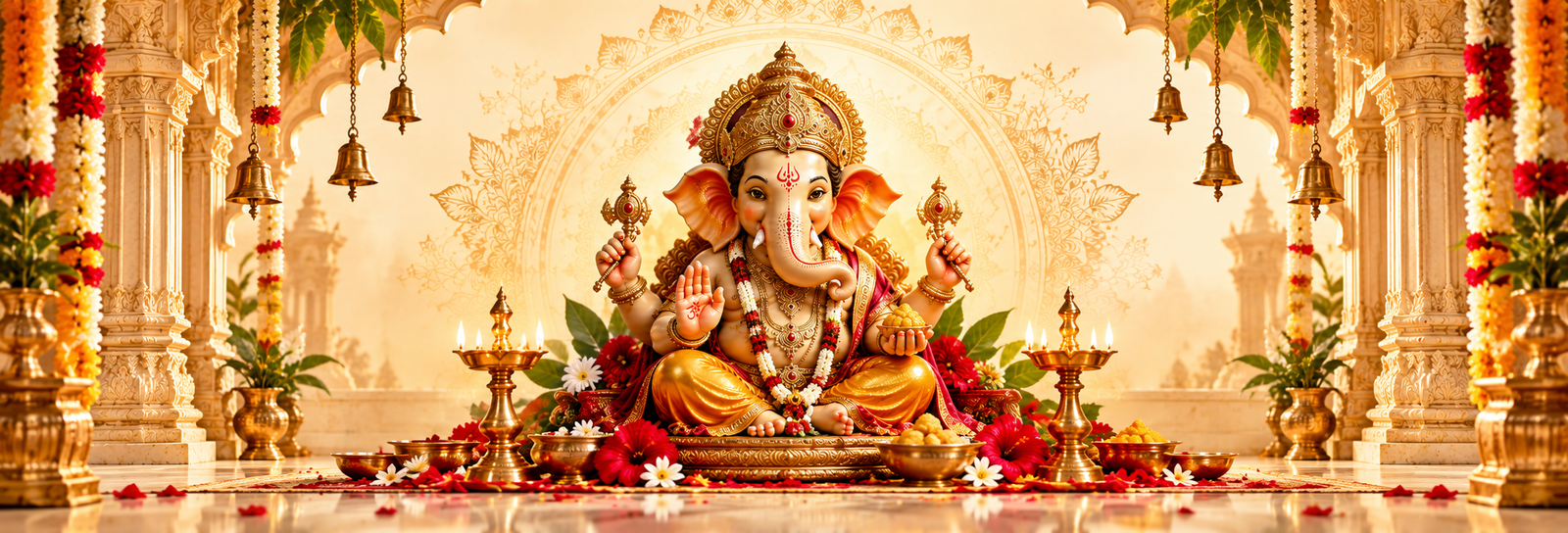
For ten days every September, something happens in Mumbai, Pune, Hyderabad, and a few thousand smaller towns in between that doesn't quite happen anywhere else on the Hindu calendar. A clay idol comes home. A neighbourhood pandal turns into the loudest, most joyful place in the city, decorated for weeks in advance by committees who treat the design theme with the seriousness of a stage production. And on the last day, that same idol is carried through the streets on shoulders, drums, and sheer collective noise, to be lowered into a river, lake, or the sea — with a promise, shouted rather than whispered, that he'll be back next year.
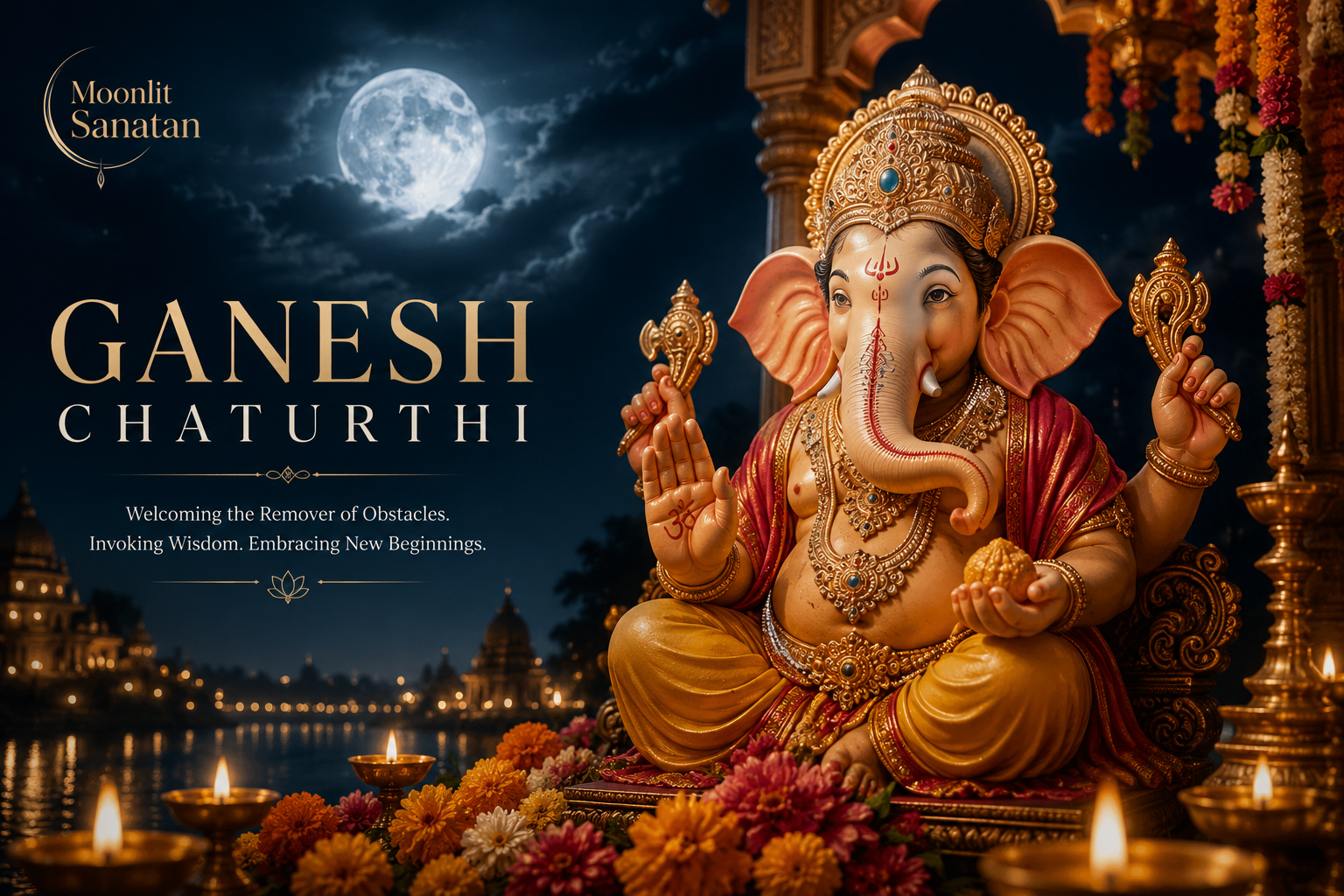
This is Ganesh Chaturthi — the birthday of Ganesha, the elephant-headed remover of obstacles, and arguably the most publicly, unapologetically joyful festival in the entire Hindu calendar. Unlike quieter, more contemplative observances built around fasting and restraint, this one was built — quite deliberately, by a freedom fighter, in 1893 — to fill streets rather than just homes, and it has only grown louder and larger with every passing decade since.
2026 gives you the full ten-day window to plan around. Here's the exact date, the installation and visarjan muhurats, the story behind the elephant head, the history of how a household ritual became a nationwide street celebration, the regional names this festival goes by across India, and everything you need for a home celebration — eco-friendly or otherwise.
Ganesh Chaturthi 2026 — Quick Answer
Monday, 14 September 2026
Sthapana Muhurat: approx. 11:00 AM – 1:30 PM · Visarjan (Anant Chaturdashi): Friday, 25 September
| Detail | Timing |
|---|---|
| Chaturthi Tithi begins | 14 September 2026, approx. 7:06 AM |
| Chaturthi Tithi ends | 15 September 2026, approx. 7:44 AM |
| Madhyahna Sthapana Muhurat (idol installation) | Approx. 11:00 AM – 1:30 PM, 14 September |
| Anant Chaturdashi (grand visarjan) | Friday, 25 September 2026 |
| Festival duration | 10 days — shorter 1.5 / 3 / 5 / 7-day options also common |
Exact minute-level muhurat timings shift slightly by city — worth a quick check against your local panchang before the day. The visarjan date is flexible by tradition: many households immerse on day 1.5, day 3, 5, or 7, while the grand public processions wait for the full ten days and Anant Chaturdashi.
The Story of the Elephant Head
The most widely told version of Ganesha's origin comes from the Shiva Purana. Goddess Parvati, wanting a guardian of her own while she bathed, molded a child out of turmeric or sandalwood paste from her own body and breathed life into him. She placed him at the entrance to her chambers with strict instructions: let no one in.
Shiva returned home and, finding a boy he didn't recognize blocking his own doorway, demanded to be let through. The child, loyal only to Parvati's instruction, refused. What followed depends on which telling you hear, but the outcome is consistent across all of them: an enraged Shiva severed the boy's head.
Shiva placed it on the boy's body and restored him to life, declaring him his own son and granting him a position no other deity holds quite the same way: Ganesha would be worshipped first, before any other god, at the start of every ritual, journey, or new undertaking. This is the root of his most common title, Vighnaharta — the remover of obstacles — and why even temples dedicated to other deities typically include a Ganesha shrine near the entrance.
A second, related story explains a curious and widely followed custom: avoiding the sight of the moon on Ganesh Chaturthi night. As the story goes, the moon god Chandra once laughed at Ganesha's rotund form and unusual mount, the mouse. Ganesha, offended, cursed Chandra to lose his light entirely — a curse only partially lifted after the other gods intervened, leaving the moon to wax and wane each month rather than shine constantly. Because of this old grievance, many devotees still avoid looking at the moon specifically on Chaturthi night, believing it invites false accusations or bad luck — a superstition many households still observe out of habit even when they can't quite recall the reason for it.
HistoryFrom Home Ritual to Street Festival: Tilak's 1893 Reinvention
Ganesh Chaturthi as a private, home-based worship day is genuinely ancient. The version most of India recognizes today — massive public pandals, community processions, and days-long street celebrations — is much younger, and traces to a specific person and year: Lokmanya Bal Gangadhar Tilak, in 1893.
Under British colonial rule, public assembly for explicitly political purposes was heavily restricted. Tilak, a leading figure in India's independence movement, transformed what had largely been a private household festival into a large public event — Sarvajanik Ganeshotsav — specifically to give Indians a lawful, culturally rooted reason to gather in large numbers, share ideas, and build collective identity across caste lines at a time when doing so politically was dangerous. The strategy worked far beyond its original purpose: the public Ganeshotsav format he popularized in Pune and Mumbai is now the dominant way the festival is celebrated across most of India, more than a century later.
This is also the origin of the now-iconic chant heard at every visarjan procession: "Ganpati Bappa Morya, Pudhchya Varshi Lavkar Ya" — "Father Ganpati, come again quickly next year." Morya itself references Morya Gosavi, a 15th-century Ganesha devotee from Chinchwad near Pune whose devotion was considered so complete that his name became permanently fused with Ganesha's own in popular chant.
Choosing How Long to Keep Ganpati: 1.5 to 10 Days
One thing that surprises first-time celebrants is that the festival's length isn't fixed — families and communities choose a duration based on tradition, space, and how elaborate the celebration will be.
| Duration | 2026 Visarjan Date | Common For |
|---|---|---|
| 1.5 days (Dedh Din) | 15 September | The classic Maharashtrian home tradition |
| 3 days | 16 September | Families wanting a fuller but still compact celebration |
| 5 days | 18 September | Often combined with Jyeshtha Gauri puja |
| 7 days | 20 September | Extended home or smaller community celebrations |
| 10 days (Anant Chaturdashi) | 25 September | The grand public Sarvajanik Ganeshotsav processions |
None of these is more "correct" than another — the choice usually comes down to family tradition, available space for daily aarti, and whether you're hosting a home Ganpati or joining a larger community celebration. Some families also base the decision on practical constraints: an apartment with limited puja space might favour the 1.5-day Dedh Din tradition, while a joint family with a dedicated puja room, or a housing society organizing a shared community Ganpati, is far more likely to commit to the full ten days leading up to Anant Chaturdashi.
Home PujaStep-by-Step Ganesh Chaturthi Puja Vidhi
- Choose your idol in advance. An eco-friendly clay (shadu mati) Ganesha idol is increasingly the preferred choice, since it dissolves cleanly during visarjan without the environmental impact of Plaster of Paris.
- Set up a decorated mandap at home before the sthapana — a simple decorative Ganpati mandap backdrop with fresh flowers and lighting gives the idol a proper seat of honour for the days ahead.
- Perform Pranapratishtha during the Madhyahna muhurat (approx. 11:00 AM–1:30 PM on 14 September), inviting the divine presence into the idol.
- Offer durva grass and red hibiscus, Ganesha's most cherished offerings — a ready durva grass and hibiscus puja kit is useful since fresh durva can be hard to source last-minute in cities.
- Prepare modak, Ganesha's favourite sweet, steamed or fried, as the central prasad of the festival — a good modak mould and steamer set makes the traditional pleated shape far easier for first-timers.
- Perform daily aarti morning and evening for the duration you've chosen to keep the idol, singing the Ganesh aarti and offering incense and diya.
- Decorate through the festival with fresh flowers, lighting, and torans — a set of festive Ganpati torans and string lighting keeps the home celebratory through all ten days without needing to restock decorations daily.
- On your chosen visarjan day, perform Uttar Puja, offer a final aarti, and immerse the idol in a water body — or in a bucket of water at home for smaller clay idols, following the increasingly common eco-conscious practice.
If you'd rather keep a Ganesha idol at home year-round in addition to the festival idol, a separate, permanently consecrated brass or silver Ganesha idol for daily worship is a common and accepted practice — most households treat the two as entirely distinct: one festival guest, one permanent resident.
The Clay vs. Plaster of Paris Debate
No modern discussion of Ganesh Chaturthi is complete without the environmental conversation that now shapes how millions of families choose their idol. Plaster of Paris (PoP) idols became dominant through the 20th century because they're cheaper, hold intricate detail well, and are easier to mass-produce for the huge public pandals — but PoP doesn't dissolve, and the paints used on it are often toxic, leaving lasting damage in the lakes and rivers where idols are traditionally immersed.
Traditional shadu clay, by contrast, is the material Ganesha idols were made from for centuries before PoP took over, and it dissolves back into the water within hours, largely without harm. Many cities now actively promote or mandate clay idols for exactly this reason, and a growing number of families — even those who grew up with PoP Ganpatis — are switching back, treating it as much an environmental choice as a devotional one. If you're buying your first idol for 2026, checking for "shadu mati" or "eco-friendly clay" in the listing is worth the extra look.
Vedic AstrologyGanesha, Ketu, and Why He's Invoked First
Beyond mythology, Vedic astrology assigns Ganesha a specific planetary association: he governs Ketu, the shadow planet linked to sudden disruption, detachment, and unresolved karmic threads from the past. This is part of why his blessing is considered essential before starting anything new — a business, a journey, a wedding, even the writing of the Mahabharata itself, which tradition holds Ganesha personally transcribed as Sage Vyasa dictated it, breaking his own tusk to use as a pen when his original stylus failed mid-verse.
The custom of invoking Ganesha before any other deity — even before Shiva, his own father, in many ritual sequences — isn't treated as a matter of rank so much as function: Ganesha is the gatekeeper, the one who clears the obstacles standing between an intention and its completion, so every other prayer that follows has a clearer path.
PrasadModak and Beyond: The Food of Ganesh Chaturthi
Modak holds a genuinely unique place in Hindu festival food — it isn't simply a sweet offered to Ganesha, it's considered his single favourite food, referenced directly in his iconography, where he's frequently depicted holding one in his trunk or hand, sometimes accompanied by his mount Mushika, the mouse, said to be equally fond of the sweet. The most traditional version, ukadiche modak, is steamed, with a rice-flour outer shell and a coconut-jaggery filling; a fried version, talniche modak, uses a wheat-flour shell instead and keeps longer, making it more common for larger community offerings.
Tradition holds that twenty-one modaks are offered during the main puja specifically, a number considered symbolically complete in Ganesha worship. Beyond modak, regional prasad traditions vary — Tamil Nadu's kozhukattai is essentially modak's South Indian counterpart, while Maharashtra also commonly prepares puran poli and besan laddoo through the festival days for family and visiting guests, since a home Ganpati typically means a steady stream of relatives and neighbours dropping in for darshan across the ten days.
EtiquetteCommon Mistakes to Avoid During Ganesh Chaturthi
- Choosing a Plaster of Paris idol without checking — many listings don't clearly state the material; look specifically for "shadu clay" or "eco-friendly" in the description if immersion-safety matters to you.
- Skipping the daily aarti after the first day or two — the festival's structure assumes twice-daily worship for however many days you keep the idol; treating it as a one-time installation misses the point of the extended stay.
- Immersing a large idol in a small water body — many cities now provide designated immersion tanks specifically to reduce the environmental burden on natural lakes and rivers; using them is increasingly treated as good practice rather than an inconvenience.
- Forgetting durva grass — flowers alone are often used as a substitute, but durva grass is considered Ganesha's specific preferred offering, distinct from the general flower offerings used across most other pujas.
- Looking at the moon on Chaturthi night without realizing it — if this custom matters to your family, it's worth checking moonrise time for your city in advance rather than discovering the concern after the fact.
Ganesh Chaturthi's Many Regional Names
Few festivals go by as many distinct regional names as this one — each tied to a specific state's language and devotional tradition, and each carrying real, independent search volume of its own:
- Maharashtra — Ganeshotsav / Ganpati: the epicentre of the public-festival tradition, with Mumbai's Lalbaugcha Raja and Pune's Dagdusheth Halwai Ganpati drawing millions of visitors across the ten days.
- Andhra Pradesh & Telangana — Vinayaka Chavithi: celebrated with equal fervour, including Hyderabad's Khairatabad Ganesh, historically one of the tallest idols installed anywhere in the country.
- Tamil Nadu — Vinayagar Chaturthi / Pillaiyar Chaturthi: "Pillaiyar" is the Tamil name for Ganesha, and the festival here often includes distinct South Indian prasad traditions like kozhukattai, the Tamil counterpart to modak.
- Karnataka — Ganesha Habba: celebrated with community Ganesha idols and a strong tradition of "Gowri-Ganesha" combined worship, similar to Maharashtra's Gauri-Ganpati pairing.
- Goa — Chavath: one of the oldest continuously observed versions of the festival, with distinct Goan-Hindu family rituals around idol-making passed down through generations.
Wherever you're celebrating from, the core devotional structure — sthapana, daily worship, modak, and visarjan — remains recognizably the same underneath the regional name and local flavour.
The Ashtavinayaka: Eight Sacred Ganesha Temples
For devotees who want to extend the festival's devotion beyond the home mandap, Maharashtra is home to the Ashtavinayaka — eight ancient Ganesha temples, each built around a self-manifested (swayambhu) idol rather than one installed by human hands, and each associated with a different form and legend of Ganesha. Traditionally, the full circuit is completed in a specific sequence over one continuous pilgrimage, starting and ending at Moreshwar Temple in Morgaon, considered the most important of the eight.
While the Ashtavinayaka yatra is undertaken year-round, many devotees specifically plan a visit around Ganesh Chaturthi or shortly after Anant Chaturdashi, when the temples see a natural surge in footfall from families extending their festival devotion into an actual pilgrimage. It's a fitting way to close out the ten days for anyone wanting to take the celebration beyond their own home altar.
Eco-Friendly Clay Ganesha
A shadu-clay idol in a size suited to your home altar keeps the celebration both traditional and environmentally responsible.
View clay Ganesha idols →Modak Mould & Steamer
Get the traditional pleated shape right even on your first attempt, for the sweet most closely associated with Ganesha himself.
View modak moulds →Decorative Mandap Backdrop
A ready-made backdrop with floral and lighting elements turns a corner of any home into a proper seat of honour for the ten days.
View mandap backdrops →Permanent Brass Ganesha Idol
A separately consecrated idol for daily worship the rest of the year, distinct from your festival idol.
View brass Ganesha idols →A small idol jewelry and ornament set — a decorative crown, garland, and adornments sized for your idol — is a nice finishing touch many households add once the mandap and lighting are already in place, especially for a permanent home idol that's worshipped year after year.
ConnectionsWhere Ganesh Chaturthi Sits in the Festival Calendar
Ganesh Chaturthi lands about ten days after Krishna Janmashtami, making late August through late September one continuous devotional stretch across much of India. If you've just wrapped up Janmashtami, our Krishna Janmashtami 2026 guide covers that festival in full, and our Raksha Bandhan 2026 guide and Sawan 2026 guide cover the two festivals before it in the same seasonal run.
FAQFrequently Asked Questions About Ganesh Chaturthi 2026
What is the date of Ganesh Chaturthi 2026?
Ganesh Chaturthi 2026 falls on Monday, 14 September, marking the Chaturthi Tithi of Bhadrapada Shukla Paksha.
When is Ganesh Visarjan in 2026?
The grand public visarjan on Anant Chaturdashi falls on Friday, 25 September 2026, marking the tenth and final day of the festival. Shorter home celebrations may immerse on day 1.5, 3, 5, or 7 instead.
What is the best muhurat for Ganpati Sthapana?
The Madhyahna (mid-day) muhurat, approximately 11:00 AM to 1:30 PM on 14 September, is considered the most auspicious window for idol installation, though morning and evening (Pradosh Kaal) options are also used if the mid-day window is missed.
Why do some regions call it Vinayaka Chavithi or Pillaiyar Chaturthi?
These are the same festival under different regional-language names — Vinayaka Chavithi in Andhra Pradesh and Telangana, and Vinayagar or Pillaiyar Chaturthi in Tamil Nadu, both referring to Ganesha under his regional names.
Why is looking at the moon avoided on Ganesh Chaturthi?
Tradition holds that the moon god Chandra once mocked Ganesha's appearance and was cursed for it, and many devotees still avoid viewing the moon on Chaturthi night to avoid inviting false accusations, based on this old story.
Is a clay idol better than a Plaster of Paris idol?
Traditional shadu clay idols dissolve naturally during immersion and are considered far less harmful to water bodies than Plaster of Paris idols, which don't dissolve and are often painted with non-biodegradable colours. Many cities now actively encourage or require clay idols for this reason.
Who popularized the public Ganesh Chaturthi celebration?
Lokmanya Bal Gangadhar Tilak transformed the traditionally private, home-based festival into a large public event, Sarvajanik Ganeshotsav, in 1893, to give Indians a lawful reason to gather in large numbers during colonial rule.
Why is Ganesha worshipped before any other deity?
Ganesha is considered the remover of obstacles, and inviting his blessing first is believed to clear the path for whatever ritual or undertaking follows, which is why he's traditionally invoked even before Shiva in many puja sequences.
What is the significance of offering 21 modaks?
Twenty-one is considered a symbolically complete number in Ganesha worship, and offering this specific count of modaks during the main puja is a widely followed tradition, particularly in Maharashtra.
A Festival That Was Always Meant to Be Shared
Most Hindu festivals are built around a household altar and a private moment of devotion. Ganesh Chaturthi, in its modern form, was deliberately built to spill out into the street — and more than a century after Tilak first made that choice, it still does exactly that, louder and bigger every year. The elephant-headed god who once simply guarded a doorway now gets carried through entire cities on his way out, with everyone he's ever blessed following behind, chanting for him to hurry back.
Whether your Ganpati stays for a day and a half or the full ten, whether you call the festival Ganeshotsav, Vinayaka Chavithi, or Pillaiyar Chaturthi, and whether your idol is a family heirloom kept year-round or a fresh clay figure bought just for this September, the spirit underneath all of it stays the same: a god who clears the way, welcomed home for a little while, and sent off again with a promise that he'll do it all over next year.
For more festival guides through the year, explore our Festivals & Their Stories section, or dive into more of Ganesha's stories in our Hindu Gods & Goddesses category.
Follow Moonlit Sanatan
Daily puja reminders, temple stories, and festival dates all through the year.
Ganpati Bappa Morya.