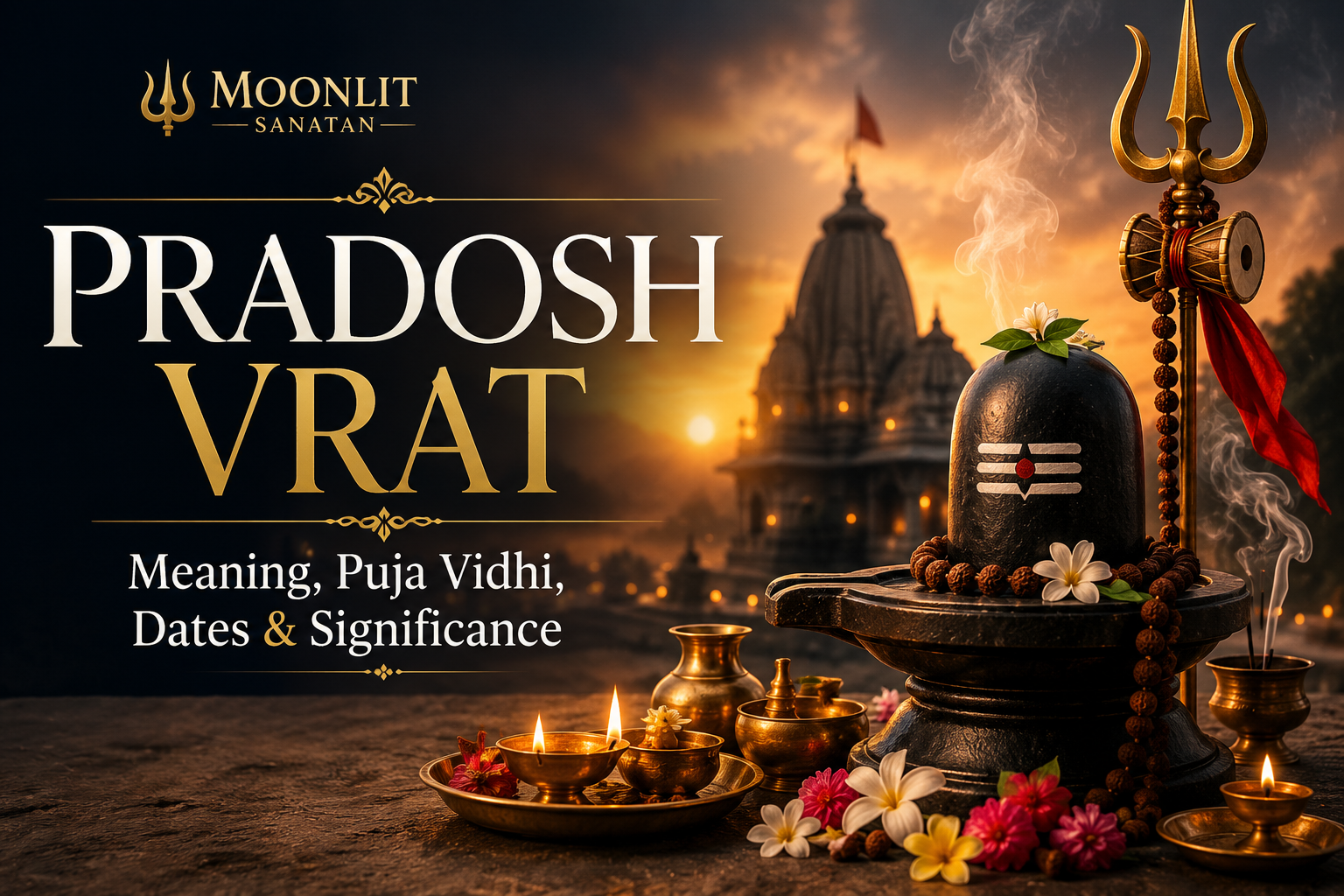
Twice every lunar month, just as the sun dips below the horizon and the sky turns the colour of embers, millions of devotees across India fall silent, light a lamp, and turn their thoughts to Lord Shiva. This is Pradosh Kaal — the sacred twilight — and the fast observed on this evening is called Pradosh Vrat. It is one of the oldest, simplest, and most powerful Shiva vratas in the Sanatan tradition, rooted in the Shiva Purana and practiced without interruption for thousands of years.
If you have ever wondered what Pradosh Vrat truly means, why it falls twice a month, how to observe it correctly, or which Pradosh dates matter most in 2026, this guide walks you through everything — the mythology, the ritual, the timings, and the deeper spiritual science behind this beautiful practice, so you can approach it not as a rigid obligation, but as a genuine, well-informed act of devotion.
Quick Summary: Pradosh Vrat is a fast observed on Trayodashi (the 13th lunar day) of both the Shukla Paksha and Krishna Paksha, dedicated to Lord Shiva and Goddess Parvati. Worship is performed during Pradosh Kaal — roughly 1.5 hours before and after sunset — and is believed to dissolve sins, remove obstacles, and grant peace, prosperity, and spiritual liberation.
What Is Pradosh Vrat? Meaning and Origins
The word Pradosh comes from Sanskrit, where "pra" means "removal" and "dosh" means "sin" or "fault." Put together, Pradosh literally means "the removal of sin" — and that single word captures the entire purpose of this vrat. It is observed to cleanse past karmic burdens, correct planetary afflictions, and invoke the compassionate, protective form of Lord Shiva.
Pradosh Vrat falls on Trayodashi Tithi, the thirteenth day of each lunar fortnight. Because the Hindu lunar month is divided into two fortnights — the waxing Shukla Paksha and the waning Krishna Paksha — Trayodashi occurs twice a month, which means Pradosh Vrat is observed 24 times a year. Each occurrence carries its own flavour depending on the day of the week it falls on, something we'll explore in detail further below.
According to the Shiva Purana, this is the hour when Lord Shiva performs his cosmic dance, the Tandava, on Mount Kailash, with Goddess Parvati, Nandi, and the celestial beings in attendance. Devotees who worship Shiva during this exact window are said to receive blessings equal to performing years of penance. This is why Pradosh Kaal is considered one of the most spiritually charged windows in the entire Hindu calendar, alongside occasions like major festivals and auspicious tithis tracked in the daily Panchang.
Understanding Pradosh Kaal — The Sacred Twilight Window
Pradosh Kaal is not the entire day of Trayodashi — it is a very specific window of roughly two hours and twenty-four minutes, split evenly around sunset: 48 minutes before sunset and 48 minutes after, though many traditions extend this to a full hour on either side for practical purposes. This twilight period is considered neither fully day nor fully night, and in Vedic cosmology, such "in-between" moments are regarded as thresholds where the veil between the physical and the divine grows thin.
Because Pradosh Kaal is calculated from local sunset, the exact timing shifts slightly depending on your city and geography. A devotee in Delhi and a devotee in Chennai will have different Pradosh Kaal windows on the same Trayodashi. The safest approach is always to check a reliable local Panchang for your city's sunset time and calculate roughly 48 minutes to an hour on either side of it.
Worship during this window typically follows a fixed rhythm: bathing and purification before sunset, arranging the puja altar, performing Abhishek (ritual bathing) of the Shiva Lingam, offering Bilva leaves, and concluding with Aarti as darkness sets in. We'll cover the complete step-by-step vidhi later in this guide.
The Legend Behind Pradosh Vrat — Samudra Manthan and Shiva's Grace
Every Hindu vrat carries a story, and Pradosh Vrat's origin is tied to one of the most celebrated episodes in Hindu mythology — the Samudra Manthan, or the Churning of the Cosmic Ocean.
As the Devas and Asuras churned the ocean of milk in search of Amrita, the nectar of immortality, the churning first released Halahala — a poison so lethal it threatened to destroy all of creation. Panic spread through the heavens. The Devas, unable to bear the toxic fumes, rushed to Mount Kailash and prayed desperately to Lord Shiva, the only being powerful enough to contain such devastation.
Moved by their devotion and the urgency of the crisis, Shiva consumed the poison himself. Goddess Parvati, fearing for her consort, clasped his throat to stop the poison from descending further into his body. The poison stayed lodged in his throat, turning it a deep blue — which is why Shiva is worshipped as Neelkanth, "the blue-throated one." It is said this act of supreme sacrifice took place precisely during the twilight hour, and the Devas, overwhelmed with gratitude, danced and celebrated in his honour right there in Pradosh Kaal. From that moment, worshipping Shiva during this twilight window on Trayodashi became a sacred tradition — a way for devotees to honour the same protective, self-sacrificing compassion Shiva showed the universe.
This story is one of many powerful episodes connected to Lord Shiva's mythology. If you'd like to explore more tales and the deeper symbolism behind Shiva's various forms, our Hindu Gods & Goddesses section and our detailed guide to the Kashi Vishwanath Temple — one of Shiva's twelve Jyotirlingas — are worth exploring next.
Pradosh Vrat 2026 — Upcoming Dates & Puja Timings
In 2026, devotees will observe a total of 24 Pradosh Vrats across the year. Below is the complete list of upcoming Pradosh Vrat dates for the remainder of 2026, along with the Paksha (lunar fortnight) and the special weekday-based name each one carries. Remember, these timings are approximate for North India — always cross-check with a local Panchang for your exact city.
| Date | Day | Paksha | Pradosh Type |
|---|---|---|---|
| 10 August 2026 | Monday | Krishna Paksha | Som Pradosh |
| 25 August 2026 | Tuesday | Shukla Paksha | Bhauma Pradosh |
| 8 September 2026 | Tuesday | Krishna Paksha | Bhauma Pradosh |
| 24 September 2026 | Thursday | Shukla Paksha | Guru Pradosh |
| 8 October 2026 | Thursday | Krishna Paksha | Guru Pradosh |
| 23 October 2026 | Friday | Shukla Paksha | Shukra Pradosh |
| 6 November 2026 | Friday | Krishna Paksha | Shukra Pradosh |
| 22 November 2026 | Sunday | Shukla Paksha | Ravi Pradosh |
| 6 December 2026 | Sunday | Krishna Paksha | Ravi Pradosh |
| 21 December 2026 | Monday | Shukla Paksha | Som Pradosh |
Note: Exact Pradosh Kaal start and end times vary by city. Bookmark this page and check back monthly, or refer to our Daily/Weekly Panchang section for city-specific timings closer to each date.
Types of Pradosh Vrat — Significance by Day of the Week
What makes Pradosh Vrat particularly fascinating is that its meaning shifts depending on which day of the week it falls on. Each weekday is ruled by a different planet or deity in Vedic astrology, and that ruling energy blends with Shiva's grace to create a unique flavour of blessing. Here's what each one signifies:
Ravi Pradosh (Sunday)
Falling on Sunday, the day ruled by the Sun, Ravi Pradosh is considered excellent for good health, vitality, longevity, and freedom from chronic ailments. Since the Sun governs confidence, leadership, and life-force energy, devotees observe this Pradosh to strengthen their willpower and overall wellbeing. Interestingly, Sun worship has its own grand tradition in Hindu architecture — if solar symbolism fascinates you, our guide to the Konark Sun Temple is a beautiful companion read.
Som Pradosh (Monday)
Monday belongs to the Moon, and Som Pradosh is regarded as one of the most auspicious of all Pradosh days because Monday is already sacred to Shiva himself. This combination is believed to bring emotional balance, mental peace, and the fulfilment of long-held wishes. Many devotees choose Som Pradosh specifically to pray for marriage, family harmony, or relief from anxiety.
Bhauma Pradosh / Mangal Pradosh (Tuesday)
Ruled by Mars (Mangal), Tuesday's Pradosh is considered highly effective for resolving health issues, clearing debts, and overcoming disputes or legal troubles. Mars represents courage and conflict, so this Pradosh is often observed by those seeking protection from enemies or financial strain.
Budh Pradosh (Wednesday)
Wednesday is governed by Mercury, the planet of intellect, communication, and commerce. Budh Pradosh is favoured by students, business owners, writers, and anyone whose work depends on clear thinking and good judgment. It is believed to sharpen the mind and remove confusion.
Guru Pradosh (Thursday)
Thursday belongs to Jupiter (Guru), the planet of wisdom, higher learning, and spiritual growth. Guru Pradosh is considered especially powerful for those pursuing education, seeking a mentor, hoping for children, or wanting to deepen their spiritual practice. It is often recommended for people with a weak Jupiter placement in their birth chart.
Shukra Pradosh (Friday)
Friday is ruled by Venus (Shukra), the planet of love, beauty, comfort, and material prosperity. This Pradosh is associated with peace of mind, harmonious relationships, and the removal of negativity from one's home and heart.
Shani Pradosh (Saturday)
Perhaps the most sought-after of all, Shani Pradosh falls on Saturday, the day of Saturn — the planet associated with karma, discipline, and life's hardest lessons. Because both Shiva and Shani are deeply connected in Vedic tradition, this Pradosh is considered extraordinarily powerful for relief from Shani Dosha, Sade Sati, and Kaal Sarp Dosha. Devotees under a difficult Saturn transit often observe Shani Pradosh with special devotion, offering black sesame seeds, mustard oil lamps, and reciting the Shani Chalisa alongside Shiva mantras.
Pradosh Vrat Puja Vidhi — Step-by-Step Ritual Guide
The beauty of Pradosh Vrat lies in its simplicity — it requires no elaborate priesthood or expensive materials, only sincerity and correct timing. Here is the traditional method of observing it at home:
- Begin the day with a vow (Sankalp): On the morning of Trayodashi, take a bath, wear clean clothes, and mentally resolve to observe the fast with devotion, keeping Lord Shiva and Goddess Parvati in mind.
- Observe the fast through the day: Traditionally, devotees eat only one satvik meal (without onion, garlic, or grains) in the afternoon, or fast completely on water and fruits until the evening puja is complete.
- Bathe again before sunset: A second bath roughly an hour before sunset is important, as it marks the transition into the sacred Pradosh Kaal.
- Prepare the puja space: Clean the altar and place a Shiva Lingam or an image of Shiva-Parvati facing north or east. Light a ghee or sesame oil lamp on either side.
- Perform Abhishek: Bathe the Shiva Lingam with water, followed by milk, curd, honey, ghee, and sugar (Panchamrit), finishing with a final rinse of clean water. Each substance is offered with reverence while chanting "Om Namah Shivaya."
- Offer sacred items: Present Bilva (bel) leaves, white flowers, Vibhuti (sacred ash), Akshat (unbroken rice), betel leaves, and seasonal fruits. Bilva leaves are considered especially dear to Shiva and should always be offered with the smooth side facing the deity.
- Light incense and the main lamp: As the sun begins to set, light dhoop and a larger ghee lamp, marking the true beginning of Pradosh Kaal worship.
- Chant and recite: Recite the Om Namah Shivaya mantra (ideally 108 times using a mala), the Shiva Panchakshara Stotram, or the Pradosh Vrat Katha, which narrates the story of the Samudra Manthan and the origin of this fast.
- Perform Aarti: Conclude the ritual with a Shiva Aarti as darkness fully sets in, offering the flame to all present and seeking blessings.
- Break the fast: The fast is generally broken after the puja concludes, with a simple satvik meal. Some traditions recommend breaking the fast only the next morning after sunrise.
Pradosh Vrat Katha — The Story Devotees Recite
Beyond the Samudra Manthan legend, a specific Pradosh Vrat Katha is traditionally read or listened to during the puja itself, and its telling varies slightly by region. One popular version narrates the story of a poor Brahmin widow and her young son, who lived in extreme hardship after losing everything they owned. Wandering from town to town in search of a livelihood, the boy eventually crossed paths with a group of young princes who had also lost their kingdom. The two families, brought together by shared misfortune, began observing the Pradosh Vrat together with unwavering faith, worshipping Shiva every Trayodashi evening despite their circumstances.
Pleased by their devotion and persistence through hardship, Lord Shiva blessed the group with the restoration of their fortunes — the princes eventually reclaimed their kingdom, and the widow's family found lasting prosperity. The story is recited to remind devotees that Pradosh Vrat is not reserved for the privileged or the pious alone; it is a fast available to anyone, regardless of their circumstances, and its rewards flow from sincerity rather than status. This Katha is typically read aloud in the household after the Aarti, often with family members gathered together, reinforcing Pradosh Vrat's role as both a personal and communal act of faith.
Fasting Rules and Do's & Don'ts
Like most Hindu vratas, Pradosh Vrat comes with a few guidelines meant to help the devotee maintain purity of body and mind through the day. These aren't rigid rules meant to cause hardship — they exist to create the right inner environment for worship, keeping the mind calm, the body light, and the senses turned inward rather than scattered across daily distractions. Traditionally, the day is treated as a mini spiritual retreat, even for householders juggling work and family responsibilities.
- Do maintain silence, calm, and positive thoughts throughout the day as much as possible.
- Do wear clean, preferably white or light-coloured clothing during the puja.
- Do chant "Om Namah Shivaya" mentally through the day if a full fast feels difficult.
- Avoid non-vegetarian food, alcohol, onion, and garlic on this day, even if you are not observing a strict fast.
- Avoid arguments, harsh words, or negative emotions — the day is meant for inner stillness.
- Avoid cutting hair or nails, as is customary on most Hindu fasting days.
- Pregnant women, elderly individuals, and those with medical conditions may observe a modified fast (fruits and milk only) rather than a complete water-only fast — devotion matters more than austerity.
Pradosh Vrat Mantras and Their Meaning
Mantras are central to Pradosh Kaal worship — they aren't just words but vibrational tools believed to align the chanter's energy with Shiva's own frequency. Here are the mantras most commonly recited during this vrat:
- Om Namah Shivaya: The Panchakshara Mantra, meaning "salutations to Shiva," is the most fundamental Shiva mantra and forms the core of Pradosh Kaal chanting. Ideally recited 108 times using a Rudraksha mala.
- Om Trayambakam Yajamahe (Mahamrityunjaya Mantra): Often added for health, protection from untimely death, and overall wellbeing. Many devotees chant this alongside the Panchakshara mantra during Shani Pradosh in particular.
- Karpur Gauram Karunavataram: A short shloka describing Shiva's radiant, compassionate form, typically recited at the end of the Aarti.
- Pradosh Stotram: A dedicated hymn praising Shiva specifically in his Pradosh Kaal form, recited by more advanced practitioners who wish to deepen their ritual practice.
You don't need to know Sanskrit fluently to benefit from these chants — even a sincere, unhurried repetition, said with attention rather than perfect pronunciation, is considered deeply effective in this tradition.
Regional Names and Traditions of Pradosh Vrat
Like most pan-Indian observances, Pradosh Vrat takes on slightly different names and flavours as you move across the country. In Tamil Nadu and much of South India, it is widely known as Pradosham, and temple towns built around Shiva Sthalas often see large public gatherings on this evening, with special Abhishekams performed in temple sanctums rather than only at home altars. Many South Indian devotees specifically time their temple visits — including pilgrimages to Jyotirlinga shrines such as the Ramanathaswamy Temple in Rameswaram — around Pradosham dates for maximum spiritual benefit.
In parts of North India, particularly in temple towns associated with Shiva worship, Pradosh evenings are marked with community bhajans and the ringing of temple bells precisely at sunset. Maharashtra and Gujarat see quieter, home-centred observance, often combined with reading the Shiva Purana. Despite these regional variations in style, the essential structure — fasting through the day and worshipping Shiva during the twilight window — remains remarkably consistent across the country, a testament to how deeply this practice is woven into the shared fabric of Sanatan Dharma.
Pradosh Vrat vs. Other Shiva Observances — What's the Difference?
Because several Shiva-related fasting days exist in the Hindu calendar, it's easy to confuse them. Here's a quick clarification:
- Pradosh Vrat vs. Maha Shivratri: Maha Shivratri is an annual, once-a-year festival marking Shiva's cosmic wedding night and is observed with an all-night vigil. Pradosh Vrat, by contrast, occurs 24 times a year and is a shorter, twilight-focused observance rather than an all-night one.
- Pradosh Vrat vs. Monthly Shivratri (Masik Shivratri): Masik Shivratri falls once a month on Krishna Chaturdashi (the 14th day), one day after the Krishna Paksha Pradosh Vrat, and is also observed at night rather than at twilight. Many devotees observe both back-to-back for maximum benefit.
- Pradosh Vrat vs. Som Pradosh: Som Pradosh isn't a separate vrat — it's simply the specific name given to Pradosh Vrat when it happens to fall on a Monday, combining Shiva's regular Pradosh energy with the Moon's influence.
Understanding these distinctions helps you plan your spiritual calendar more intentionally, rather than treating every Shiva-related date as identical.
Spiritual and Astrological Benefits of Pradosh Vrat
Beyond its devotional significance, Pradosh Vrat is deeply woven into Vedic astrology and is often recommended by astrologers as a remedy for specific planetary weaknesses. Because the vrat is dedicated to Shiva — regarded as the ultimate healer and destroyer of negativity — its benefits are believed to touch nearly every area of life:
- Karmic cleansing: Regular observance is said to gradually dissolve accumulated sins (paap) and negative karma from past actions.
- Planetary remedies: Each weekday-specific Pradosh (especially Shani Pradosh) is used as a natural remedy for afflicted planets in one's birth chart.
- Marital harmony: Unmarried devotees, particularly women, observe Pradosh Vrat seeking a compatible life partner, while married couples observe it for a harmonious relationship.
- Health and longevity: The fast is believed to purify the body and calm the nervous system, and evening fasting aligns naturally with the body's circadian rhythm.
- Progeny and family wellbeing: Many families observe this vrat together while praying for the health and prosperity of their children.
- Moksha and spiritual growth: At its highest level, Pradosh Vrat is considered a path toward liberation (moksha), as consistent Shiva worship is said to gradually dissolve the ego and attachment to material outcomes.
If planetary influences and remedies interest you, you may also enjoy exploring our broader Vedic Astrology section, including our guides on Rashi (Zodiac Signs) and Planetary Influence.
What makes Pradosh Vrat especially practical for modern life is that it doesn't demand you step away from your responsibilities. Because the core worship window lasts under two and a half hours around sunset, working professionals, students, and homemakers alike can observe it without disrupting their daily routine. Many devotees simply keep the day lighter — a modest breakfast, a satvik lunch, and a calm, screen-free evening dedicated to the puja — making Pradosh Vrat one of the most sustainable spiritual practices to build into a busy month, twice over, every single time Trayodashi arrives.
Puja Essentials for Pradosh Vrat
Setting up a proper puja altar makes a real difference to how the ritual feels. Here are a few thoughtfully chosen essentials that devotees commonly keep at home for Pradosh Vrat and regular Shiva puja:
| Puja Essential | Why You Need It | Check Price |
|---|---|---|
| Brass Shiva Lingam with Yoni Base | The centrepiece for Abhishek and daily worship at home. | View on Amazon |
| 108-Bead Rudraksha Mala | For chanting "Om Namah Shivaya" during Pradosh Kaal. | View on Amazon |
| Brass Puja Thali Set (Complete) | Everything you need — bell, diya stand, kalash and more — in one set. | View on Amazon |
| Brass Akhand Diya (Oil Lamp) | A dedicated lamp to keep lit through the Pradosh Kaal Aarti. | View on Amazon |
| Pure Camphor Cubes & Dhoop Combo | Essential for Aarti and purifying the puja space. | View on Amazon |
| Wooden Puja Chowki with Asana Cloth | A dedicated, elevated seat for your deity during worship. | View on Amazon |
Frequently Asked Questions About Pradosh Vrat
1. What is the meaning of Pradosh Vrat?
Pradosh Vrat is a fast dedicated to Lord Shiva and Goddess Parvati, observed on Trayodashi Tithi during the twilight hour (Pradosh Kaal) to seek forgiveness for sins, remove obstacles, and invoke divine blessings.
2. How many times does Pradosh Vrat occur in a year?
Pradosh Vrat occurs 24 times a year — twice every lunar month, once in the Shukla Paksha and once in the Krishna Paksha.
3. What is Pradosh Kaal timing?
Pradosh Kaal generally spans about 48 minutes before and after sunset, though the exact window varies by city and is best confirmed through a local Panchang.
4. Which Pradosh Vrat is considered the most powerful?
Shani Pradosh (falling on Saturday) is widely regarded as the most powerful, especially for remedying Shani Dosha, Sade Sati, and Kaal Sarp Dosha, since it combines the energies of both Shiva and Saturn.
5. Can I observe Pradosh Vrat without a complete fast?
Yes. While a strict water-only fast is traditional, many devotees — especially the elderly, pregnant women, or those with health conditions — observe a modified fast with fruits and milk. Sincerity of devotion matters more than the severity of the fast.
6. What should I offer Lord Shiva during Pradosh Vrat?
Common offerings include Bilva (bel) leaves, milk, curd, honey, ghee, sugar, white flowers, Vibhuti, and water, along with the recitation of "Om Namah Shivaya" and the Pradosh Vrat Katha.
7. Can women observe Pradosh Vrat?
Yes, Pradosh Vrat can be observed by all devotees regardless of age or gender. It is especially popular among unmarried women praying for a good life partner and married women praying for their family's wellbeing.
8. What happens if I accidentally miss the exact Pradosh Kaal timing?
Don't be too hard on yourself — sincerity matters more than precision. If you miss the exact window, you can still perform a simplified puja and chant Shiva mantras as soon as possible that evening. Devotees are also encouraged to seek forgiveness through prayer and observe the next Pradosh Vrat with renewed discipline.
9. Is Pradosh Vrat the same in every Hindu calendar tradition?
The core tithi-based calculation (Trayodashi in both Paksha) is consistent everywhere, but exact Pradosh Kaal timings differ by city due to local sunset, and regional customs — such as South India's temple-centred Pradosham celebrations — can differ in style even though the underlying observance is the same.
10. Can I observe Pradosh Vrat if I've never done a Hindu fast before?
Absolutely. Pradosh Vrat is considered one of the most beginner-friendly vratas because it doesn't require elaborate rituals or priestly assistance. Even lighting a lamp, offering a Bilva leaf, and chanting "Om Namah Shivaya" with sincerity during Pradosh Kaal is considered a complete and meaningful observance.
Final Thoughts
Pradosh Vrat is a beautiful reminder that devotion doesn't need grandeur — just sincerity, timing, and a quiet heart turned toward the divine. Whether you observe it for spiritual growth, planetary remedies, or simply to feel closer to Shiva's grace, this twilight fast connects you to a tradition that has anchored countless generations of devotees before you. As you plan your next Pradosh Vrat, keep this guide handy for the dates, the vidhi, and the meaning behind each ritual step — and may Lord Shiva's grace remove every obstacle from your path.
For more temple guides, festival stories, and Vedic wisdom, explore our Dharma & Spirituality section, and follow our journey on Instagram, Facebook, and Pinterest for daily spiritual updates, temple stories, and panchang reminders.