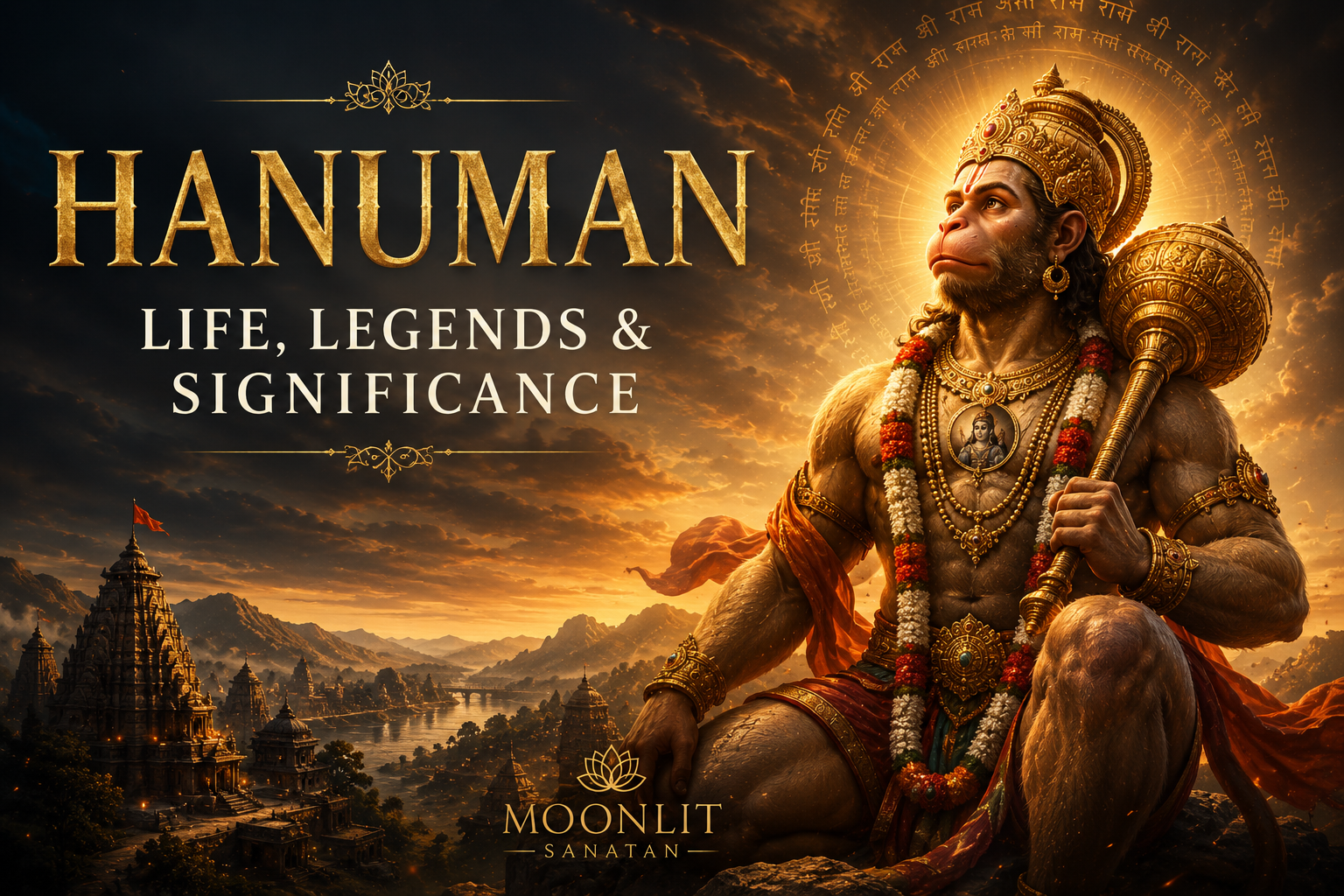
Hanuman: Life, Legends & Significance
The story of devotion, strength, and selfless service behind Hinduism's most beloved and most worshipped deity.
There is a reason nearly every neighbourhood in India, however small, has at least one shrine to Hanuman. No other Hindu deity is quite as universally loved, quite as freely approached, or quite as thoroughly woven into daily life — from the Hanuman Chalisa recited each morning in millions of homes, to the small idol tucked into car dashboards and shop counters across the country. Hanuman is strength without arrogance, power without cruelty, and devotion so complete that it has become the very definition of bhakti, the path of loving surrender, in Hindu spiritual tradition.
This guide traces Hanuman's story from birth to his role in the Ramayana and beyond, explores what his many names and forms represent, and looks at why, more than two thousand years after his story was first told, he remains one of the most actively worshipped deities in the world.
Quick Facts
| Also known as | Bajrangbali, Anjaneya, Pawanputra, Maruti, Kesari Nandan, Sankat Mochan, Mahavira |
| Parents | Anjana (mother) and Kesari (father); son of Vayu, the wind god, by divine blessing |
| Associated epic | The Ramayana — devoted follower and messenger of Lord Rama |
| Status | Chiranjivi — one of the immortals said to still walk the earth |
| Symbolizes | Strength, devotion (bhakti), humility, celibacy (brahmacharya), selfless service |
| Sacred text | Hanuman Chalisa, composed by the poet-saint Tulsidas |
| Major festival | Hanuman Jayanti — observed on Chaitra Purnima in most of North India (regional dates vary) |
| Common iconography | Vanara (monkey) form, gada (mace), Sanjeevani mountain, torn-open chest revealing Rama and Sita |
Inside This Guide
- The Birth of Hanuman
- Hanuman's Many Names & What They Mean
- The Sun-Eating Child & the Curse of Forgetting
- Hanuman in the Ramayana
- Hanuman in the Mahabharata
- Chiranjivi: The Immortal Devotee
- Panchamukhi Hanuman & Other Forms
- What Hanuman Represents
- The Hanuman Chalisa
- Hanuman Jayanti: Dates & Celebrations
- How Hanuman Is Worshipped
- Famous Hanuman Temples in India
- Frequently Asked Questions
The Birth of Hanuman
Hanuman's birth story begins with his mother, Anjana, an apsara who had been cursed to be born on earth as a vanara (a monkey-like celestial being) and could only regain her true form by giving birth to an incarnation of Lord Shiva. Anjana undertook years of intense penance to Lord Shiva to be blessed with a child, and was married to Kesari, a powerful and virtuous vanara chieftain.
Around the same time, King Dasharatha of Ayodhya, Rama's father, performed the Putrakameshti yagna to be blessed with sons, and received a bowl of sacred payasam (a sweet pudding) to distribute among his queens. According to tradition, a portion of this divine offering was carried away by a kite and dropped in the forest, where Anjana, deep in her penance, consumed it. From this union of Shiva's blessing and the sacred payasam, Hanuman was born — making him, in different tellings, either an incarnation of Shiva himself or a being empowered directly by his grace.
His father in spirit, however, is just as central to his identity as his birth parents. Vayu, the god of wind, is said to have carried the falling payasam to Anjana, and in some tellings, directly blessed the child with his own divine strength and the power of flight. This is why Hanuman is so often called Pawanputra, "son of the wind" — a title that speaks to both his supernatural speed and his boundless, unrestrainable energy.
Hanuman's Many Names & What They Mean
Few deities in Hindu tradition carry as many names as Hanuman, each capturing a different facet of his character and story.
The name "Hanuman" itself, meaning roughly "one with a disfigured jaw," comes from a childhood episode central to his story — and it's one worth telling in full, since it also explains a great deal about his personality as an adult.
The Sun-Eating Child & the Curse of Forgetting
As an infant, Hanuman was already extraordinarily powerful, capable of leaping vast distances. One morning, mistaking the rising sun for a ripe, red fruit, he leapt into the sky to devour it. Alarmed, Indra, king of the gods, struck the child with his Vajra (thunderbolt) to stop him, injuring his jaw and sending him falling back to earth.
Enraged at his son's injury, Vayu withdrew air from the entire universe in protest, threatening the balance of creation itself. To pacify him, the gods rushed to bless the child with extraordinary boons: Brahma granted him invulnerability to celestial weapons, Indra gifted him the ability to control the manner of his own death, and other gods bestowed further gifts of strength, wisdom, and shape-shifting. It was this incident — the injury to his "hanu," or jaw — that gave the child his name, Hanuman.
Given the sheer scale of these childhood powers, sages later placed a gentle curse on Hanuman: that he would forget the full extent of his own strength until reminded of it by another. This is precisely what unfolds decades later, when Jambavan, the wise bear-king, reminds Hanuman of his true power before the leap across the ocean to Lanka — one of the most pivotal moments in the entire Ramayana.
Hanuman in the Ramayana
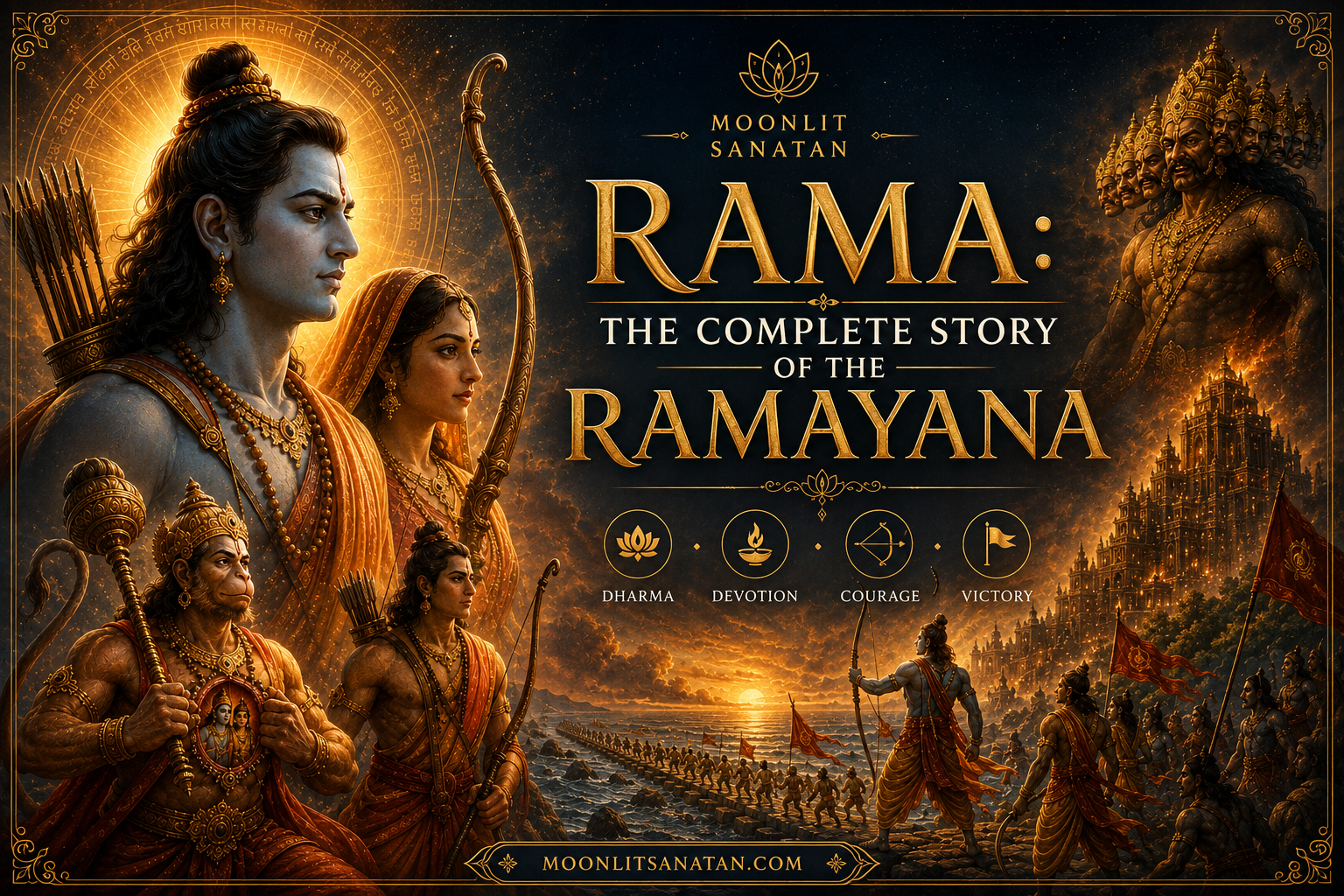
Hanuman's defining role begins when he meets Lord Rama and his brother Lakshmana in the forests near Kishkindha, sent by the vanara king Sugriva to assess whether these two exiled princes could be trusted allies. Disguised as a Brahmin, Hanuman's wisdom and eloquence in this first meeting so impressed Rama that it marked the start of a bond considered, in Hindu tradition, the single greatest example of devotion between a devotee and the divine.
Hanuman quickly became instrumental in the alliance between Rama and Sugriva, helping restore Sugriva to his throne after his brother Vali had wrongfully usurped it. When Rama's wife, Sita, was abducted by the demon king Ravana and taken to Lanka, it was Hanuman who volunteered for the seemingly impossible task of crossing the ocean to find her — a leap made possible only once Jambavan reminded him of the boundless powers granted to him in childhood.
Finding Sita & Burning Lanka
Hanuman located Sita in the Ashoka Vatika, a grove within Ravana's palace grounds, and delivered Rama's ring as proof of his mission, comforting her in her captivity. Before returning, Hanuman deliberately allowed himself to be captured and brought before Ravana, using the confrontation to deliver a warning on Rama's behalf. When Ravana's forces set fire to Hanuman's tail as punishment, Hanuman used the flames to set much of Lanka ablaze before extinguishing himself in the ocean and returning to Rama with news of Sita's location.
The Sanjeevani Mountain
Perhaps the most iconic image associated with Hanuman — and the one most commonly depicted in art and idols across India — comes from the war that followed. When Lakshmana was gravely wounded on the battlefield, the physician Sushena identified a rare herb, Sanjeevani, growing on a specific Himalayan mountain, as the only cure, needed before sunrise. Unable to identify the exact herb among the mountain's vegetation, Hanuman simply lifted the entire mountain, Sanjeevani and all, and flew it back to the battlefield in time to save Lakshmana's life.
Hanuman went on to play a decisive role throughout the war against Ravana, fighting alongside Rama's army and displaying both his martial power and unwavering loyalty at every turn, until Ravana's eventual defeat and Sita's rescue.
Hanuman in the Mahabharata
Though most closely associated with the Ramayana, Hanuman also appears in the later epic, the Mahabharata, underscoring his status as Chiranjivi — a being who transcends any single era. In one well-known episode, Bhima, one of the five Pandava brothers and himself considered a son of Vayu (making him Hanuman's half-brother in spirit), encounters an aged monkey blocking a mountain path and arrogantly demands it move aside.
The monkey, revealed to be Hanuman in disguise, gently humbles Bhima by asking him to simply move its tail out of the way — a seemingly trivial task Bhima finds himself utterly unable to accomplish. Recognising his error, Bhima seeks forgiveness, and Hanuman reveals his true form, offering guidance and blessings. Hanuman is also said to have promised Bhima that he would lend his strength to the Pandava cause during the Kurukshetra war, manifesting as the emblem on Arjuna's chariot flag throughout the battle — a quiet, protective presence during one of Hindu mythology's most consequential conflicts.
Chiranjivi: The Immortal Devotee
Hanuman is counted among the Chiranjivis, a select group of beings in Hindu tradition believed to remain alive on earth until the end of the current cosmic age. This status stems from a boon granted to him for his unmatched service to Rama, and it is central to why devotion to Hanuman feels, to many worshippers, less like praying to a distant historical figure and more like addressing someone genuinely present and reachable.
Popular tradition holds that wherever the Ramayana or the name of Rama is recited with sincere devotion, Hanuman is present, listening — a belief that gives daily practices like reciting the Hanuman Chalisa a particularly immediate, personal quality for many devotees.
Panchamukhi Hanuman & Other Forms
Beyond his familiar vanara form, Hanuman is also worshipped in several other iconographic representations, the most significant being Panchamukhi Hanuman — a five-faced form comprising Hanuman's own face along with those of Narasimha (Vishnu's lion-avatar), Garuda, Varaha (the boar), and Hayagriva (the horse-headed form). This form is associated with a specific episode in some Ramayana traditions, where Hanuman assumed this powerful, protective shape to defeat the sorcerer-king Ahiravana and rescue Rama and Lakshmana from the underworld.
Other depictions include Hanuman in a meditative, devotional pose with hands folded before Rama, and the especially popular Veera Hanuman or "Ashtabhuja" (eight-armed) forms, shown mid-flight carrying the Sanjeevani mountain, embodying action and urgency rather than stillness.
What Hanuman Represents
Hanuman's enduring popularity comes down to how completely he embodies a set of values most people, across every walk of life, find genuinely aspirational.
- Strength without ego — Hanuman is among the most powerful beings in Hindu mythology, yet he consistently uses this power in service of others, never for personal gain or dominance.
- Bhakti (devotion) — His relationship with Rama is held up as the archetypal model of complete, selfless devotion, famously summarised in his own words that he considers himself Rama's servant, not his equal, even when addressed as divine himself.
- Brahmacharya (celibacy & discipline) — Hanuman's lifelong celibacy is often cited as a source of his unmatched strength and single-minded focus, and he is widely invoked by those seeking discipline, self-control, and protection from distraction.
- Humility — Despite performing feats no other being could accomplish, Hanuman is consistently depicted as humble, self-effacing, and quick to credit Rama for any success.
- Courage in the face of fear — This is why Hanuman is so often invoked specifically for protection, to dispel fear, negative energy, and obstacles in daily life.
The Hanuman Chalisa
No devotional text is more closely associated with Hanuman than the Hanuman Chalisa, a 40-verse hymn composed by the 16th-century poet-saint Tulsidas, also the author of the Ramcharitmanas. Written in Awadhi, the Chalisa is among the most widely recited prayers in all of Hinduism, chanted daily in homes, temples, and workplaces across India and the global Hindu diaspora, regardless of region, sect, or caste.
The hymn moves through Hanuman's virtues, his deeds in the Ramayana, and his role as a protector, closing with a promise that whoever recites it with true devotion will receive Hanuman's blessings, courage, and freedom from fear and misfortune. Its accessibility — short, rhythmic, and requiring no elaborate ritual to recite — is a major part of why Hanuman worship remains so woven into ordinary daily life across India.
Hanuman Jayanti: Dates & Celebrations
Hanuman Jayanti, celebrating Hanuman's birth, is observed on Chaitra Purnima, the full moon day of the Chaitra month, across most of North India. In 2026, this fell on April 2nd. Regional traditions vary considerably, however: several southern states, including Tamil Nadu and Karnataka, observe Hanuman Jayanti during the Margashirsha month (roughly December-January) instead, while Odisha ties the celebration to Pana Sankranti, the Odia New Year, in mid-April. Andhra Pradesh and Telangana observe one of the longest celebrations in the country — a 41-day festival period beginning on Chaitra Purnima and concluding roughly a month later.
On Hanuman Jayanti, devotees typically wake before sunrise, visit Hanuman temples, recite the Hanuman Chalisa and Sundara Kanda (the section of the Ramayana devoted to Hanuman's exploits), and offer sindoor, jasmine garlands, and sweets such as laddoos as prasad. Major temples, including the Hanuman Garhi in Ayodhya and the Hanuman Mandir at Connaught Place in Delhi, see especially large crowds and processions on this day.
A Note on Regional Dates
Because Hanuman Jayanti dates vary by region and calendar tradition, it's worth confirming the specific date observed in your area or the temple you plan to visit each year, rather than assuming the North Indian Chaitra Purnima date applies everywhere.
How Hanuman Is Worshipped
Hanuman worship is notably accessible compared to many other Hindu deities, requiring little elaborate ritual to begin. Common practices include:
- Reciting the Hanuman Chalisa, often daily, particularly on Tuesdays and Saturdays, the days most closely associated with Hanuman worship.
- Offering sindoor (vermilion), a practice tied to a legend in which Hanuman applied sindoor to his entire body upon learning that Sita used it as a mark of devotion to Rama's long life.
- Chanting the Hanuman mantra or Gayatri — "Om Hanumate Namah" or the longer Hanuman Gayatri mantra, believed to instil courage and remove fear.
- Reading the Sundara Kanda, the section of the Ramayana devoted to Hanuman's journey to Lanka, considered especially auspicious and protective.
- Fasting on Tuesdays, observed by many devotees as a specific act of devotion to Hanuman throughout the year, not only on Hanuman Jayanti.
Famous Hanuman Temples in India
Hanuman temples are found in nearly every town in India, but a handful hold particular significance for pilgrims:
- Hanuman Garhi, Ayodhya — One of the most visited Hanuman shrines in India, believed to mark the site where Hanuman himself resided to guard the city of Rama's birth.
- Salasar Balaji, Rajasthan — A major pilgrimage destination known for its distinctive depiction of Hanuman with a flowing beard and moustache.
- Sankat Mochan Temple, Varanasi — Founded by the Hanuman Chalisa's own author, Tulsidas, and dedicated specifically to Hanuman's role as remover of troubles.
- Hanuman Dhara, Chitrakoot — Associated with the legend of Hanuman cooling his tail here after setting Lanka ablaze.
- Jakhoo Temple, Shimla — Home to one of India's tallest Hanuman statues, set high in the Himalayan foothills.
Devotional Essentials for Hanuman Worship
Whether you're setting up a home altar or observing Hanuman Jayanti and weekly Tuesday worship, a few items make daily devotion easier and more meaningful:
Hanuman Chalisa Book (with Meaning)
A well-translated edition helps you recite the Chalisa with genuine understanding, not just memorised sound — a small but meaningful upgrade to daily practice.
View on AmazonBajrangbali Idol / Murti
A well-crafted Hanuman idol for your home altar, ideally in the flying or Sanjeevani-carrying pose favoured by many devotees.
View on AmazonPure Sindoor (Vermilion) for Offerings
Traditional sindoor for offering to Hanuman, in keeping with the legend of his complete devotion to Sita's mark of devotion.
View on AmazonRudraksha Mala for Mantra Japa
A simple mala for counting repetitions while chanting "Om Hanumate Namah" or the Hanuman Gayatri mantra.
View on AmazonSundara Kanda Book (Ramayana Excerpt)
A dedicated edition of the Sundara Kanda, the section of the Ramayana devoted entirely to Hanuman's journey to Lanka, popular for weekly and Jayanti reading.
View on AmazonPanchamukhi Hanuman Yantra
A yantra depicting Hanuman's powerful five-faced form, popularly kept for protection and removal of obstacles.
View on AmazonDisclosure: Some links on this page are Amazon affiliate links. As an Amazon Associate, Moonlit Sanatan may earn from qualifying purchases, at no extra cost to you. (Replace the placeholder Amazon search links above with your own tagged affiliate links before publishing.)
Frequently Asked Questions
Who are Hanuman's parents?
Hanuman's mother was Anjana, an apsara born on earth as a vanara, and his father was Kesari, a vanara chieftain. He is also considered the son of Vayu, the wind god, who is credited with his birth and extraordinary powers, giving him the name Pawanputra.
Why is Hanuman called Bajrangbali?
"Bajrangbali" means "one whose limbs are as strong as Vajra," the thunderbolt weapon of Indra, referring to Hanuman's immense physical strength and unbreakable body.
What is Hanuman's role in the Ramayana?
Hanuman is Lord Rama's most devoted follower and messenger. He locates Sita in Lanka, delivers Rama's message to her, sets fire to Lanka, brings the Sanjeevani mountain to save Lakshmana's life, and plays a decisive role in the war against Ravana.
Is Hanuman still alive today?
According to Hindu tradition, Hanuman is one of the Chiranjivis, immortal beings believed to remain present on earth until the end of the current cosmic age, which is part of why devotees consider him an especially reachable, present deity.
What is the Hanuman Chalisa?
The Hanuman Chalisa is a 40-verse devotional hymn composed by the poet-saint Tulsidas in the 16th century, praising Hanuman's virtues and deeds. It is one of the most widely recited prayers in Hinduism, chanted daily by millions of devotees.
When is Hanuman Jayanti celebrated?
Hanuman Jayanti is celebrated on Chaitra Purnima in most of North India (April 2 in 2026), though several southern states observe it during Margashirsha (December-January), and Odisha ties it to Pana Sankranti in mid-April.
Why does Hanuman carry a mountain in most depictions?
This depicts the moment Hanuman lifted the entire Sanjeevani mountain to save Lakshmana's life during the war in Lanka, unable to identify the specific life-saving herb needed before sunrise.
What does Panchamukhi Hanuman mean?
Panchamukhi Hanuman is a five-faced form of Hanuman, combining his own face with those of Narasimha, Garuda, Varaha, and Hayagriva, associated with his defeat of the sorcerer-king Ahiravana to rescue Rama and Lakshmana.
Final Thoughts
Hanuman's story endures not because he is distant or unreachable, but precisely because he isn't. He is powerful enough to lift mountains and cross oceans, yet humble enough to describe himself only as a servant. He is fierce enough to burn a demon king's city, yet gentle enough to comfort a grieving queen in captivity. For millions of devotees, that combination — immense strength held entirely in service of love and duty — is exactly why Hanuman remains, generation after generation, one of the most trusted and most personally invoked figures in the entire Hindu pantheon.
"Jai Bajrang Bali" — a name still whispered before every journey, every exam, every difficult morning, across millions of homes.
Continue Exploring on Moonlit Sanatan
Follow Moonlit Sanatan
For more mythology, temple guides, and daily Sanatan wisdom, follow along on our social channels: