What Is Karma, Really?
No word from Sanskrit philosophy has traveled further into everyday English, and none has been more thoroughly misunderstood along the way. "Karma" now gets used as a punchline for bad parking, a hashtag for schadenfreude, a vague sense that the universe keeps score. Almost none of that resembles what the word actually describes in the tradition it comes from — and the gap between the pop-culture version and the philosophical one is wide enough that it's worth closing properly, one idea at a time.
This guide sets the record straight, in order: the real one-sentence definition, why karma is not the same thing as fate, how the law actually works according to Hindu philosophy, the three specific types of karma classical texts describe, how karma connects to Karma Yoga and the Bhagavad Gita's teaching on selfless action, how the concept differs from the Buddhist idea of the same name, and what to make of the popular "laws of karma" lists that circulate online but don't actually come from any Sanskrit scripture.
The Real Definition, Without the Baggage
Strip away the pop-culture noise, and karma is a remarkably simple idea: every intentional action carries a consequence, and that consequence will be experienced by the one who acted — if not immediately, then later, and if not in this life, then in a future one. The Sanskrit root, kṛ, simply means "to do" or "to make." Karma, at its root, is not a mystical force or a cosmic punishment system. It is, quite literally, action itself, along with the unbroken thread of consequence that follows any action.
Karma Is Not Fate — and It Isn't Punishment
The single most common misunderstanding of karma, in both Western pop culture and casual Indian usage, is treating it as a synonym for fate: an unchangeable script the universe has already written for you. Classical Hindu philosophy explicitly rejects this. Karma explains the raw material a person is working with in this life — their circumstances, tendencies, and starting conditions — but it does not remove free will (purushartha) from the equation. A person's present choices are understood as new karma, actively shaping what comes next, not simply a performance of a fate already fixed.
It's equally inaccurate to treat karma as divine punishment, handed down by a judgmental god keeping score. There's no external judge in this framework — karma functions less like a courtroom verdict and more like a law of nature, closer in spirit to gravity or momentum than to justice administered from outside. An action creates its consequence the way a thrown stone creates ripples: automatically, impersonally, and by nature rather than by decree.
A Few More Myths Worth Clearing Up
Myth: Karma resolves quickly, often within the same day or situation. In classical Hindu thought, karma frequently spans lifetimes rather than hours — the popular idea of instant karmic payback, while occasionally true in a small way, isn't how the tradition actually describes the deeper mechanism.
Myth: Bad things happening to you means you did something wrong. This reverses the logic in a way classical texts explicitly warn against. Prarabdha karma explains present circumstances as the ripening of past causes, not as a verdict on someone's current moral character — treating visible suffering as proof of hidden wrongdoing is a distortion of the concept, not a faithful application of it.
Myth: Karma is a purely individual, private matter with no social dimension. Classical texts do describe shared or collective karma affecting families, communities, and even nations, though this is a less emphasized and more debated corner of the tradition than personal karma.
Myth: Karma and destiny are the same thing. As covered above, karma explains the starting conditions a person inherits, not a fixed script for everything that follows. Agami karma — the karma generated by present choices — is explicitly described as open and undetermined.
Karma Yoga by Swami Vivekananda
Vivekananda's classic lecture series remains one of the clearest, most accessible entry points into how karma actually functions in Hindu philosophy — a short, dense read that cuts through most of the confusion this article is untangling.
View on AmazonThe Hindu Concept of Karma, Explained in Full
Karma doesn't operate in isolation within Hindu thought — it's tightly bound to three other core concepts, and understanding karma properly means understanding how all four fit together.
Karma and Dharma
Dharma is right action — duty aligned with one's nature, role, and stage of life. Acting in accordance with dharma is understood to generate good karma; acting against it generates the opposite. Karma is, in this sense, dharma's accounting system: the record of how closely a person's actions matched what was rightly theirs to do.
Karma and Samsara
Samsara is the cycle of birth, death, and rebirth that Hindu philosophy holds every soul (atman) moves through. Karma is the engine of that cycle — it's specifically the accumulated weight of unresolved action and consequence that determines the circumstances of each subsequent birth, including the family, body, and life situation a soul is born into.
Karma and Moksha
Moksha is liberation — release from the cycle of samsara altogether. Since karma is what keeps the wheel turning, moksha is understood as the point at which a soul's karma has been fully resolved or transcended, ending the need for further rebirth. Nearly every major practice within Hindu spiritual life — devotion, meditation, selfless action, knowledge — is ultimately oriented toward this same goal: working through karma rather than accumulating more of it.
The Law of Karma: How It Actually Works
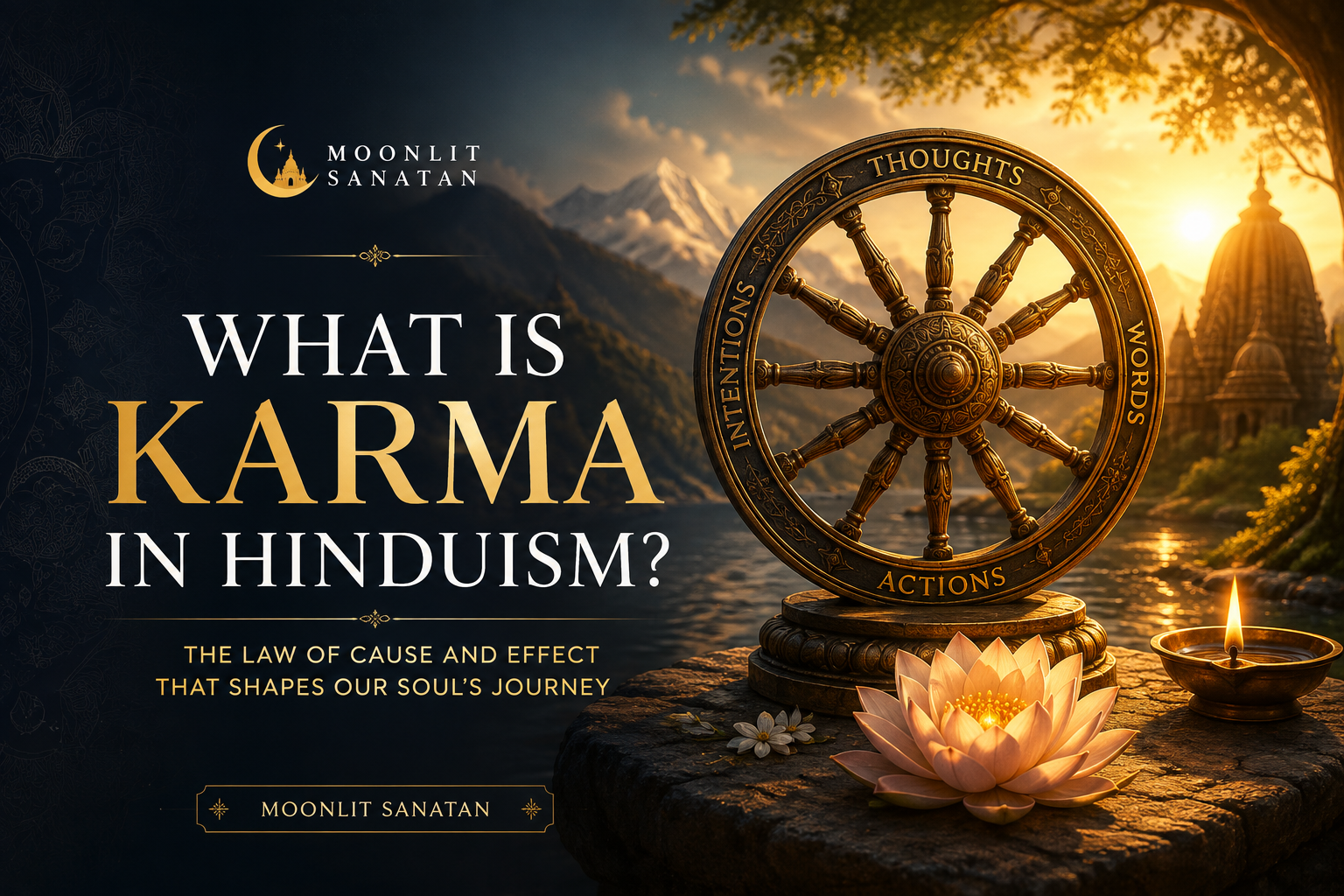
Reduced to its mechanics, the law of karma follows a consistent chain, repeated endlessly across a lifetime and across lives:
Intention (Sankalpa). Karma begins not with the action itself but with the intention behind it — this is why two outwardly identical acts, one done with malice and one done by accident, are not treated as carrying equal karmic weight.
Action (Karma). The intention is carried out — through thought, word, or physical deed. Classical texts treat all three as genuine forms of action, not just physical behavior.
Consequence (Phala). The action generates a result — for the actor specifically, not diffused into some vague general cosmic balance. This result may be immediate, delayed within this life, or deferred to a future birth entirely.
Accumulation (Sanchita). Unresolved consequences don't vanish — they accumulate as a kind of karmic reserve, carried forward and drawn upon across future lifetimes until they are eventually experienced and resolved.
What this chain makes clear is that karma is fundamentally about intention and cause, not simply outcome. This is also why classical texts place so much emphasis on the state of mind behind an action — a generous act performed for selfish recognition is treated very differently from the same act performed without any expectation of return.
A Simple Illustration
Consider two people who each donate the same amount of money to the same cause. One does it quietly, without telling anyone, genuinely wanting to help. The other does it publicly, primarily to be seen as generous. The outward action — and its visible effect on the recipient — is identical. But classical Hindu ethics treats these as generating meaningfully different karma, because the intention behind each act is different. The first is closer to selfless action; the second is still bound up in self-interest, even though it looks charitable from the outside. This is precisely the distinction the Bhagavad Gita's teaching on Karma Yoga, covered further below, is built around.
Good Karma vs. Bad Karma
Hindu texts use two specific Sanskrit terms rather than the vague "good" and "bad" of casual English. Punya refers to merit generated by virtuous action — truthfulness, generosity, non-violence, fulfilling one's duties honestly. Papa refers to the opposite: demerit generated by harmful, dishonest, or selfish action.
It's worth noting that punya and papa aren't treated as permanently fixed labels on a person, the way "good person" or "bad person" might function in casual speech. They're closer to a running ledger, constantly updated by present choices — which is precisely why the tradition treats every moment as an opportunity to shift the balance, regardless of what's accumulated before.
The Three Types of Karma
Classical Vedantic philosophy is notably precise about this, dividing a person's total karma into three distinct categories rather than treating it as one undifferentiated mass.
| Type | Meaning |
|---|---|
| Sanchita Karma | The full accumulated reserve of karma from all past lifetimes — the total, unresolved balance, most of which remains dormant rather than actively affecting the present. |
| Prarabdha Karma | The specific portion of sanchita karma that has "ripened" and is actively being experienced in the present life — essentially, the part of the reserve currently due. This is often described as the karma responsible for a person's basic life circumstances: family, body, and core life situation. |
| Agami (or Kriyamana) Karma | New karma being generated right now, through present choices and actions — which will itself eventually become part of a future sanchita reserve, continuing the cycle. |
This three-part model is part of why Hindu philosophy avoids simple fatalism. Prarabdha karma explains why a person is born into particular circumstances beyond their choosing, while agami karma insists that what they do with those circumstances remains genuinely, meaningfully up to them.
The Upanishads (Translated Edition)
The philosophical foundations of karma, atman, and moksha are laid out most directly in the Upanishads — a worthwhile next step for readers who want the primary source material behind the concepts this guide summarizes.
View on AmazonKarma Yoga: Acting Without Being Bound by the Result
If karma is generated by action, an obvious question follows: is the only way to stop generating karma to simply stop acting? The Bhagavad Gita addresses this question directly, and its answer became one of the most influential teachings in Hindu philosophy — Karma Yoga, the path of selfless action.
Krishna's teaching to Arjuna is that renouncing action entirely is neither possible nor desirable — action is unavoidable simply by being alive. What can be changed is a person's relationship to the outcome of their actions. Acting from duty, with full effort, but without attachment or anxious grasping at a specific result, is described as a way of acting that no longer binds the actor to new karma in the same way self-interested action does. This is why Karma Yoga is often summarized as "action without attachment" rather than "no action at all."
This teaching arrives in the Gita at a specifically practical moment — Arjuna, facing a battle against his own relatives and teachers, wants to simply withdraw and refuse to act at all rather than face the consequences of fighting. Krishna's response isn't a simple command to fight regardless; it's a deeper reframing of what action itself means. Arjuna's duty as a warrior (his dharma) cannot be avoided by inaction, since even choosing not to act is itself a choice with consequences. What Krishna offers instead is a way to act fully within one's role while releasing the anxious grip on outcome that turns ordinary action into karma-generating attachment.
Karma in Hinduism vs. Buddhism
Both traditions share the word and much of the surrounding logic — but they diverge on one crucial point that changes everything downstream of it.
Hinduism
Karma is carried by an eternal, unchanging soul (atman) across countless lifetimes. The ultimate goal, moksha, is the atman's liberation from samsara and its recognition of its true nature, often described as identity with Brahman, the ultimate reality.
Buddhism
Buddhism rejects the idea of a permanent, unchanging self (anatta, or "non-self"). Karma is still understood to carry forward, but through a continuously changing stream of causes and conditions rather than a fixed soul. The goal, nirvana, is the cessation of craving and suffering rather than the liberation of an eternal self.
In practice, both traditions agree on far more than they disagree on: intention matters more than outward action, harmful actions generate suffering that eventually returns to their source, and spiritual practice is largely aimed at breaking free of this cycle altogether. The philosophical disagreement over whether there's a permanent self being reborn is subtle, but it's the single detail scholars point to most often when explaining why these are, technically, two distinct doctrines rather than one shared idea.
Reflection & Gratitude Journal
Since agami karma is created by present intention, many practitioners use a simple daily journal to track intentions, actions, and reflections — a low-effort way to stay more conscious of the karma being created in the present moment.
View on AmazonThe "9 Laws of Karma" — Scripture or Modern Idea?
A quick, honest note on something searched surprisingly often: lists like "the 9 laws of karma" or "the 12 laws of karma," complete with catchy names like the Great Law, the Law of Growth, or the Law of Connection, circulate widely online. It's worth knowing plainly that these numbered lists are a modern, Western self-help framework — they do not come from the Vedas, Upanishads, Puranas, or the Bhagavad Gita, and no single, standardized version of the list even exists across the websites that repeat it.
That doesn't necessarily make the individual ideas within these lists wrong — many loosely echo genuine classical concepts, like the idea that thought precedes action, or that consequences eventually return to their source. But presenting them as ancient Hindu scripture is inaccurate, and readers looking for the authentic textual basis of karma are better served by the three-type model, the punya/papa framework, and the Bhagavad Gita's teaching on Karma Yoga covered above — all of which do come directly from classical sources.
How Karma Shapes Rebirth
At the moment of death, Hindu philosophy holds that a soul's accumulated karma — specifically the sanchita reserve, minus whatever has already ripened as prarabdha in the life just ended — determines the circumstances of the next birth. This isn't described as a mechanical, impersonal lottery so much as a kind of natural gravitational pull: a soul is drawn toward the body, family, and life situation that best matches the karmic tendencies it has developed, the way water finds its own level.
This is also the philosophical basis for why Hindu tradition treats the choices made in this life as genuinely consequential well beyond it — the person a soul becomes through a lifetime of choices is, quite literally, understood to shape the starting conditions of the next one.
It's worth noting that different philosophical schools within Hinduism describe the mechanics of this process somewhat differently — Advaita Vedanta, Vishishtadvaita, and Dvaita traditions each offer their own account of exactly how the atman relates to karma and to ultimate liberation. What remains consistent across virtually all of them, however, is the basic structure: karma accumulates, karma determines the conditions of rebirth, and spiritual practice is the means by which that cycle is eventually resolved.
Hand-Carved Wooden Om Wall Hanging
Many practitioners keep a simple Om symbol visible in a study or meditation space as a quiet, daily reminder of the underlying unity — Brahman — that karma and moksha are ultimately oriented toward realizing.
View on AmazonEco-Friendly Cork Yoga & Meditation Mat
Since Karma Yoga is ultimately a practice, not just a philosophy to read about, many people pair study of these ideas with a regular seated meditation or yoga practice — a natural-material mat is a small, practical way to make that daily habit easier to keep.
View on AmazonLiving With Karma: What This Actually Changes
Understood correctly, karma is less a belief to hold and more a lens to act through. It's worth being honest that not every Hindu practitioner engages with karma as a fully worked-out philosophical system in daily life — for many, it functions more as background intuition than active doctrine. Still, a few practical implications follow directly from everything laid out above, for anyone who wants to take the framework seriously.
Intention Deserves as Much Attention as Outcome
Since karma is generated primarily by intention, the tradition places real weight on examining why an action is taken, not just whether it "worked out." A generous act done for recognition and the same act done quietly, without any audience, are not treated as equivalent — even if the visible result is identical.
Present Circumstances Aren't a Verdict on Character
Because prarabdha karma explains present circumstances as the ripening of past causes rather than current moral failing, this framework resists using someone's hardship as evidence of their present-day wrongdoing — a distortion of karma that has, unfortunately, been used to justify social inequality at various points in Indian history, despite standing in direct tension with the tradition's own emphasis on free will and present-moment choice.
The Present Moment Is Where the Real Leverage Is
Sanchita and prarabdha karma are largely outside a person's direct control — they represent what has already been set in motion. Agami karma, generated right now, is the one category a person has full authority over. Practically, this shifts the tradition's emphasis away from anxious rumination about the past and squarely onto the quality of attention and intention brought to the present.
The Word Deserves Its Meaning Back
It's a strange fate for a philosophical concept this carefully reasoned to end up flattened into a punchline about parking tickets and bad dates. The actual idea underneath the word "karma" is more demanding, and more genuinely useful, than the pop-culture version ever gave it credit for: that every choice a person makes, however small, is a real cause with a real effect, and that the single moment any of us actually has authority over is the one happening right now.
That's a heavier responsibility than "the universe keeps score" — and, properly understood, a considerably more hopeful one too. It means the story isn't finished, no matter what's already been written into the sanchita ledger. It means the next choice, whatever it is, genuinely counts. And it means that the word deserves to be picked back up, dusted off, and used the way it was actually meant — not as a punchline, but as an invitation to pay closer attention to the only part of any of this a person has ever really controlled: what they do next.
Frequently Asked Questions
- What is karma in one word?
- Action — karma comes from the Sanskrit root kṛ, meaning "to do." The fuller idea is that every intentional action carries a corresponding consequence for the one who acted.
- What is the true meaning of karma?
- Karma is the principle that every intentional action, in thought, word, or deed, generates a consequence that will eventually be experienced by the person who acted — shaping present circumstances and, according to Hindu belief, future rebirths.
- What is the law of karma in Hinduism?
- The law of karma holds that intention leads to action, action leads to consequence, and unresolved consequences accumulate and carry forward across lifetimes until they are eventually experienced and resolved.
- What is good karma in Hinduism?
- Good karma, called punya, is merit generated through virtuous action such as truthfulness, generosity, and fulfilling one's duties honestly. Its opposite, papa, is demerit generated by harmful or selfish action.
- What is karma in Hinduism and Buddhism?
- Both traditions hold that intentional action generates consequences that carry forward. The key difference is that Hinduism attributes this to an eternal soul (atman) reincarnating across lives, while Buddhism rejects a permanent self, describing karma as carried forward through a continuously changing stream of causes instead.
- What are the 9 laws of karma?
- Numbered lists like "the 9 laws of karma" are a modern, Western self-help framework rather than a teaching found in the Vedas, Upanishads, or Bhagavad Gita. Classical Hindu texts describe karma instead through the three-type model (sanchita, prarabdha, and agami karma) and the punya/papa framework.
- What does karma measure in Hinduism?
- Karma doesn't measure outcomes so much as it tracks the accumulated weight of intentional action and its unresolved consequences, which together shape the circumstances of a soul's present and future lives within the cycle of samsara.
- Is karma the same as fate?
- No. Karma explains the starting conditions a person is born into as the ripening of past causes, but it does not eliminate free will. Present choices generate new karma (agami karma) and remain genuinely open, which is why Hindu philosophy distinguishes karma from a fixed, unchangeable fate.
Follow Moonlit Sanatan
Vedic philosophy, temple guides, and Sanatan Dharma traditions — right in your feed.
Instagram Facebook PinterestThis article is offered for educational and devotional purposes as part of Sanatan Dharma tradition. Interpretations of karma vary across Hindu philosophical schools, texts, and lineages; this guide reflects the most widely shared classical understanding rather than any single sect's complete doctrine.