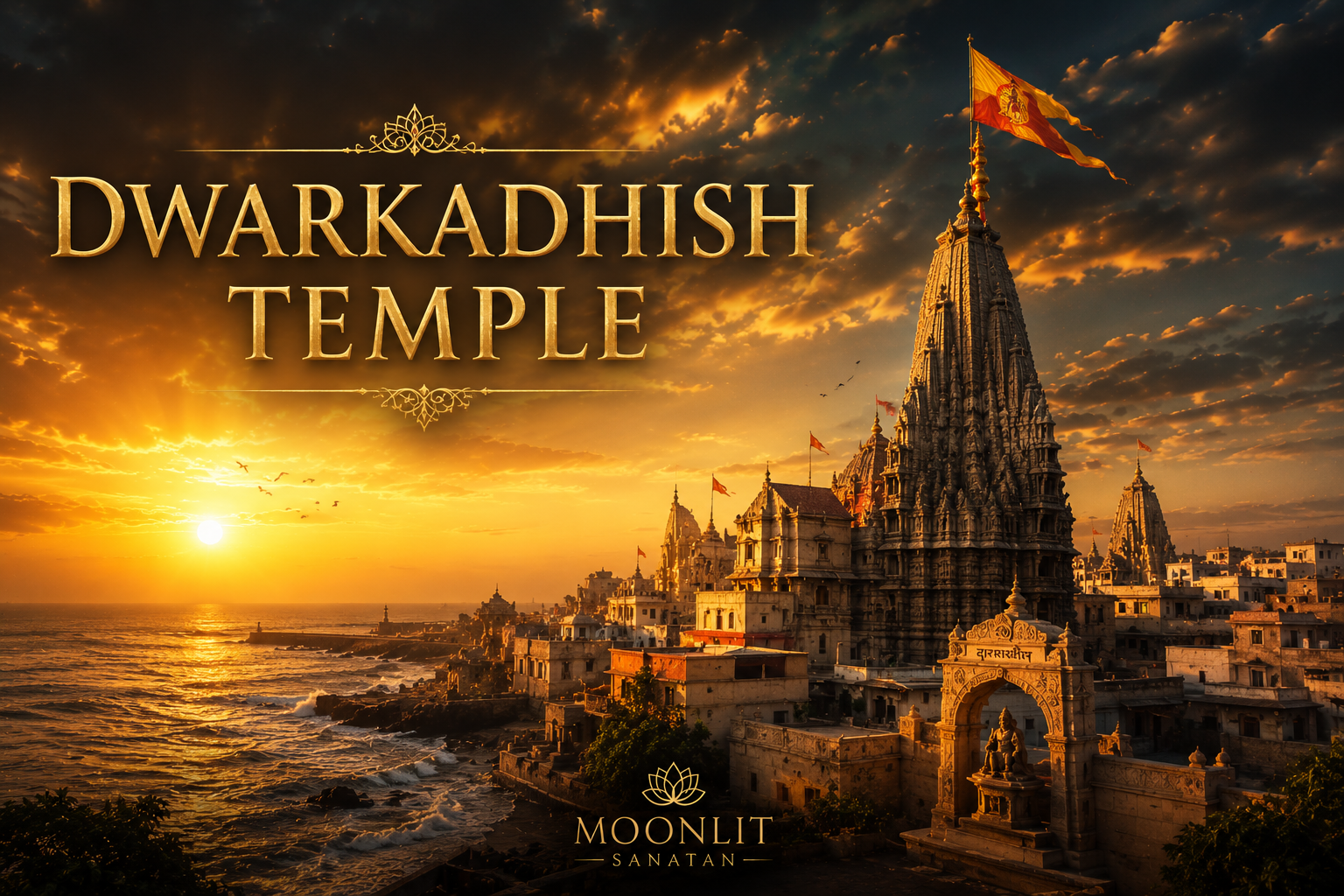
Dwarkadhish Temple: The Complete Guide to Lord Krishna's Jagat Mandir
Inside the five-storeyed shrine of the "King of Dwarka" — history, legend, architecture, and everything you need for a truly memorable darshan.
On the western edge of India, where the Gomti river meets the Arabian Sea, stands a temple that Hindu tradition holds has watched over this coastline for over two thousand years. This is the Dwarkadhish Temple, also known as the Jagat Mandir — "temple of the universe" — dedicated to Lord Krishna, worshipped here in his most regal form as Dwarkadhish, the King of Dwarka. It is one of the four sacred Char Dhams of Hinduism, one of the four mathas established by Adi Shankaracharya, and by most traditional accounts, the very spot where Krishna's own capital city once stood.
This guide covers everything from the legend of how the temple came to be, through its architecture and the deity within, to practical details for planning your own pilgrimage to Dwarka in 2026.
Quick Facts
| Deity | Lord Krishna, worshipped as Dwarkadhish ("King of Dwarka") and Ranchhodji |
| Significance | One of the 4 Char Dhams · One of Adi Shankaracharya's 4 mathas (Sharada Peeth) · Part of the 108 Divya Desams |
| Location | Dwarka, Devbhoomi Dwarka District, Gujarat – 361335, on the banks of the Gomti river |
| Architecture | 5-storey Jagat Mandir, 72 pillars, ~78 m spire, Chalukya-style, limestone & sandstone |
| Original builder | Traditionally Vajranabha, Krishna's great-grandson, over the Hari Griha (Krishna's residence) |
| Present structure | Rebuilt and enlarged in the 15th–16th century |
| Darshan timings | 6:30 AM – 1:00 PM and 5:00 PM – 9:30 PM (regular days) |
| Entry fee | Free general darshan; paid Bhog/Seva options available |
| Nearest airport | Jamnagar Airport (~137 km) or Porbandar Airport |
| Nearest railway station | Dwarka Railway Station, on the temple town itself |
Inside This Guide
- The Legend: Krishna's Dwarka & the Original Temple
- Why Pilgrims Consider Dwarka So Significant
- History of the Jagat Mandir
- Dwarkadhish, the Char Dham & the Sharada Peeth
- Architecture: 72 Pillars & the Jagat Mandir
- The Deity: Dwarkadhish & Ranchhodji
- Not to Be Confused With: The Mathura Dwarkadhish Temple
- Darshan Timings, Aarti & Seva Booking
- Best Time to Visit & Major Festivals
- Dress Code & Temple Etiquette
- How to Reach Dwarka
- Places to Visit Near Dwarkadhish Temple
- What to Pack for Your Dwarka Yatra
- Frequently Asked Questions
The Legend: Krishna's Dwarka & the Original Temple
The story of Dwarkadhish Temple begins with an exile and a new beginning. After Krishna defeated his tyrannical uncle Kansa in Mathura, repeated attacks from the hostile king Jarasandha made the city unsafe for the Yadava clan. Rather than continue the conflict, Krishna is said to have led his people west, to the shores of the Arabian Sea, where he built an entirely new capital reclaimed from the ocean and named it Dwarka — "the gateway."
According to tradition, Krishna lived out much of his later life here as king, in a palace known as the Hari Griha. When Krishna departed the mortal world, legend holds that the sea rose and reclaimed his city, submerging it beneath the waves — a story that has long fascinated archaeologists and marine researchers who have surveyed the coastal waters off modern Dwarka for traces of ancient submerged structures.
Generations later, Krishna's great-grandson Vajranabha is believed to have returned to this sacred ground and built a temple directly over the site of the Hari Griha, in devotion to his illustrious ancestor. A popular local legend holds that the original shrine was raised in a single night, through supernatural means. Whether myth or memory, this founding story is why Dwarka is still regarded by many pilgrims as the closest living link to Krishna's own lifetime.
This legend of a city built and lost to the sea has never simply stayed in the realm of myth. Marine archaeological expeditions off the Dwarka coast, conducted over several decades, have documented submerged structures, stone anchors, and pottery in the waters near the present-day temple, findings that continue to be studied and debated by historians and archaeologists. For pilgrims, though, the deeper draw has always been less about proving the legend and more about standing at a site so thoroughly woven into the story of Krishna's own life — not just his childhood in Vrindavan and Mathura, but the decades he is believed to have spent ruling here as king.
Why Pilgrims Consider Dwarka So Significant
Among the great Vaishnava pilgrimage centres of India, Dwarka occupies a particularly personal place in the Krishna tradition. Unlike Vrindavan and Mathura, which are associated with Krishna's youth as a cowherd and playful child, Dwarka represents Krishna's mature life — as statesman, king, husband, and diplomat, navigating the complex politics of the Mahabharata era. For many devotees, this makes a Dwarka pilgrimage feel like completing the full arc of Krishna's story, from the mischievous butter-thief of Vrindavan to the wise ruler who counselled Arjuna on the battlefield of Kurukshetra.
The temple's inclusion in both the Char Dham circuit and the list of the 108 Divya Desams — the most sacred Vaishnava shrines celebrated by the Alvar saints of South India — also gives it an unusually broad devotional following, drawing pilgrims from Vaishnava traditions across the length of the country, not just from Gujarat and western India.
History of the Jagat Mandir
Archaeological surveys suggest a temple has stood on this site for roughly 2,000 to 2,200 years, making Dwarkadhish Temple one of the oldest continuously worshipped shrines in western India. Over the centuries, the temple weathered considerable turmoil — historical accounts describe it being attacked during the 13th and 16th centuries, with priests reportedly moving the sacred image to the island of Bet Dwarka at one point to protect it from destruction.
The structure that stands today took shape largely in the 15th and 16th centuries, when the temple was substantially rebuilt and enlarged, traditionally credited to the local ruler Raja Jagat Singh Rathore — which is how the shrine came to be known as the Jagat Mandir. The current image of Dwarkadhish enshrined in the sanctum is recorded as having been installed in 1559.
A flag of 52 yards, bearing the symbols of the sun and moon, flies atop the temple's spire and is ceremonially changed five times every day — a tradition rooted in the belief that Krishna's presence here will endure "as long as the sun and moon exist."
What makes the Jagat Mandir's survival especially notable is how much history it has quietly absorbed. Successive ruling dynasties left their own carvings and additions, priests safeguarded the sacred image through periods of conflict, and the temple's continued function as a living, actively worshipped shrine — rather than a preserved ruin — sets it apart from many equally ancient sites elsewhere in India. Walking through the temple today, a pilgrim is engaging with essentially the same rituals, the same aartis, and largely the same architectural bones that have defined Dwarkadhish worship for centuries.
Dwarkadhish, the Char Dham & the Sharada Peeth
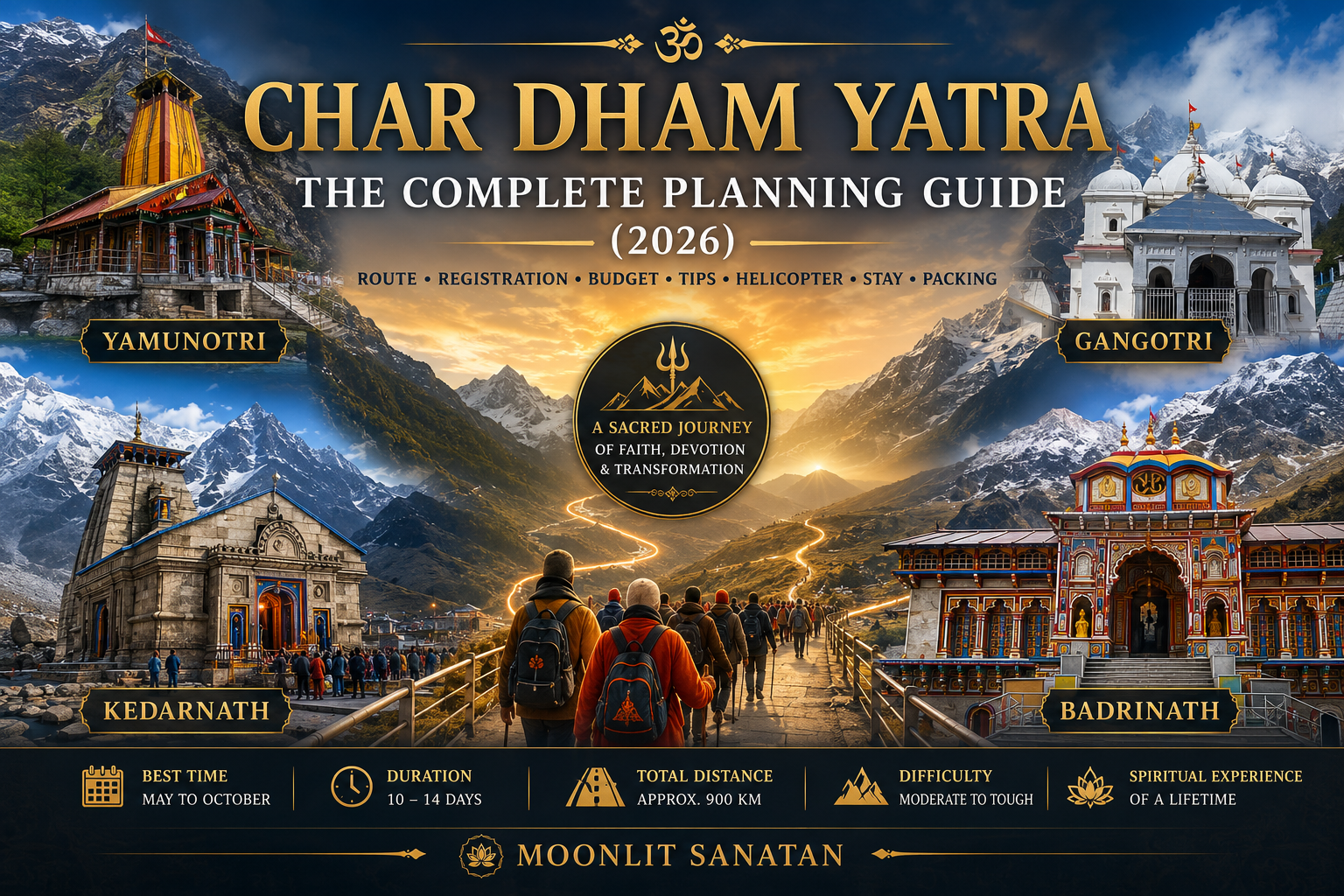
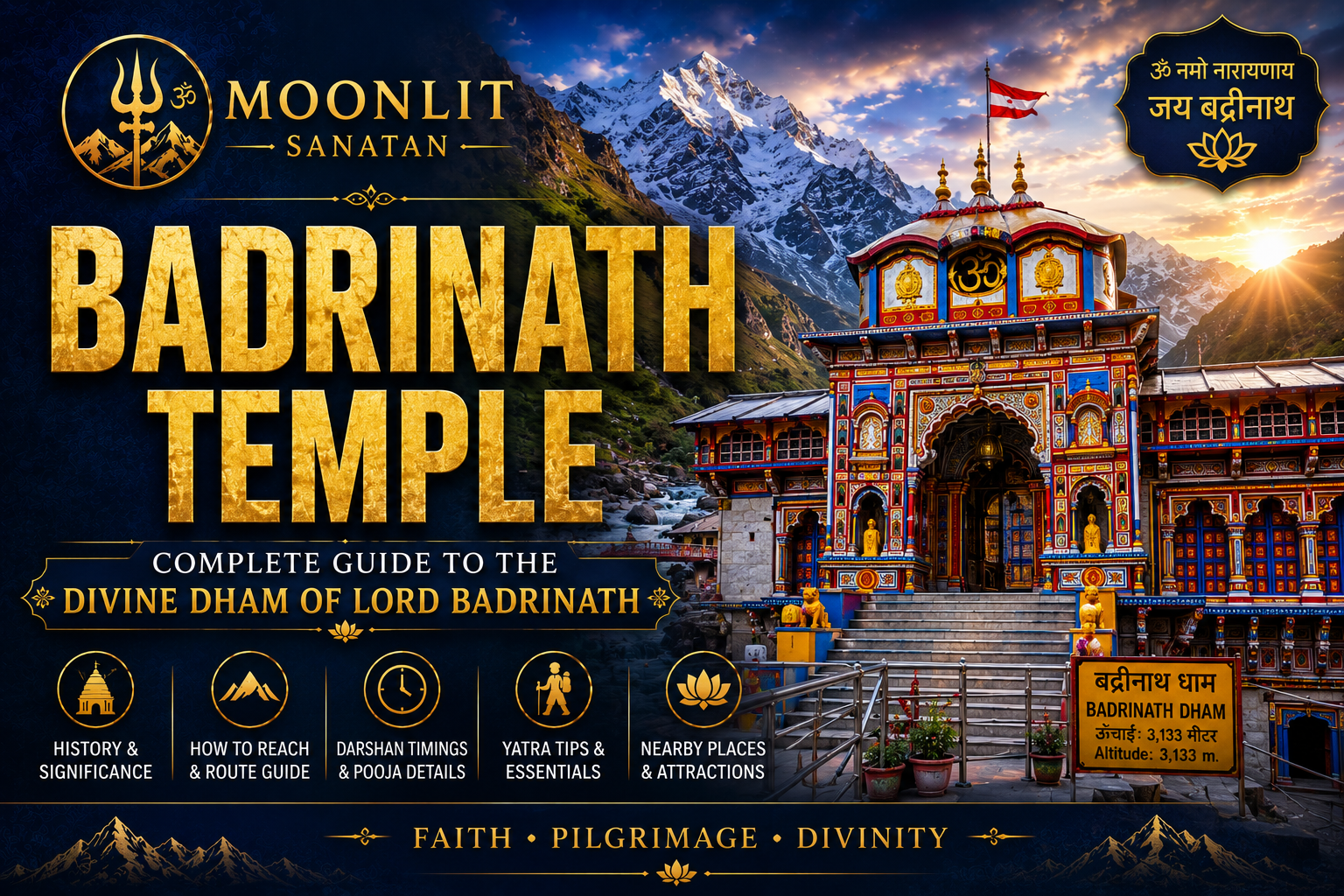
Dwarka holds a rare double distinction in Hindu tradition. It is one of the four Char Dhams — alongside Badrinath in the north, Puri in the east, and Rameswaram in the south — the four cardinal pilgrimage sites that together are said to encompass the sacred geography of the entire subcontinent. If you've followed our earlier guides to the Badrinath Temple, Jagannath Temple, Puri, and the Ramanathaswamy Temple, Rameswaram, Dwarka completes the circuit — the western anchor of this ancient four-directional pilgrimage.
Dwarka is also one of the four mathas (monastic institutions) established by the 8th-century philosopher-saint Adi Shankaracharya, known here as the Sharada Peeth (or Kalika Peetha), one of his four cardinal seats of Vedantic learning alongside those at Puri, Badrinath, and Sringeri. Shankaracharya's visit here in the 8th century is remembered throughout the temple, with carvings and depictions of his life found on the temple walls, and it was this visit that firmly cemented Dwarka's place within the Char Dham circuit as it's understood today.
Architecture: 72 Pillars & the Jagat Mandir
The Dwarkadhish Temple is a striking example of Chalukya-style temple architecture, constructed almost entirely of limestone and sandstone. The main shrine, the five-storey Jagat Mandir (also called the Nija Mandir), rests on 72 intricately carved pillars and rises to a spire roughly 78 metres tall — a height that makes it visible from a considerable distance across the flat coastal landscape of Devbhoomi Dwarka.
The temple has two principal entrances, each carrying deep symbolic meaning. The northern gate, the Moksha Dwara ("Door to Salvation"), opens toward the town's main market and is the customary entry point for pilgrims. The southern gate, the Swarga Dwara ("Gate to Heaven"), serves as the exit, leading down a flight of 56 stone steps to the ghats of the Gomti river below — a descent many pilgrims treat as its own small ritual, echoing the river-bathing traditions found at other major temple towns.
Inside, the temple complex spans roughly 29 metres by 23 metres, and its walls are covered in detailed carvings added across successive centuries by the dynasties that patronised the site, giving the temple a layered, almost archaeological quality — each era of Indian temple-building leaving its own mark on the stone.
Approaching the temple from the market side, visitors first pass beneath the towering spire before entering the relatively compact, densely carved interior — a contrast that many first-time pilgrims find striking, given how modest the inner sanctum feels compared to the monumental exterior. The pillars supporting each of the five storeys are carved with recurring motifs of lotus flowers, mythological figures, and geometric patterns typical of the Chalukya tradition, and climbing between levels (where accessible to visitors) offers a rare vantage point over both the temple town and the Arabian Sea beyond.
A Living Tradition of Devotion
The medieval poet-saint Mirabai, one of the most celebrated Krishna devotees in Indian history, is believed to have spent her final years in Dwarka, composing devotional verses to Krishna until she is said to have merged into the deity's idol at this very temple — a story still recounted by priests and pilgrims today.
The Deity: Dwarkadhish & Ranchhodji
Within the Nija Mandir, Krishna is enshrined as Dwarkadhish — a majestic, four-armed form holding the conch, discus, mace, and lotus, dressed in the full regalia of a reigning king rather than the more familiar cowherd or flute-playing forms seen elsewhere in India. He is also affectionately known here as Ranchhodji, "the one who left the battlefield," a reference to Krishna's strategic withdrawal from conflict with Jarasandha in favour of his people's safety — a name that carries no shame in Hindu tradition, but rather reflects wisdom over pride.
The temple follows the Pushtimarg tradition of worship, established by the saint Vallabhacharya, and its daily rituals — from the pre-dawn Mangla Aarti to the night's closing rites — are conducted according to this school's distinctive devotional practices. Elsewhere within the complex, devotees also pay respects at smaller shrines, including one to Adi Shakti established, by tradition, by Adi Shankaracharya himself on an upper floor of the temple.
Devotees often note the deliberate contrast between how Krishna is envisioned here and how he appears in the more pastoral imagery associated with his childhood. At Dwarkadhish, there is no flute, no cows, no forest backdrop — instead, a crowned, richly adorned sovereign, flanked by the emblems of royal and divine authority. For pilgrims who grew up with the image of Krishna the playful child of Vrindavan, encountering him here as a reigning monarch is often described as a genuinely moving shift in perspective, a reminder that Krishna's story, like any complete life, moved through very different chapters.
Not to Be Confused With: The Mathura Dwarkadhish Temple
One point of genuine confusion worth clearing up: there is a second, much newer temple that also carries the name "Dwarkadhish Temple," located in Mathura, Uttar Pradesh. Built in the 19th century by the treasurer Seth Gokul Das Parekh, the Mathura shrine is a beautiful and popular pilgrimage site in its own right, also dedicated to Krishna — but it is an entirely separate temple, roughly 900 km away from Dwarka, Gujarat, with a much shorter history and no connection to the Char Dham circuit.
If your search brought you here while planning a Char Dham pilgrimage, make sure you're booking travel to Dwarka, Gujarat — the ancient Jagat Mandir covered in this guide, and the one that completes the four-dham circuit.
Darshan Timings, Aarti & Seva Booking
On regular days, the Dwarkadhish Temple follows a schedule built around six daily aartis, beginning with the Mangla Aarti in the very early morning and concluding with the night's closing rites:
- Morning darshan: Approximately 6:30 AM – 1:00 PM (with a brief pause around the Mangla Aarti)
- Afternoon closure: The temple typically closes between roughly 1:00 PM and 5:00 PM
- Evening darshan: Approximately 5:00 PM – 9:30 PM, including the popular Sandhya (evening) Aarti
General darshan is free of charge. For a more organised experience with reduced waiting, the temple also offers Bhog and Seva bookings, which function much like a VIP or quick-darshan pass, with charges reported to range from roughly ₹701 up to ₹21,001 depending on the ritual and offering selected. These can typically be arranged through the temple's official channels or booking portal.
Before You Travel
Timings shift around major festivals such as Janmashtami, Sharad Purnima, and Annakut, and the temple often remains open through the night during Janmashtami itself. Always reconfirm the current schedule and any Seva booking details through the official Dwarkadhish Temple channels or your hotel before finalising your visit.
Best Time to Visit & Major Festivals
Janmashtami
Krishna's birthday is, unsurprisingly, the single biggest celebration at Dwarkadhish Temple. The temple remains open through the night, culminating in a midnight abhishek marking the moment of Krishna's birth — an experience many devotees describe as the pinnacle of a Dwarka pilgrimage. Expect enormous crowds; arriving a day early is common practice among seasoned pilgrims.
Sharad Purnima & Diwali/Annakut
The autumn and winter festival season brings its own charged atmosphere, with special decorations, extended aarti programs, and the Annakut festival's elaborate food offerings drawing large numbers of devotees.
Ideal Season Overall
Given Dwarka's coastal, semi-arid climate, the cooler months from October through March are generally the most comfortable for travel and darshan, avoiding both the intense pre-monsoon heat and the humidity of the monsoon season. Early morning visits, timed around the Mangla Aarti, offer the coolest and calmest darshan experience year-round, while the golden hour before the evening Sandhya Aarti is, by many pilgrims' accounts, the most visually striking time to be at the temple, with the spire catching the last light over the Gomti.
Dress Code & Temple Etiquette
- Modest, traditional attire is expected for both men and women; sleeveless or overly casual western clothing is best avoided inside the temple premises.
- As with most major Krishna temples, footwear is removed before entering the sanctum areas.
- Photography rules can vary by area within the complex, so it's best to check signage or ask temple staff before photographing near the sanctum.
- Since the Swarga Dwara exit leads down 56 steps to the Gomti ghats, comfortable footwear for the approach and a little extra time for the descent are worth planning for, especially for elderly pilgrims.
How to Reach Dwarka
By Air
Jamnagar Airport, roughly 137 km away, is the most commonly used gateway, with regular domestic connections. Porbandar Airport offers another nearby option depending on your route and flight availability.
By Rail
Dwarka has its own well-connected railway station, directly linked to major cities including Ahmedabad, Mumbai, and Delhi, making the train one of the most convenient ways to arrive without additional road transfers.
By Road
Dwarka is well connected by Gujarat's state highway network, with Jamnagar around 137 km away and Rajkot roughly 220 km, both served by regular bus and taxi services. Many pilgrims combine the drive with stops at Nageshwar Jyotirlinga and Bet Dwarka along the way.
Places to Visit Near Dwarkadhish Temple
Nageshwar Jyotirlinga
Just a short drive from Dwarka, Nageshwar is one of the twelve Jyotirlingas of Lord Shiva, and most pilgrims combine both shrines into a single, deeply rewarding day of darshan spanning both Vaishnava and Shaiva traditions. The temple is also known for its massive Shiva statue visible from the approach road, making it an easy, memorable stop even for travellers short on time.
Bet Dwarka
A small island just off the coast, reachable by boat, believed to have been part of Krishna's original residential grounds and, by some accounts, the very place where the sacred image was hidden during medieval attacks on the mainland temple. The boat crossing itself, across calm coastal waters dotted with fishing boats, is often a highlight of the trip for visitors, alongside the temple and old township on the island.
Rukmini Devi Temple
Dedicated to Krishna's chief queen, Rukmini, this temple lies a short distance from the main Dwarkadhish shrine and is known for its own detailed carvings and quieter, more contemplative atmosphere. Local legend attributes its separate location, slightly outside the main temple town, to a sage's curse involving Rukmini and Krishna — a story temple guides are often happy to recount in more detail on site.
Gomti Ghat & Sudama Setu
The riverside ghats near the temple are a natural spot for the ritual bath many pilgrims take before or after darshan, while the nearby Sudama Setu, a pedestrian bridge across the Gomti, offers pleasant views of the temple skyline, especially around sunset. Early morning at the ghats, before the day's crowds arrive, is a particularly peaceful time to experience this part of Dwarka.
For more of South and West India's great pilgrimage circuits, explore our guides to Tirupati Balaji Temple and Meenakshi Temple, Madurai, or browse our complete Char Dham collection now that all four dhams are covered.
Where to Stay & What to Eat
Dwarka town offers a full range of accommodation, from simple dharamshalas and pilgrim guesthouses close to the temple to comfortable mid-range hotels and a few upscale resorts along the coast. Most visitors prefer staying within easy walking distance of the Moksha Dwara entrance, since the pre-dawn Mangla Aarti and the evening Sandhya Aarti are both worth attending, and a nearby base makes it far easier to catch both. As with Janmashtami at any major Krishna temple, rooms fill up quickly around the festival, so booking well ahead is wise.
Food around the temple leans toward simple, satvik Gujarati vegetarian fare — thalis, farsan, and sweets are easy to find on the streets near the temple, and many pilgrims make a point of trying the local Gujarati thali at least once during their stay, alongside the traditional prasad distributed at the temple itself.
What to Pack for Your Dwarka Yatra
Dwarka's coastal, often warm climate and the temple's steps and ghats mean a little preparation goes a long way. Here are some genuinely useful essentials for the trip:
Traditional Cotton Kurta / Dhoti Set
Lightweight, breathable traditional wear keeps you comfortable in Gujarat's coastal heat while staying appropriate for the temple's dress expectations.
View on AmazonCompact Krishna / Dwarkadhish Idol
A beautifully finished travel-sized idol of Krishna makes a meaningful keepsake from this deeply historic Char Dham shrine.
View on AmazonTulsi Mala
A classic Tulsi mala, closely associated with Vaishnav worship, is a popular pick-up for devotees visiting a major Krishna shrine like Dwarkadhish.
View on AmazonSun Protection Kit (Cap, Sunglasses, Sunscreen)
Dwarka's coastal sun is intense, especially around midday and while exploring Bet Dwarka or the Gomti ghats — a simple protection kit makes sightseeing far more comfortable.
View on AmazonLightweight Travel Backpack
With the temple, Nageshwar Jyotirlinga, and the Bet Dwarka boat crossing all on the itinerary, a comfortable daypack makes multi-stop sightseeing much easier.
View on AmazonPortable Brass Puja Thali Set
A compact brass thali with diya and kumkum box is handy for personal prayers at your hotel each morning before setting out for darshan.
View on AmazonWaterproof Phone & Document Pouch
Useful for the Gomti ghat visit and the boat ride to Bet Dwarka, keeping your phone, cash, and ID safe and dry throughout the day.
View on AmazonDisclosure: Some links on this page are Amazon affiliate links. As an Amazon Associate, Moonlit Sanatan may earn from qualifying purchases, at no extra cost to you. (Replace the placeholder Amazon search links above with your own tagged affiliate links before publishing.)
Frequently Asked Questions
Who built the Dwarkadhish Temple?
Tradition holds that the original temple was built by Vajranabha, the great-grandson of Lord Krishna, over the Hari Griha, Krishna's own residence in Dwarka. The present structure was largely rebuilt and enlarged in the 15th-16th century.
In which city and state is Dwarkadhish Temple located?
The temple is located in Dwarka city, in the Devbhoomi Dwarka district of Gujarat, India, on the banks of the Gomti river near the Arabian Sea coast.
What is inside the Dwarkadhish Temple?
The main sanctum, the Nija Mandir, houses the four-armed idol of Dwarkadhish (Krishna as King of Dwarka). The five-storey complex also includes additional shrines, including one to Adi Shakti established by Adi Shankaracharya, and is supported by 72 carved pillars.
Is the Dwarkadhish Temple in Dwarka the same as the one in Mathura?
No. They are two separate temples. The Dwarka, Gujarat temple (Jagat Mandir) is the ancient Char Dham shrine covered in this guide, while the Dwarkadhish Temple in Mathura, Uttar Pradesh is a distinct, 19th-century temple with no connection to the Char Dham circuit.
What are the Dwarkadhish Temple darshan timings?
On regular days, the temple is generally open from around 6:30 AM to 1:00 PM and again from 5:00 PM to 9:30 PM, though timings can extend or shift during major festivals like Janmashtami, so it's best to confirm before visiting.
How do I reach Dwarka?
The nearest airport is Jamnagar Airport (~137 km), and Dwarka has its own railway station with direct connections to major Indian cities. The town is also well connected by road via Gujarat's state highway network.
What else should I visit near Dwarkadhish Temple?
Popular nearby sites include the Nageshwar Jyotirlinga, the island of Bet Dwarka (reachable by boat), the Rukmini Devi Temple, and the Gomti Ghat with its Sudama Setu bridge.
Is Dwarkadhish Temple part of the Char Dham Yatra?
Yes. Dwarkadhish Temple is one of the four Char Dhams, alongside Badrinath, Puri, and Rameswaram, and is also one of the four mathas (the Sharada Peeth) established by Adi Shankaracharya in the 8th century.
Why is Krishna called Ranchhodji at Dwarkadhish Temple?
"Ranchhodji" means "the one who left the battlefield," referring to Krishna's decision to relocate his people from Mathura to Dwarka rather than continue fighting the hostile king Jarasandha. In Hindu tradition, this name reflects wise, protective leadership rather than any weakness.
Can I visit Nageshwar Jyotirlinga and Bet Dwarka on the same trip?
Yes, both are commonly combined with a Dwarkadhish Temple visit. Nageshwar Jyotirlinga is a short drive away, and Bet Dwarka is reachable by a short boat ride from the coast near Dwarka, making a well-rounded one or two-day itinerary around the town.
"As long as the sun and moon endure, Krishna endures in Dwarka" — a promise this temple has kept, in one form or another, for over two thousand years.
Continue Exploring on Moonlit Sanatan
Follow Moonlit Sanatan
For more temple guides, Krishna stories, and daily Sanatan wisdom, follow along on our social channels: