Jagannath Temple, Puri: The Complete History & Darshan Guide
On the shores of the Bay of Bengal stands one of India's four sacred Char Dham — a temple whose wooden deities, deliberately left unfinished by their divine sculptor, are reborn every few years and pulled through the streets by millions during Rath Yatra. Here's the real legend, the history, and everything you need to plan a visit.
Why Jagannath Temple Is Unlike Any Other Vishnu Shrine
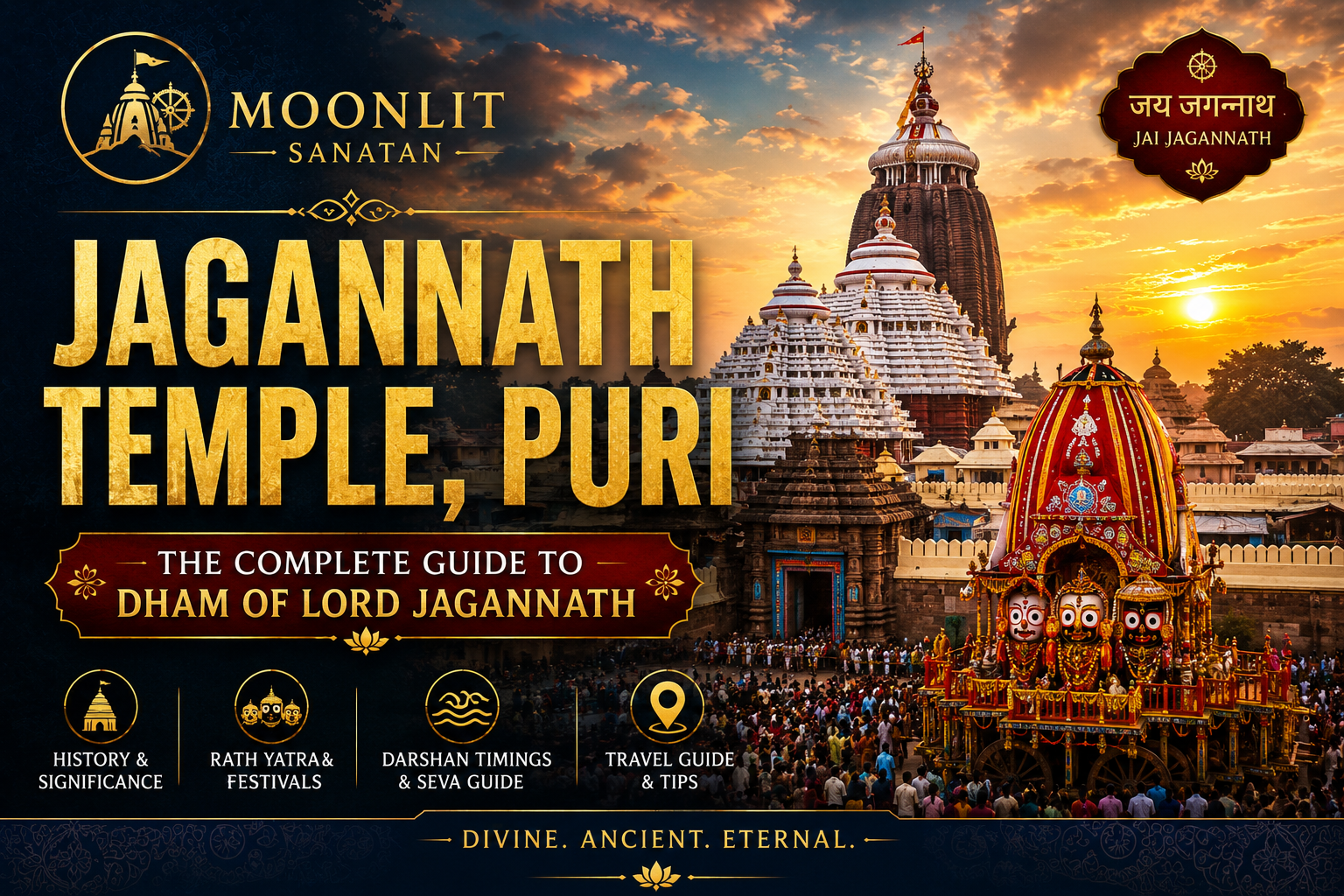
Most people encounter Jagannath Temple through a single image: three enormous, brightly painted chariots being hauled through Puri's streets by thousands of hands during Rath Yatra. That image isn't wrong — it's just incomplete. The chariot festival is famous precisely because of what it briefly makes possible: a deity ordinarily kept fully hidden from the outside world, momentarily visible to everyone, regardless of faith.
The temple stands in Puri, on Odisha's eastern coastline, and is dedicated to Lord Jagannath — "Lord of the Universe" — worshipped here alongside his siblings Balabhadra and Subhadra as forms of Vishnu and Krishna. Unlike almost every other major Hindu shrine, the deities aren't carved from stone or cast in metal. They're wooden, deliberately unfinished, and are ceremonially replaced altogether every several years in a ritual called Nabakalebara.
If you've read our guides to Kamakhya Temple, Vaishno Devi, or Tirupati Balaji Temple, you'll notice Jagannath Puri runs on its own entirely distinct rhythm — a temple built around a legend of divine craftsmanship interrupted mid-work, an unusually strict entry tradition, and a kitchen that reportedly feeds more people, more consistently, than almost any other in the world. This guide covers the real founding history, the wooden-idol legend, Rath Yatra, Mahaprasad, entry rules, and the practical details of getting there.
What Makes Jagannath Temple Different From Other Major Shrines
A handful of things set this temple apart even among India's most significant pilgrimage sites.
- 🪵Wooden deities, not stone or metal — Jagannath, Balabhadra, and Subhadra are carved from sacred neem wood (Daru Brahma) and deliberately left without fully formed hands or feet.
- 🔄The deities are periodically reborn — in the Nabakalebara ritual, held roughly every 8 to 19 years depending on the lunar calendar, the wooden idols are ceremonially replaced entirely.
- 🚫One of the strictest entry traditions in India — only Hindus may enter the main sanctum; the rule is applied without exception, a signboard at the Singhadwara has stated this for generations.
- 🍚A kitchen of near-mythic scale — the temple's Rosha Ghara is widely regarded as one of the largest functioning kitchens in the world, cooking Mahaprasad daily for thousands of devotees.
Each of these threads has its own story, so that's exactly what the rest of this guide unpacks.
The Story of Jagannath — King Indradyumna and the Unfinished Idols
According to tradition, King Indradyumna of Avanti was a devoted follower of Vishnu who learned of a deity named Nilamadhava, secretly worshipped by a tribal chief named Vishvavasu deep in the forest. Indradyumna sent his priest Vidyapati to find it — but by the time the king himself arrived, the deity had vanished, leaving only a divine voice instructing him to build a temple on the Nila hill, the site of today's Puri.
Guided by further divine signs, Indradyumna is said to have found a sacred log of neem wood — the Daru Brahma — floating in the sea, meant to become the new form of the deity. No sculptor could be found capable of the task until Vishwakarma, the celestial architect, appeared in the guise of an ordinary carpenter. He agreed to carve the idols on one condition: that no one enter the room or disturb him until the work was complete.
After many days of silence, an anxious Queen Gundicha could wait no longer and opened the door. Vishwakarma vanished instantly, leaving the idols of Jagannath, Balabhadra, and Subhadra unfinished — without fully carved hands or feet. Rather than treating this as a flaw, tradition holds that the king consecrated the idols exactly as they were, and they have been worshipped in that same unfinished form ever since.
This account is presented here as it's understood within Hindu devotional tradition — a story of divine craftsmanship, faith, and impatience — rather than as a claim of historical fact.
Who Actually Built Jagannath Temple, and When?
Separate from the founding legend, historians generally date the present temple structure to the 12th century CE, with construction begun around 1135–1150 under King Anantavarman Chodaganga Deva of the Eastern Ganga dynasty and completed by his successor, Anangabhima Deva. The temple was built in the Kalinga architectural style native to Odisha, combining the Rekha Deula and Pidha Deula forms across its four main structures: the Vimana (sanctum), Jagamohana (assembly hall), Nata Mandapa (dance hall), and Bhoga Mandapa (offering hall).
The temple's tower, or Vimana, rises roughly 65 meters and is topped by the Neelachakra, a sacred wheel associated with Vishnu, along with the temple flag. Over the following centuries, Suryavanshi rulers and later Maratha governors contributed further expansion and protection to the complex, making it a continuously living monument rather than a single fixed-point construction.
Jagannath, Jagan Nath, Jagdish — Are They the Same Temple?
Yes. "Jagannath" (जगन्नाथ) means "Lord of the Universe," and its spelling varies widely across regions and transliteration styles — Jagan Nath, Jagannatha, and even the common colloquial slip "Jagdish" all refer to the same deity and the same temple in Puri. In Tamil Nadu, devotees sometimes say "Jeganathar," reflecting the same root name adapted to local pronunciation. All of these point to the same wooden deity inside the Puri sanctum.
Rath Yatra: When the Deities Leave the Temple
Once a year — usually in June or July, on Ashadha Shukla Dwitiya — Jagannath, Balabhadra, and Subhadra are brought out of the temple and placed on three enormous, freshly built wooden chariots for the journey to the Gundicha Temple, about 3 km away, where they stay for several days before returning. The scale is genuinely difficult to overstate: this is one of the largest religious gatherings on Earth, and it's the origin of the English word "juggernaut," coined by colonial-era observers describing the sheer, unstoppable momentum of the chariots.
Rath Yatra is the one time of year the usual entry restriction relaxes in practice — as the deities travel openly through the streets, devotees of every background can view them, even though the temple's sanctum itself remains reserved for Hindus.
Who Can Enter Jagannath Temple?
Entry to the main temple complex is restricted to Hindus — a rule maintained without exception, reportedly stated on signage at the Singhadwara (Lion's Gate) in multiple languages for generations. This isn't selectively enforced for visiting dignitaries or celebrities; it applies uniformly.
- 🙏Hindus, including Sikhs, Jains, and Buddhists of Indian origin, are generally permitted entry; the temple does not check formal ID at the gate, but staff may ask questions if unsure.
- 👁️Non-Hindu visitors can still view the temple's towering spire and Neelachakra from the Raghunandan Library rooftop, just across the road from the Singhadwara.
- 📵Mobile phones and cameras are strictly prohibited inside the complex for everyone, regardless of faith.
Mahaprasad — Inside One of the World's Largest Temple Kitchens
The temple's kitchen, known as the Rosha Ghara or Mahalakshmi Kitchen, is widely described as one of the largest functioning kitchens anywhere in the world, cooking food daily for thousands of devotees using firewood and stacked earthen pots — a method essentially unchanged for centuries. Once offered to the deities, the food becomes Mahaprasad and is distributed to devotees at the Ananda Bazaar inside the temple complex, typically from around 2:00 PM for cooked items, with dry prasad like laddoos available earlier in the day.
Local guides and generations of visitors describe the kitchen's output as remarkably consistent — rarely running short, rarely producing excess — though this is best understood as devotional lore passed down through pilgrimage tradition rather than a documented, measured claim.
How to Reach Jagannath Temple, Puri
| Route | Distance / Duration | Notes |
|---|---|---|
| Biju Patnaik Airport, Bhubaneswar → Puri | ~60 km / ~1.5–2 hrs | Nearest airport, connected to major Indian cities; taxis and buses run onward to Puri |
| Puri Railway Station → Temple | ~2 km / ~10–15 min | Puri is a major terminus with direct trains from Kolkata, Bhubaneswar, and several other cities; the temple is a short auto or walking distance away |
| By Road | Well-connected via NH16 | Regular buses and taxis run from Bhubaneswar (~60 km) and Konark (~35 km), often combined into a single day-trip circuit |
Puri's compact size makes it genuinely walkable — most hotels, the Grand Road used for Rath Yatra, and the temple itself sit within a short distance of one another.
What to Know Before You Go
- 👘Dress modestly — traditional Indian clothing is preferred; avoid shorts, sleeveless tops, and other overly casual wear.
- 📵Leave phones and cameras behind or in a locker — they're not permitted inside the complex, and this is enforced strictly.
- 🪪Non-Hindu visitors should head straight to the Raghunandan Library rooftop rather than attempting entry at the gates, to avoid an awkward turn-away.
- 🚶Expect crowds and queues, especially around festivals and weekends — patience goes a long way here.
- 🍽️Try the Mahaprasad at Ananda Bazaar if you're eligible for entry — it's considered an essential part of the pilgrimage experience, not just a meal.
Jagannath Puri Among India's Char Dham
Jagannath Puri is one of the four Char Dham — alongside Badrinath, Dwarka, and Rameswaram — that many devout Hindus aim to visit in a single lifetime. Where Tirupati Balaji Temple centers on darshan efficiency at enormous scale, and Vaishno Devi and Kamakhya Temple represent Shakti worship in very different regional traditions, Jagannath Puri's identity is built around something else entirely — a deity whose very "incompleteness" is the point, and a festival that briefly opens what is otherwise one of India's most tightly guarded sanctums.
📝 Internal link opportunity: if Moonlit Sanatan publishes a dedicated "Char Dham Yatra" pillar article, link this paragraph to it directly for readers wanting the full four-site context.
Best Time to Visit Jagannath Temple
| Season | What to Expect |
|---|---|
| Oct–Mar | Cool, pleasant coastal weather — the most comfortable window for temple visits and exploring Puri town. |
| Rath Yatra (Jun/Jul) | The temple's most significant event by far — extraordinary atmosphere, but also the single heaviest crowd of the year across all of Puri. |
| Apr–Jun (Summer) | Hot and humid; manageable but less comfortable for long queues or walking around the temple complex. |
| Jul–Sep (Monsoon) | Heavy coastal rain; travel and outdoor plans can be disrupted, though the temple itself remains open. |
For a calmer visit, aim for a weekday between October and March. If witnessing Rath Yatra is the goal, plan travel and accommodation many months ahead — Puri's hotels fill up fast around the festival.
Continue the Journey With Us
We regularly share temple histories, festival guides, and Sanatan Dharma traditions across our pages — a good way to keep discovering shrines like Jagannath Puri beyond a single article.
Frequently Asked Questions About Jagannath Temple
Who built Jagannath Temple?
By tradition, King Indradyumna founded the original shrine after being divinely guided to a sacred log of neem wood. The present temple structure, however, is historically dated to the 12th century CE, begun by King Anantavarman Chodaganga Deva of the Eastern Ganga dynasty and completed by his successor, Anangabhima Deva.
What is the history of Jagannath Temple?
Construction of the current structure began around 1135–1150 CE in the Kalinga architectural style, on a site tradition holds was chosen by divine instruction to King Indradyumna. Over later centuries, Suryavanshi rulers and Maratha governors contributed further expansion and protection to the complex.
Why is the idol of Lord Jagannath unfinished, made of wood?
According to legend, the celestial architect Vishwakarma, disguised as a carpenter, was carving the idols on the condition that no one disturb him until he finished. An anxious queen opened the door too early, and he vanished, leaving the idols without fully formed hands or feet — worshipped in that same form ever since.
What is Rath Yatra?
Rath Yatra is the annual chariot festival, usually held in June or July, when Jagannath, Balabhadra, and Subhadra are taken from the temple to the Gundicha Temple on three giant wooden chariots — one of the largest religious gatherings in the world, and the origin of the English word "juggernaut."
Why are non-Hindus not allowed inside Jagannath Temple?
The restriction is a long-standing temple tradition, reportedly posted at the Singhadwara for generations and applied without exception. Non-Hindu visitors can still view the temple's spire and sacred wheel from the Raghunandan Library rooftop across the road, and during Rath Yatra the deities are visible to everyone as they travel through the streets.
What is Mahaprasad, and where can I get it?
Mahaprasad is the sacred food cooked daily in the temple's massive kitchen and offered to the deities before distribution. It's available to eligible visitors at the Ananda Bazaar inside the temple complex, with cooked dishes typically served from around 2:00 PM.
Where is Jagannath Temple located?
The temple is in Puri, on Odisha's eastern coastline in India, close to the Bay of Bengal — about 60 km from Bhubaneswar, the nearest major airport and railhead.
What is Nabakalebara?
Nabakalebara is the ritual replacement of the wooden deities, held roughly every 8 to 19 years according to a specific lunar calendar calculation. New idols are carved from freshly sourced neem wood, and the old ones are ceremonially buried within the temple complex.
What are Jagannath Temple's darshan timings?
The temple is generally open from early morning until late evening daily, though exact hours and special darshan windows shift around festivals — it's worth checking current timings closer to your visit rather than relying on a fixed schedule.
What is the best time to visit Jagannath Temple?
October through March offers the most comfortable coastal weather for visiting. If witnessing Rath Yatra is the goal, plan travel and accommodation well in advance, as this is by far the busiest period of the year in Puri.
A Respectful Note
This article draws on widely cited historical accounts, traditional devotional retellings of the Indradyumna–Vishwakarma legend, and commonly published temple guides. Beliefs, rituals, and popular lore described here are presented as they are understood within Hindu devotional tradition, not as independently verified scientific claims. Entry rules, timings, and festival dates change and are strictly enforced — please verify current information through official Odisha tourism or temple administration channels before planning your visit.
Historical & Travel Reference Sources
- 📖 Historical accounts of the Eastern Ganga dynasty and 12th-century Kalinga temple architecture, as commonly recorded in Odisha temple scholarship
- 📖 Traditional devotional accounts of the Indradyumna–Vishwakarma wooden-idol legend, as passed down in pilgrimage guides
- 📖 Widely published Jagannath Temple visitor guides covering entry rules, Mahaprasad, Rath Yatra, and travel logistics
Witnessed Rath Yatra, or Planning Your First Visit? 🛕
Whether you've stood in the crowd as the chariots rolled down Grand Road, tasted Mahaprasad at Ananda Bazaar, or you're still mapping out your first trip to Puri — we'd love to hear about it. Drop a comment below and share what stayed with you most. 💬
Want More Temple Histories and Sanatan Dharma Guides Like This?
Moonlit Sanatan explores the real stories, scholarship, and living traditions behind India's most significant sacred sites — no sensationalism, just genuine reverence.
📸 Follow on Instagram 📌 Follow on Pinterest